Cannes Voices: Dhruv Warrior on what print must demand of itself in 2026
As VML India's Executive Creative Director joins Print & Publishing jury at Cannes Lions, Warrior makes a case for a medium he believes the industry has been too quick to eulogise & too slow to push
 by
by
Published: Jun 18, 2026 9:07 AM | 10 min read
 Follow Us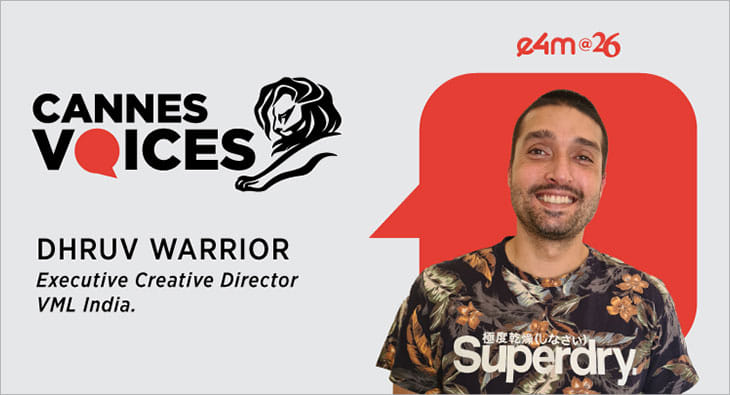

- The Indian print market is showing resilience, with print advertising revenues increasing by 2% in 2025, despite a 1% decline in circulation revenues for the second consecutive year, supported by strong vernacular readership and effective distribution networks.
- Dhruv Warrior, Executive Creative Director at VML India, emphasizes the need for print to excel in its unique capabilities, focusing on cultural resonance and the importance of context in print advertising rather than competing with digital media.
- Warrior distinguishes between timeless and nostalgic advertising, asserting that timeless work addresses enduring human truths and maintains tension, while nostalgic work relies on past relevance without contemporary significance.
- He advocates for print advertising that captivates audiences and fosters a renewed appreciation for physical media, arguing that print's distinct qualities offer creative opportunities that digital formats cannot replicate.
The obituary for print has been written so many times and with such conviction that it has started to feel like a ritual, an annual industry exercise in managed grief. Every year, the numbers arrive to reinforce the narrative. Every year, the medium survives in ways that make the narrative look slightly embarrassing in hindsight. In India, that paradox is especially pronounced.
According to the FICCI-EY Media and Entertainment Report 2026, print advertising revenues grew by approximately two per cent in 2025, reaching ₹25,900 crore, even as circulation revenues dipped by 1% for the second consecutive year. The Indian print market continues to hold its own in a way that no Western market has managed, sustained by vernacular readership, doorstep distribution networks that reach deep into non-metro India, and an advertiser trust in the medium that has not fully migrated online.
Print is not dying. It is under structural pressure, operating in an environment that demands more of its creative work than it has historically required.
Dhruv Warrior has spent his career at exactly that intersection: print and craft, held to the highest possible standard. He is the Executive Creative Director at VML India, the WPP marketing transformation company that brought home two Lions at Cannes 2024 for Coca-Cola's ‘Sing to Remember’ campaign, a culturally resonant piece of work that helped relaunch Coke Studio in India and lit up mainstream media long before any jury sat down to evaluate it.
Warrior carries 17 years of advertising and brand communication experience across JWT, VMLY&R Dubai, and FoxyMoron, where he served as National Creative Director before joining VML last year. It’s the combination of international craft rigour and the specific knowledge of what print can do that makes his seat on the Print and Publishing jury at the Cannes Lions International Festival of Creativity 2026 a natural one.
When we spoke to Warrior ahead of the festival, the conversation was notable for what it was not: a defence of print's continuing relevance. He took that as given. What he was interested in discussing was the harder question of what print must do to earn the attention it still commands.
The medium is the lever
The Print and Publishing category at Cannes evaluates work on its own terms, independent of the broader digital-first context in which it was produced. That is, in Warrior's view, precisely as it should be. The category does not ask print to compete with digital. It asks print to be excellent at what print does.
"A print piece can be a bold front-page ad, or a witty 25cc release in the classified, a poster that reveals a message when exposed to sunlight, or a patch that, when scratched, releases a scent," he says. "Print was the pioneer of moment marketing. Sharp placement, and when you release the piece, becomes an important factor in amplifying the creative element of the overall piece. As is with any kind of advertising, the audience you speak to matters, so where the ad is seen is important too. Of course, the key components of the print medium are the craft elements behind the idea — art and copy, which need to be excellent to make a successful, award-winning idea."
The emphasis on placement and timing as creative decisions, not merely media planning decisions, is significant. Print has always had the capacity to function as a contextual medium, like the newspaper front page on the morning of a national event, the classified ad buried in the sports section on the day of a match, or the outdoor poster positioned at the exact intersection where the joke lands. These are not amplification strategies. They are the idea. Work that understands this is operating at a different level of sophistication than work that uses print as a distribution surface for a thought conceived in another medium.
Warrior's time at VMLY&R Dubai is worth pausing on. The agency was ranked the third-best worldwide for craft by Cannes Lions in 2018 and named MENA Agency of the Decade in 2020, an environment where the standard applied to every piece of work, including print, was uncompromising. He absorbed that standard in a market where print advertising retains a different kind of premium, and carried it back to India, where the medium's commercial context is more complex, but its creative potential is equally untapped.
Timeless versus nostalgic
One of the more persistent confusions in print advertising, and in craft categories generally, is between timeless work and work that is merely nostalgic. They can look similar on a page. The difference is structural.
"Nostalgia from a craft perspective relies on borrowing relevance from the past," Warrior says. "And it works for specific briefs or occasions or moments. Nostalgia aims to tug on the heartstrings and pull us back to the warmth of days past. That doesn't necessarily make nostalgic work timeless. Timeless work is built on an enduring human truth, executed with contemporary relevance. To identify it, I look at the tension in the ad. Timeless work addresses a fundamental human emotion — fear, greed, love, vanity, humour — but frames it in a way that feels urgent right now."
The tension test is a useful evaluative tool because it is precise without being reductive. An ad built on nostalgia resolves the tension before the viewer engages with it. An ad built on a timeless human truth keeps the tension alive because the truth it identifies is one that the viewer recognises in their current experience. The best print advertising has always operated this way: not by showing people something from before, but by showing them something true about now, framed in a way that no digital format, with its perpetual scrolling and layered interactivity, can quite achieve. A great press ad stops time. That is both its limitation and its superpower.
What Lion-worthy print actually demands
Warrior's articulation of what elevates print and publishing work to Lion-worthy is the most fully developed passage of our conversation, and the most demanding. He does not offer a framework. He offers a set of standards, each one harder to meet than the last.
"When you look at what actually triumphs at the highest level of print and publishing today, you realise the medium has undergone a profound evolution," he says. "It is no longer about filling a page; it is about disrupting a space. To win a Lion today, a campaign must first possess deep cultural resonance. It cannot rely on manufactured advertising tropes; it has to intercept real human behaviour and social tension. The best work is so plugged into the current zeitgeist that it becomes a talking point in mainstream media long before the jury even convenes."
The last observation is operationally important and is rarely stated this plainly. The work that wins Print Lions at Cannes has, in the best years, already left a mark on the culture. It has been photographed, shared, debated, and referenced by audiences who had no idea a Cannes jury would eventually see it. That organic cultural penetration is not a by-product of great print work. It is increasingly a prerequisite. Work that required a case study film to achieve its impact has, by that point, already conceded something.
"We are seeing an incredible 'action-first' shift where print is no longer just a canvas, but a utility," Warrior adds. "The most courageous work actually redefines the medium — using the physical page to alter a product, change a brand's delivery, or force a tangible consumer action. This requires an instant, almost violent clarity. If a print ad feels like it needs a two-minute case study video to explain itself, it has already failed. The layout, copy, and visual must fuse into a single, undeniable message that leaps off the page and hits the viewer straight in the gut."
The phrase 'violent clarity' is not hyperbole. Print, in its constraint, has always had to work harder than any other medium to earn its moment of attention. The reader's eye can skip a page in a fraction of a second. The ad that stops that skip and creates the kind of involuntary double-take that makes someone fold the paper back and look again is doing something that cannot be engineered through data optimisation or platform targeting. It requires a standard of craft that Warrior is explicit about: micro-craft in service of macro-truth.
"At the awards level, craft is never just ornament; it is a narrative device," he says. "Every sensory element must be engineered to make the central truth of the ad hit harder. But even the most beautiful execution is meaningless without measurable disruption. We are not awarding expensive art; we are awarding commercial creativity. The work must prove it solved a genuine business challenge and generated the kind of PR and results that go beyond any kind of investment. Ultimately, a Lion-worthy print piece becomes a part of culture, or even shapes it."
The case for falling back in love
Warrior's final answer is the most personal in the conversation, and perhaps the most radical in its implications. It is not a jury criterion. It is a conviction.
"I am answering this question from the heart," he says. "I would like to see print work that makes people fall in love with newspapers and magazines and posters all over again. I think the kind of work that makes you want to put down your phone and pick up a book or a pen needs greater global recognition. In a way, maybe I want people to fall in love with the analogue part of life that we have been distancing ourselves from at breakneck speed."
This is, on one reading, an entirely impractical ambition for an awards category. Cannes Lions does not award sentiment. It awards ideas that change commercial reality. But on a closer reading, Warrior is identifying something that the Print and Publishing category is uniquely positioned to demonstrate: that the physical, tactile, time-bound experience of print is not an inferior version of digital. It is a different experience entirely, with different affordances, different emotional registers, and different creative possibilities.
The work that understands this does not try to approximate digital. It does the things digital cannot: it slows the reader down, demands their full attention, occupies physical space in their home or their commute, and creates a relationship with the printed word that has been, for most of human civilisation, the primary technology of knowledge and culture.
India is one of the few markets in the world where that relationship has not been severed. With approximately 29.7 million certified daily newspaper copies in circulation as of the first half of 2025, according to the Audit Bureau of Circulations, a figure that grew 2.77% in that period despite structural pressures, Indian print retains an audience at scale that most Western markets lost a decade ago.
The creative work produced for that audience has, historically, not always risen to the occasion. If Dhruv Warrior uses his time on the Cannes jury to reward the work that does, the work that makes someone put the phone down, even for a moment, and feel something on a page, it will have served the medium as well as any award can.
Read more news about Cannes Lions Festival, Advertising, Marketing, Digital Media, PR & Corporate Communication News
For more updates, be socially connected with us onInstagram, LinkedIn, Twitter, Facebook YouTube , WhatsApp & Google News