The politics of branding: How Joseph Vijay is engineering a new visual identity
Guest Column: M. Gautham Machaiah, a senior media professional, shares how political leaders are no longer judged only by speeches or policies, they are carefully packaged as visual brands
 by
by
Published: May 19, 2026 3:44 PM | 5 min read
 Follow Us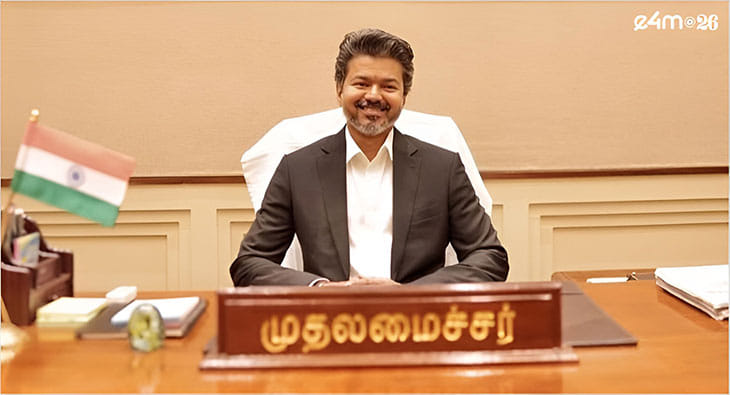

- Tamil Nadu Chief Minister C. Joseph Vijay employs a consistent wardrobe of a black suit and white shirt to create a recognizable visual identity, projecting authority and modernity in a crowded political landscape.
- This strategy aligns with the "uniform effect" in marketing, where a fixed appearance simplifies identification and fosters recall among voters, similar to how brands like McDonald's and Coca-Cola are instantly recognized.
- Vijay's attire distinguishes him from traditional Indian political aesthetics, positioning him as a professional administrator rather than a typical mass politician, appealing particularly to younger, aspirational voters.
- While this corporate-style image may attract urban support, it risks alienating rural voters who prefer culturally rooted representations, highlighting the tension between modern branding and traditional political imagery.
In the world of consumer marketing, consistency is often the foundation of recall. Apple’s minimalist design language, Nike’s swoosh, or the late Steve Jobs appearing almost exclusively in a black turtleneck all demonstrate the same principle: repeated imagery builds familiarity, and familiarity builds trust. Politics today increasingly operates on the same logic. In an age shaped by television frames, Instagram reels, and endless scrolling, political leaders are no longer judged only by speeches or policies—they are carefully packaged visual brands—newly elected Tamil Nadu Chief Minister C. Joseph Vijay appears to understand this instinctively.
Since assuming office, Vijay has consistently appeared in a sharply tailored black suit paired with a crisp white shirt. The choice is far more strategic than cosmetic. In branding terms, it creates a fixed political silhouette—one that becomes immediately associated with authority, modernity, and administrative focus. Unlike most Indian politicians, whose attire varies within a broader cultural template—white kurtas, veshtis, or regional wear—Vijay, by repeating the same combination, is forging a recognisable visual identity, transforming clothing into a logo.
The ‘Uniform Effect’ in political marketing
This technique draws from what marketers often call the “uniform effect”. A fixed appearance simplifies identification in cluttered visual environments. Consumers do not need to read a slogan to identify a familiar brand; the imagery itself does the work. The same holds for politics: a fleeting social media thumbnail, a campaign poster or a television clip becomes enough to trigger association. In a crowded political marketplace, this visual consistency is the fastest route to recall.
Consumers instantly identify McDonald’s by its golden arches or Coca-Cola by its red-and-white palette. The logic is simple: a fixed appearance projects focus, stability and predictability. It also subtly communicates that the individual is concentrating on larger tasks rather than personal vanity. Similarly, Vijay’s attire is beginning to function as shorthand for the political persona he intends to portray.
The colour combination itself carries layered symbolism. In Indian politics, white has deep historical resonance and evokes purity, sacrifice, transparency and public service — imagery rooted in the freedom movement. By retaining it, Vijay preserves a symbolic connection with the political mainstream and the common man.
The black suit, however, radically alters the equation. It distances him from the conventional aesthetic of Dravidian politics, which has historically revolved around the white shirt-and-veshti combination. Instead, Vijay projects a ‘Chief Executive Officer-style’ image of governance, signalling professionalism, authority and global exposure. More significantly, it positions him as an administrator-manager, not just a mass politician.
This differentiation is particularly significant in Tamil Nadu, where political imagery has remained remarkably consistent for decades. Against this backdrop, Vijay’s look comes as a breath of fresh air. In advertising language, it functions as a visual disruption: when every competitor uses similar packaging, the brand that looks different automatically commands attention.
Branding for the aspirational voter
This approach also appears calibrated for younger and urban audiences. For aspirational middle-class voters shaped by corporate culture, start-up ambition and global media influences, the suit represents managerial competence and upward mobility.
There is also a practical psychological dimension. Many high-performing leaders adopt simplified wardrobes to reduce what behavioural scientists describe as “decision fatigue”. Former United States President Barack Obama once remarked that he largely restricted himself to grey and blue suits because he did not want to waste mental energy making routine choices about clothing. Eliminating small daily choices conserves attention for more consequential matters.
Perhaps most significantly, Vijay is consciously constructing a legacy image. Few examples illustrate this better than Mahatma Gandhi, whose round spectacles became so deeply associated with him that even a minimalist line drawing is instantly identifiable across India and beyond. By maintaining a fixed visual identity early in his political career, Vijay is similarly shaping how he will exist in photographs, posters, archives and public imagination decades later.
Indian politics has a rich history of visual branding. Former Tamil Nadu Chief Minister M.G. Ramachandran mastered this through his fur cap and dark glasses, which preserved his larger-than-life screen personality even after entering politics. In Karnataka, BJP leader B.S Yediyurappa became synonymous with his white safari suit. Similarly, Mamata Banerjee became identified with her plain white cotton sarees and rubber slippers, while former Prime Minister Manmohan Singh was almost always seen in his trademark light blue turban.
Yet Vijay’s approach differs from theirs because it resembles corporate image-building more than traditional political symbolism. It is less about cultural familiarity and more about aspiration.
The risks of the executive aesthetic
That strategy, however, is not without risks. Tamil Nadu politics has historically rewarded leaders who appear culturally rooted and emotionally accessible. A suit can project efficiency and authority, but it may also invite criticism of elitism or excessive corporatisation of politics. For sections of rural and traditional voters accustomed to the symbolism of the veshti-and-white shirt, the executive aesthetic could at times appear distant from grassroots realities.
Yet it is this very tension that makes Vijay’s positioning politically significant. He is not merely trying to inherit an existing political template; he is attempting to redefine it. In the age of digital politics, where leaders are consumed as much through images as through ideology, attire itself becomes communication.
Ultimately, Vijay’s wardrobe demonstrates how deeply politics has absorbed the language of advertising and consumer branding. Modern politicians are increasingly packaged like products — through colours, symbols, and emotional associations designed for instant recall. In Vijay’s case, the black suit and white shirt are no longer simply clothes. They are a carefully constructed political identity stitched into fabric.
(The author is a senior media professional whose career spans editorial and leadership positions across print, broadcast, and digital platforms.)
Read more news about Digital Media, Television Media, Out of Home Advertising, Print Media, Latest Advertising India
For more updates, be socially connected with us onInstagram, LinkedIn, Twitter, Facebook, YouTube & Google News
