The picture of journalism is not as gloomy as it is portrayed: Jaideep Karnik
At samachar4media's ‘Journalism 40 Under 40’ event, Amar Ujala Digital Editor Jaideep Karnik
 by
by
Published: Aug 3, 2026 1:42 PM | 6 min read
 Follow Us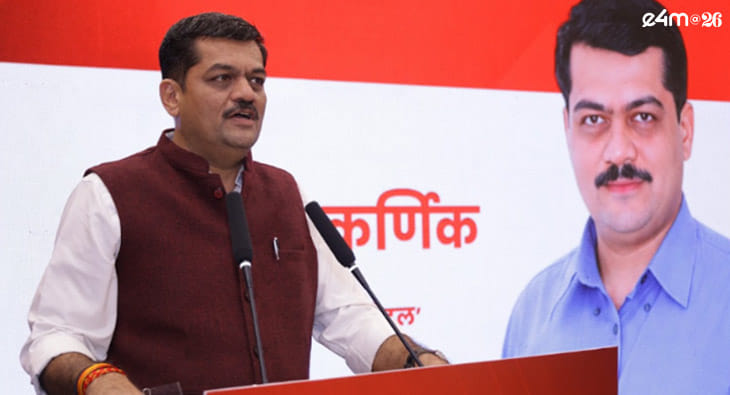

- Jaideep Karnik, Digital Editor of Amar Ujala, emphasized the importance of introspection in journalism during his address at the 'Journalism 40 Under 40' event, advocating for self-evaluation to improve the field rather than to highlight weaknesses.
- He praised the event's organizers and highlighted the significance of open discussions among journalists about the challenges and shortcomings of the industry, likening it to family conversations that can lead to problem-solving.
- Karnik noted the evolving nature of journalism in response to societal changes and technological advancements, stressing the need for journalists to deliver accurate and reliable news amidst an overwhelming amount of information.
- He underscored the enduring value of mainstream media in providing trustworthy journalism, asserting that despite the rise of social media, the principles of truth, fairness, and credibility remain essential for the future of the profession.
Speaking at samachar4media's ‘Journalism 40 Under 40’ event, Amar Ujala Digital Editor Jaideep Karnik said that journalists themselves are the ones who discuss journalism the most, and that this introspection can sometimes feel like we're lashing ourselves in the back. He said that introspection is necessary, but its purpose should not be to prove oneself weak, but rather to improve journalism.
Jaideep Karnik began his address by praising the event's organizers. He noted that Dr. Anurag Batra, Chairman and Editor-in-Chief of Exchange4Media Group and BW Businessworld, is leading the event with immense passion, determination, and dedication. He also praised Anurag Muskan, the senior journalist who hosted the event, saying that, true to his name, he kept a smile on his face throughout the day and that he made the event impactful with his voice and experience. He also offered a light-hearted reference to the organizing team, calling them part of the strong team behind the event.
He said that many important discussions had taken place since morning. He couldn't listen to all the sessions, but he did hear the views of Alok ji, Vinod ji, and senior journalist Sudhir Chaudhary. He then explained the importance of journalistic introspection with an example. He said that as a child he had witnessed a spectacle in which a man whipped his own back. Whenever introspection takes place in the media world today, he remembers that scene.
Jaideep Karnik said that since morning, discussions have been going on about the shortcomings and challenges of journalism, and it seems that journalists are criticizing themselves the most. He said that this is not a bad thing, because the media should first evaluate itself. If journalists review their own work, there will be no need for anyone else to criticize journalism or put journalists in the dock.
He said that journalists understand each other well because they spend most of their time in the newsroom. Therefore, conversations between journalists are not sermons, but rather a sharing of experiences. He added that if journalism students, researchers, or ordinary citizens were present here, they might have been told different things. However, since most of the people here are involved in the media, it's important that they speak openly, like family members.
He said that family problems can be resolved when family members speak openly with each other. The same applies to the media. The challenges and shortcomings of journalism should be discussed within the media itself, so that solutions can emerge. He said that the biggest achievement of this platform is that journalism veterans are openly expressing their views and honestly discussing the challenges facing the media.
Jaideep Karnik also cited senior journalist Sudhir Chaudhary's observation that most journalists today work for corporate organizations. He said that journalists are, in fact, employed, and every job has its limitations. Despite this, journalists strive to fulfill their professional responsibilities.
He told all the journalists present at the event that this honor belongs not only to the awardees, but to all journalists who, despite financial pressures, corporate challenges, criticism, and difficult circumstances, find space for good and positive news every day. He said that even amidst all the pressures, journalists strive to bring forward news that is of social interest, and this is their greatest strength.
Jaideep Karnik said that this is why he calls today's journalism "Robin Hood journalism." According to him, media organizations may have their own resources, business, and corporate pressures, but even amidst all this, editors and journalists constantly seek space for good news. He said that therefore, the picture of journalism is not as bleak as it is often portrayed. There are certainly challenges, but even amidst them, journalists are fulfilling their responsibilities.
Continuing his address at News4Media's "Journalism 40 Under 40" program, Amar Ujala Digital Editor Jaideep Karnik said that when discussing journalism, it's important to understand that society is constantly changing. As society, technology, and public perceptions change, it's natural for journalism to evolve as well. Therefore, every change shouldn't be viewed solely from a negative perspective.
He said that people often say that the media is not what it used to be, but the question should also be asked whether society is the same. He said that society's needs, methods of obtaining information, and people's habits have completely changed. As such, journalism is also changing at the same pace. This change is a demand of the times, not just a media choice.
Jaideep Karnik said that in the past, people had limited access to information. Newspapers, radio, and later television were the main sources of news. However, today, digital platforms, social media, OTT platforms, and mobile phones have completely transformed the world of information. Now, every person has a medium at their fingertips, allowing them to both acquire and disseminate information.
He said that the biggest challenge facing journalism is how to deliver accurate and reliable news to the public in this flood of information. Previously, news sources were limited, but today, thousands of pieces of information reach people every minute. In such an environment, the responsibility of a journalist has increased more than ever. Now, simply being the first to report is no longer enough; its truthfulness and reliability are equally important.
In his address, he referred to the various protests held at Jantar Mantar and emphasized the crucial role media plays in making any movement effective. He said that people often assume that social media is the most powerful vehicle for change, but the reality is that unless mainstream media raises an issue widely, its impact remains limited.
He said that while social media has certainly become a powerful medium, it also has its limitations. Mainstream media operates with fact-checking, editorial processes, and accountability. This is why, even today, when a major issue arises, people seek confirmation from trusted media outlets.
Jaideep Karnik said that the value of journalism lies not just in publishing news, but in providing society with accurate, contextual and reliable information. If the media continues to fulfill this responsibility honestly, its relevance will never diminish. No matter how much technology changes, society will always need trustworthy journalism.
He said that journalists need not be afraid of change. They should embrace new technology, new platforms, and new mediums, but should never compromise the fundamental principles of journalism—truth, fairness, and credibility. These principles will be the defining characteristics of future journalism.
Read more news about Digital Media, Television Media, Out of Home Advertising, Print Media, Latest Advertising India
For more updates, be socially connected with us onInstagram, LinkedIn, Twitter, Facebook, YouTube & Google News