Remembering Swapan Sadhan Bose: The man who called Mohun Bagan his third son
Tutu Babu was much more than an administrator to generations of green-and-maroon faithfuls
 by
by
Published: May 13, 2026 1:09 PM | 4 min read
 Follow Us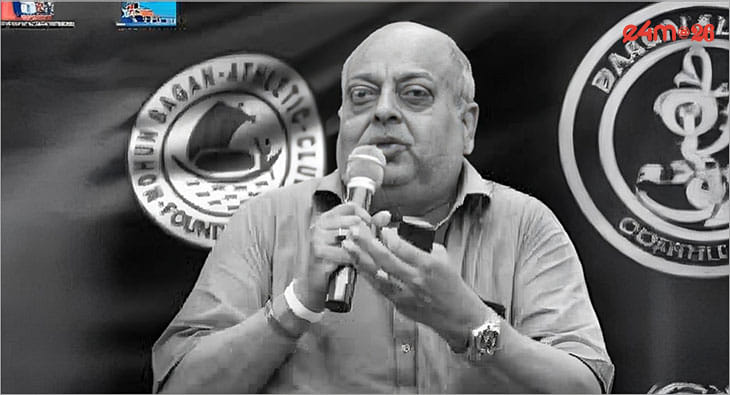

- Swapan Sadhan Bose, known as Tutu Babu, passed away at the age of 78 due to cardiac failure, leaving a significant impact on Indian football, particularly as a long-time administrator of Mohun Bagan Football Club.
- Bose served multiple terms as secretary and president of Mohun Bagan, where he was known for his financial generosity and strategic decisions, including changing club policies to allow foreign players.
- In addition to his contributions to football, Bose was a successful businessman and media entrepreneur, founding the Bengali-language daily Sangbad Pratidin and operating the Radio Asia Network in Dubai.
- He was also a member of the Rajya Sabha from 2005 to 2011 and played a key role in securing corporate partnerships for Mohun Bagan, notably the merger with ATK in 2020.
A businessman, a parliamentarian, and the most ardent custodian the Mariners ever had. Tutu Babu's passing leaves a void in Indian football that no election or balance sheet can fill.
Indian football lost one of its most steadfast guardians on Tuesday night. Swapan Sadhan Bose, also known as Tutu Babu to the generations of green-and-maroon faithful who knew him as much more than an administrator, passed away at a private hospital in Kolkata following a massive cardiac failure. He was 78.
A man who built empires in business and corridors of influence in politics, he reserved his deepest devotion for a football club founded in 1889. He called Mohun Bagan his third son. By all evidence of his life and conduct, he meant it literally.
Bose served as Mohun Bagan secretary from 1991 to 1995, and then as club president till 2018. He was elected secretary again in 2018, became president once more from 2020 to 2022, and served a final term from 2023 to 2025. Few figures in Indian club football have held such sustained administrative authority across so many decades, and fewer still have exercised it with the combination of financial generosity and tactical shrewdness that defined Bose's tenure.
Beyond football and politics, Tutu Babu was also a significant figure in the Indian media landscape. His interest in media went back to August 1992, when he diversified his business portfolio through the Bengali-language daily Sangbad Pratidin, a publication that would go on to become one of the most widely read newspapers in Bengal. His media ambitions, however, extended well beyond Kolkata. Operating out of Dubai, where he spent a considerable part of his time, Bose ran the Radio Asia Network and the Dolphin Recording Studio.
But it was in the transfer market and the committee rooms of Kolkata football that his legend was truly forged. From Cheema Okerie to Krishanu Dey, and Bikash Panji to Monoranjan Bhattacharya, Bose orchestrated transfer after transfer in the Kolkata football ecosystem, going to extraordinary personal lengths to bring the players he wanted to the club.
He also challenged one of Mohun Bagan's most entrenched orthodoxies: the prohibition on signing foreign players. Against considerable resistance, he forced a rule change, and within five years, Mohun Bagan had secured the services of players that East Bengal fans had only dreamed of seeing in the rival camp.
His financial commitment to the club was, by any measure, staggering. Bose reportedly spent around ₹6 crore a year just to keep the football team running, with no return on the investment. When the club faced suspension by the federation, he personally loaned ₹2 crore to pay the fine, a sum he later donated outright to the club.
He also brought in major corporate patronage, most notably engineering the landmark 2020 merger with ATK under the RPSG Group banner. As chairman of Mohun Bagan Football Club, Bose articulated the rationale for that difficult but necessary decision: that the romance of a 130-year-old tradition, at some point, requires a partner named practicality.
It was a characteristically Tutu Babu formulation. Sentiment and realism held in careful balance. The man who once sat all day at a footballer's doorstep just to secure a signature also understood, better than most romantics around him, that an institution without financial architecture is an institution in slow decline.
He suffered a heart attack on Monday evening, was hospitalized and placed on ventilation support, and passed away late on Tuesday night.
Mohun Bagan has had great players, celebrated coaches, and passionate supporters stretching across continents. But the administrative story of the club across the last three decades is inseparable from one name. Tutu Babu did not merely run Mohun Bagan. He carried it. And he carried it the way one carries something precious: not with ease, but with love.
Read more news about Digital Media, Television Media, Out of Home Advertising, Print Media, Latest Advertising India
For more updates, be socially connected with us onInstagram, LinkedIn, Twitter, Facebook, YouTube & Google News