Hall of Ads: The Pepsi ad that turned a football trick into a cultural moment
In 2002, Pepsi and Roberto Carlos staged a World Cup ad so cleverly cultural that it still lives rent-free in advertising memory
 by
by
Published: Jun 5, 2026 8:58 AM | 6 min read
 Follow Us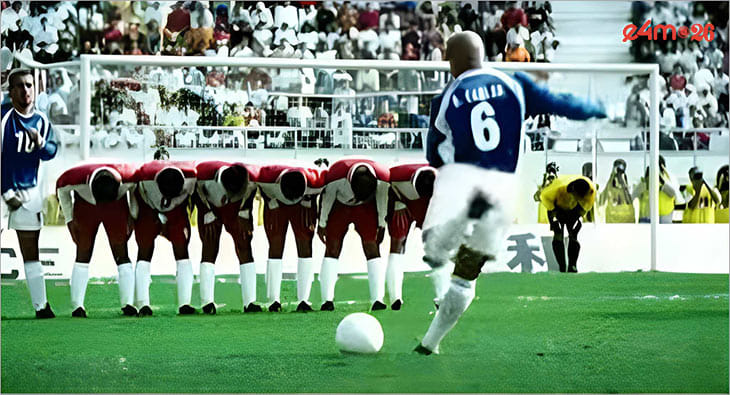

- The Pepsi 'Greetings' ad from the 2002 FIFA World Cup continues to resonate on social media, showcasing its lasting impact in football advertising 24 years later.
- The ad features Brazilian footballer Roberto Carlos and highlights the cultural practice of bowing in Japan, using this insight as the foundation of its humor and storytelling.
- Unlike typical global campaigns that prioritize universality, the ad successfully embraces cultural specificity, making it relatable even to audiences unfamiliar with Japanese customs.
- The ad exemplifies effective celebrity advertising by aligning Carlos's established persona with the brand's message, demonstrating that a focused cultural insight can create memorable and enduring content.
There is a specific kind of advertising genius that does not announce itself loudly. It does not rely on a jingle, a tagline, or a celebrity mugging for the camera. It simply places two cultures in the same frame, lets the tension breathe, and then releases it at exactly the right moment. The Pepsi 'Greetings' ad from the 2002 FIFA World Cup is that kind of genius.
24 years on, the spot continues to circulate on social media, draw fresh commentary, and earn its place in the canon of great football advertising. For an industry that debates the half-life of a campaign with increasing anxiety, that kind of longevity demands examination.
The 2002 FIFA World Cup was, by most measures, a marketer's dream. It was the first World Cup to be jointly hosted by two Asian nations, South Korea and Japan, bringing the tournament to a geography that was simultaneously unfamiliar to Western football audiences and deeply significant to the sport's expanding commercial ambitions.
FIFA reported a cumulative global audience of 28.8 billion for the 2002 tournament across all matches, with the final watched by an estimated 1.1 billion viewers. For Pepsi, which had built its football advertising identity on high-octane celebrity excess through the nineties, the World Cup presented an opportunity to do something different.
The brief, as it eventually manifested on screen, was deceptively simple: take Roberto Carlos, who at the time was one of the most recognisable footballers on the planet, famous specifically for his physics-defying free kicks, and place him inside Japan. Let the culture do the rest.
The spot opens at an airport. A young Japanese boy spots Carlos, approaches him with wide-eyed reverence, takes his autograph and hands him a bottle of Pepsi. The boy then does what is entirely natural in his cultural context: he bows, deep and respectful. Carlos, delighted, bows dramatically back.
Cut to a match between Brazil and Japan, Carlos lines up for a free kick against the Japanese national team. The defensive wall assembles, resolute. Then, just as he begins his trademark run-up, Carlos bows to the wall. The wall, acting on pure cultural instinct, on the muscle memory of a society built on mutual respect, bows back. Heads drop, and the guard falls. Carlos strikes, and the ball curves into the top corner. It is, on its face, a 30-second comedy of manners. But the craft underneath it is considerable.
The advertising industry tends to treat cultural insight as a finishing touch: a coat of local colour applied over a campaign that was fundamentally designed elsewhere. The Pepsi 'Greetings' ad inverts that entirely. The cultural insight is not the decoration; it is the load-bearing structure. Remove the bow, and there is no ad. Remove Japan, and there is no joke. The entire architecture of the spot is built on a single, precise piece of anthropological observation: that the Japanese practice of ‘ojigi’, or bowing as a sign of respect, is so deeply instinctive that even a disciplined defensive wall at a football match might not be immune to it.
This is a level of specificity that most brand advertising actively avoids, for understandable commercial reasons. Global campaigns prefer universality. They reach for emotion rather than context. The Pepsi 'Greetings' ad, by contrast, commits entirely to its cultural premise and trusts that even audiences who do not share that context will find it legible, because the mechanics of the joke (distraction, misdirection, the gap between politeness and competitive instinct) are, in fact, universal.
There is also something worth noting about the representation. Carlos is not portrayed as an outsider bumbling through an unfamiliar culture. He is curious, warm, and quick, as he picks up the bow almost immediately, turns it playful, and then, on the pitch, weaponises it. The cultural exchange is bilateral. Both sides come away with something. That is a more sophisticated piece of storytelling than most football ads manage.
Roberto Carlos was, at the time, arguably the most exciting left-back in the history of the sport. His 1997 free kick against France, a ball that moved so improbably through the air that the goalkeeper reportedly stepped aside in disbelief, had already entered football mythology. Pepsi was not merely casting a famous footballer; they were casting a man whose primary association in the public imagination was the bending, the curving, the impossible.
The ad, conceptualised by AlmapBBDO Brazil, understands this perfectly. It does not ask Carlos to do something new. It takes what the audience already knows about him and layers a new logic on top of it. The bow is not just a cultural joke; it is an extension of the Carlos legend. Of course, he would find a way to score that no one had thought of before. Of course, the method would be absurd and brilliant in equal measure.
This is what good celebrity advertising does: it does not simply borrow equity from a famous face. It finds the intersection between the celebrity's established narrative and the brand's intended message, and it builds its story there.
In an era where advertising effectiveness research consistently shows that emotional, memorable, culturally resonant work drives longer-term brand value than performance-led messaging, the Pepsi 'Greetings' ad reads almost like a textbook demonstration. It is funny without being cheap. It is culturally specific without being exclusionary. It uses its celebrity asset with precision rather than as wallpaper. And it sells the product without once making the product the point.
For practitioners working in India (a market where cultural specificity is both a creative opportunity and a commercial necessity, where a festival is never just a festival and a gesture is never just a gesture), the ad offers a useful model. The insight does not have to be large to be powerful. The Pepsi ad is built on a single observation about a single cultural practice. What makes it iconic is the rigour with which that observation was developed into a complete, coherent piece of storytelling.
24 years on, the spot has outlasted the tournament it was made for, the campaign it was part of, and, arguably, the era of football advertising it helped define. That is not an accident. That is what happens when an insight is true enough, and the craft is good enough, to make a film that has no real expiry date.
The wall bowed. The internet never forgot.
Read more news about Internet Advertising India, Marketing News, PR and Corporate Communication News, Digital Media News, Television Media News
For more updates, be socially connected with us onInstagram, LinkedIn, Twitter, Facebook YouTube & Google News