Hall of Ads: Gems Museum - The ad that taught us to stay ‘umarless’
The museum, the sculpture, the favourite blue colour: Deconstructing Cadbury's most memorable campaign
 by
by
Published: Jan 17, 2026 9:22 AM | 6 min read
 Follow Us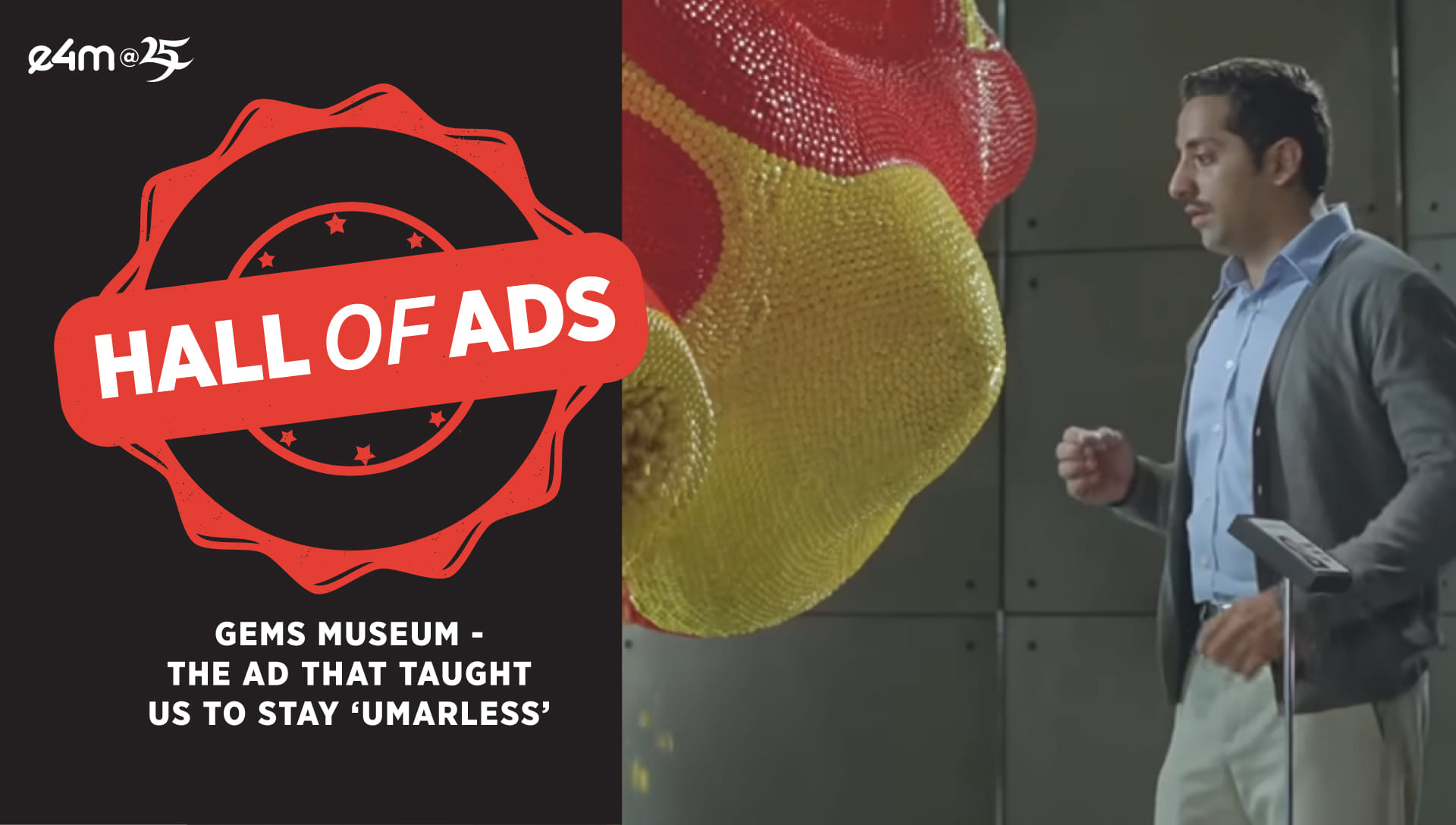

In the pantheon of Indian advertising, certain campaigns transcend their commercial purpose to become cultural touchstones. The Cadbury Gems Museum advertisement stands as one such masterpiece. A minute-long slice of brilliance that captured the essence of childlike wonder while redefining the brand's audience. Part of the groundbreaking "Raho Umarless" campaign launched in 2012, this particular commercial didn't just sell chocolate; it sold an idea that resonated across generations.
The TVC opens with a contemplative scene: a well-dressed man, played by Vikram Kochhar, wandering through the hushed corridors of an art gallery. The setting itself is deliberate: museums are sanctuaries of restraint, places where we're expected to look but never touch, to appreciate but never possess. This is adult territory, governed by unspoken rules of decorum and self-control.
Then he sees it: an artist's sculpture crafted entirely from Cadbury Gems. The installation gleams with colorful chocolate buttons, arranged in what appears to be a carefully constructed work of abstract art. However, nestled within this edible masterpiece is a single blue Gem in a sea full of yellow ones. In that moment, the entire premise crystallizes. Here is a man, presumably sophisticated and cultured, reduced to his most primal desire by something as simple as a colored chocolate.
The man's internal struggle plays out silently across his face. Should he? Could he? The blue Gem beckons. Unable to resist, he reaches out with the furtiveness of a child stealing cookies, plucks the blue Gem from the sculpture, and the entire artwork collapses in a cascade of colorful chaos.
The artist of the sculpture, who has presumably spent hours constructing this piece, looks on in horror. But our protagonist, caught in the act, does the only thing a child would do: he pops the Gem into his mouth with a sheepish grin. The commercial ends with the tagline appearing on screen: "No umar for favourite colour" (No age for favorite colors), followed by "Raho Umarless" (Stay Ageless).
Why does it work?
The genius of the Museum ad lies in its multiple layers of storytelling. On the surface, it's a humorous vignette about a grown man making a childish mistake. But dig deeper, and the commercial reveals sophisticated insights about human nature, desire, and the masks we wear as adults.
First, the insight is universal. Every adult remembers having a favorite color of Gems. That preference is one of those pure childhood joys that advertising often overlooks. By anchoring the entire narrative around this specific memory, Ogilvy India tapped into something visceral. The commercial doesn't ask us to remember being children; it shows us that we never stopped being children, not really.
Second, the choice of setting is masterful. Museums represent everything adulthood demands: patience, appreciation without possession, contemplation over consumption. By staging this act of rebellion in such a space, the advertisement creates maximum comedic and emotional contrast. The man isn't just eating a chocolate; he's transgressing the boundaries of adult behavior in the most sacred of adult spaces.
Third, there's the matter of consequence. The sculpture collapses, the artist is dismayed, but the man eats the Gem anyway. He accepts social embarrassment for a moment of pleasure. This is profoundly childlike, while being profoundly human. Adults calculate consequences; children (and the child within us) act on desire. The commercial suggests that sometimes, the latter approach might actually be more honest, more alive.
Strategic repositioning: From kids to everyone
Before the "Raho Umarless" campaign, Cadbury Gems had painted itself into a corner since the 90s cricket ad. It was perceived almost exclusively as a children's brand, as those colorful buttons of chocolate were for birthday parties and school tiffin boxes. While this gave Gems a strong foothold with one demographic, it also limited the brand's growth potential.
The Museum ad, along with its companion spots in the campaign, represented a calculated risk: expanding the target audience without alienating the core consumers. The strategic pivot was elegant. Rather than abandoning the association with childhood, the campaign doubled down on it, but reframed childhood as a state of mind rather than a stage of life. "Raho Umarless" didn't ask adults to pretend they were sophisticated chocolate connoisseurs. Instead, it permitted them to embrace their childish impulses, their irrational preferences, their spontaneous joys.
The cultural context
The campaign launched in 2012, a moment when Indian advertising was undergoing its own evolution. Brands were beginning to understand that millennials and young adults didn't want to be spoken to as "grown-ups" in the traditional sense. There was a growing cultural acceptance of playfulness, nostalgia, and the rejection of rigid life stages.
"Raho Umarless" arrived perfectly positioned to capture this zeitgeist. The campaign didn't feel like a corporation trying to be cool; it felt like a brand that genuinely understood something true about contemporary adult life.
We work hard, we have responsibilities, we follow rules. But we also need moments of pure, unguarded joy. A blue Gem in a museum. A found treasure in a park. These small rebellions make life worth living.
Simplicity as sophistication
Directed by Prakash Varma and produced by Nirvana Films, the Museum ad demonstrates how much can be accomplished with restraint. There's no elaborate CGI, no celebrity endorsement, no complex narrative. The setting is simple, the action is straightforward, and the humor emerges naturally from the situation rather than being forced through exaggerated performances or slapstick.
The casting is pitch-perfect. Vikram Kochhar, from Sacred Games and Dunki fame, was neither too young nor too old, neither too polished nor too casual. He could be anyone: an architect visiting an exhibition, a tourist on a Sunday afternoon, an office worker on his lunch break. This everyman quality makes the ad relatable, while the specific scenario makes it memorable.
The pacing deserves mention too. The commercial takes its time, allowing tension to build as the man notices the sculpture, contemplates it, and makes his fateful decision. This patience pays off in the punchline, which lands with maximum impact because we've been made to invest in the moment.
Legacy and impact
More than a decade after its release, the Museum ad remains a case study in effective brand repositioning. It achieved what many campaigns attempt, but few accomplish: it changed perceptions while remaining entertaining, expanded the target audience without diluting the brand essence, and created a cultural conversation that extended beyond the product itself.
The ‘Umarless’ philosophy became shorthand for a particular kind of joyful rebellion. The campaign gave people language and permission to embrace their childlike impulses, whether that meant eating colorful chocolate, playing in puddles, or choosing pleasure over propriety occasionally.
For Cadbury Gems, the impact was tangible. The brand successfully shed its "kids only" image and positioned itself as a treat for anyone who remembers what it's like to have a favorite color (which is to say, everyone). Sales expanded beyond traditional juvenile demographics, and Gems secured its place as a multigenerational product.
Read more news about Internet Advertising India, Marketing News, PR and Corporate Communication News, Digital Media News, Television Media News
For more updates, be socially connected with us onInstagram, LinkedIn, Twitter, Facebook YouTube & Google News