Human First. AI Second. In That Order.
Nikesh Ghosh, Co-founder, Offbeat Origins, in conversation with Shripad Kulkarni on why Gen AI has changed economics of creative production & why the sequence in which you use it determines everything
 by
by
Published: May 9, 2026 2:22 PM | 5 min read
 Follow Us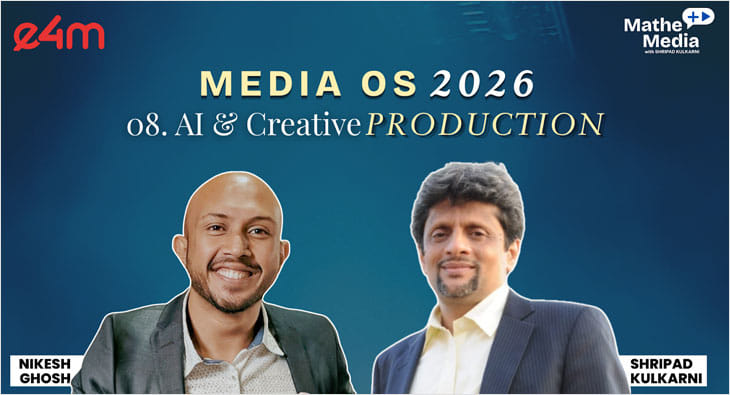

- Offbeat Origins, led by Nikesh Ghosh, successfully produced a 45-second 3D animation on a pan-India scale with a limited team and budget, showcasing new economic possibilities in Indian creative production.
- The production highlights a shift in the advertising industry, with major brands like Coca-Cola integrating AI, data, and creative processes, indicating a permanent change in the economics of creative production.
- Ghosh emphasizes that AI should enhance human creativity rather than replace it, advocating for a collaborative approach where human insight precedes AI assistance in the creative process.
- The future of successful creative production lies in establishing effective workflows and systems that integrate AI tools, rather than merely accumulating technology, ensuring that human expertise remains central to the creative process.
The brief arrived. A 45-second 3D animation. Pan-India scale. With a timeline that left very little room for a conventional production process. The kind of production that would normally require a 50-to-60-member animation team and a budget to match. Nikesh Ghosh said ‘yes’.
Offbeat Origins is a creative production studio working at the intersection of human-led storytelling and AI-enabled production workflows. They did not have a large team. What they had were the tools, and the understanding of how to use them. The film got made. And in the process, it established a new baseline for what is now economically possible in Indian creative production.
“You can actually create big scale campaigns at much faster speed and with much lesser bottlenecks and few interventions.”
- NIKESH GHOSH
But Nikesh is careful not to let that number do the wrong work. Speed and scale are now table stakes. Every brand, every agency, every studio has access to the same tools. The 45-second film is the starting point of the conversation, not the conclusion.
The Film That Should Not Have Been Possible
The most telling proof of where this is heading is not what happened at Offbeat Origins. It is what one of the world’s largest advertisers is doing.
“Coca-Cola's work with partners like OpenAI and Bain & Company shows how large advertisers are beginning to combine creativity, data, and AI-led production thinking at scale.”
When the most established creative advertiser in the world restructures its production around AI, data, and consulting, together, it is not an experiment. It is a signal. The economics of creative production have permanently shifted.
Platforms Drew a Line
The platforms themselves have started to push back. And the pushback is not about quality in the traditional sense. It is about something more fundamental.
“Platforms like YouTube are already signalling that AI-generated content without originality, narrative, or human intent will struggle to earn distribution.”
The tool can generate views. It cannot originate. The narrative, the human intent behind the content, still must come from real people.
The Marriage, Not the Replacement
The fear in the industry is that AI replaces the people. Nikesh has a different view of what is actually happening on set.
“It’s not that storyboarding and shooting, is suddenly being done by AI. Those still come from people with that experience. I still have a director, still have a creative director, still have a DOP. You are training them to use AI to extend their expertise to get this done quicker and better. A lot of people are scared because they think it’s AI against them. But it’s not. It’s the marriage.”
The director still shapes the vision. The creative director still protects the idea. The DOP is still directing light, lensing, movement of human craft and frame. What AI has done is extend the reach of each of those people, not replace their judgement, but amplify what their judgement can produce. That is what Nikesh means by the marriage. Not a compromise. A multiplication of human craft.
The Right Way to Use an LLM
The single biggest mistake Nikesh sees brands and marketers making is the order in which they engage with AI. They go to the LLM first.
“Going to an LLM first and asking, I need a campaign, give me five ideas, is a wrong format. If you start with your thinking, saying okay this is the narrative, let’s sit with an LLM to expand the idea, that is when you get real value out of it.”
The LLM works from pre-trained data. It does not know your brand. It does not know your consumer. It does not know what makes your category different. When you go to it first, you get generic output built on the average of everything that came before. When you go to it second, with your narrative already formed, your insight already established, your story already shaped, you get something that expands from a real foundation.
The human thinking has to come first. Always. The moment you reverse that order; you have outsourced the most important part of the creative process to a machine that does not know your brand.
Workflows, Not Tools
The final argument Nikesh makes is structural. The brands and agencies that will win in this environment are not the ones with the most tools. They are the ones who have built the best systems around those tools.
The point is not to keep adding more AI tools to the stack. The brands and agencies that will win are the ones that understand where each tool belongs in the creative process. One tool may help sharpen the brief. Another may help visualize early directions. Another may support production, adaptation, or versioning. But no single tool can solve the full creative problem on its own. That too only when organised as right workflows with right human involvement.
“Workflows and systems rather than individual tools, that is going to be the name of the game. No one single tool would work out for you for sorting your grand scheme of the problem.”
The hybrid imperative is not just about combining AI and human talent in the right proportion. It is about building the infrastructure, the workflows, the briefs, the brand team capabilities, that makes that combination consistently productive.
The 45-second film that should not have been possible was not made by AI alone. It was made by a director, a creative director, a DOP, and tools that extended their craft. Human first. AI second. In that order. That is the only formula that wins.
Nikesh Ghosh is a contributor to the Media OS 2026 Report, examining how Indian advertising is being rebuilt from the ground up. This piece has been curated by Shripad Kulkarni based on the conversation for the MatheMedia Podcast Series.
Read more news about Digital Media, Television Media, Out of Home Advertising, Print Media, Latest Advertising India
For more updates, be socially connected with us onInstagram, LinkedIn, Twitter, Facebook, YouTube & Google News