With AI creativity rising, are creators struggling to preserve the human touch?
Brands turn to creators for their human, relatable voice. But with 95% now using AI to create and grow content, that line is beginning to blur. Here’s what experts say
 by
by
Published: Jan 28, 2026 9:16 AM | 11 min read
 Follow Us

A single prompt can now deliver what once required a detailed brief, a production crew and a sizeable budget. Ask for a cat drinking a coffee, and you’ve effectively created a branded asset. This seemingly simple shift is fundamentally redefining how creativity is produced, distributed and monetised across the creator economy, with implications for brands, agencies and platforms alike.
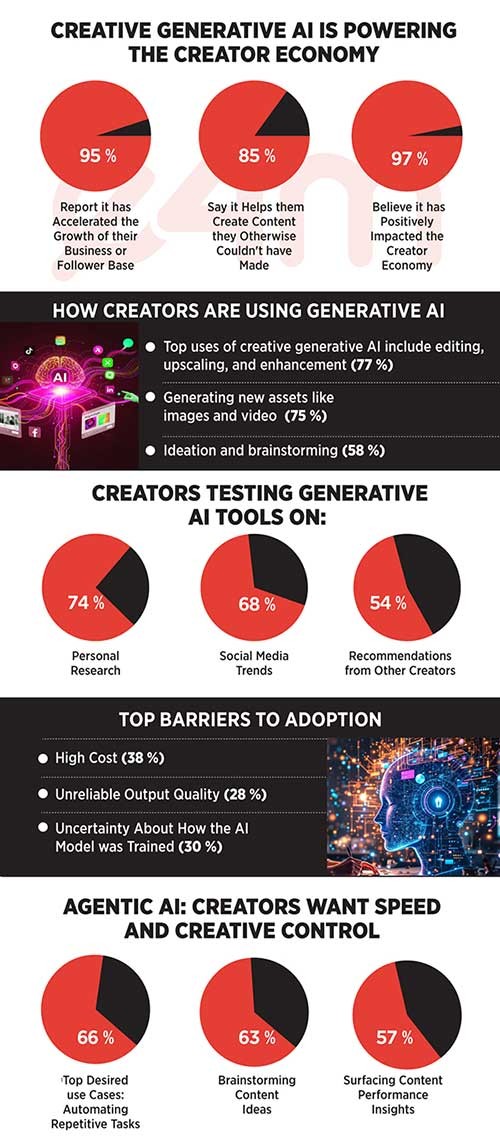
Generative AI has moved from being a fun experiment to becoming a serious production engine for creators. In fact, 95 percent of creators say AI has directly helped them grow their business or their audience.
According to Adobe, creators are most commonly using AI for editing, upscaling and enhancing content, with 77 percent relying on it to polish what they create. Another 75 percent are generating entirely new assets like images and videos using AI, while 58 percent use it at the ideation and brainstorming stage.
AI-native channels like 'Bandar Apna Dost', which clocks over 2.07 billion views and an estimated ₹35–36 crore in annual revenue, underline how Indian creators are no longer just adopting global AI trends but shaping them at global scale.
Yet, even as creators, platforms, and agencies embrace AI for speed, localisation and cost efficiency, brand leaders caution against over-automation.
View this post on Instagram
Sanjiv Puri, Chairman and Managing Director of ITC Limited said, “Today, with the need for micro-segmentation, the plethora of channels, and the need to connect with the consumer at the right channel at the right time, there is a high degree of segmentation and a high degree of personalisation. Technology plays a critical role and that must be leveraged well.”
Puri cautioned against over-reliance on tools, adding, “Along with technology, the creative mind, the human touch, and the insights that come from a human mind have to be blended together with tools to really make an impact. If we all become slaves to the tool, then the issue of differentiation and the issue of connecting with consumers, connecting with people, will be completely missed.”
On measurement and ROI in influencer collaborations, he noted, “There are ways to measure it, but I do not think it is a perfect science as yet, because outcomes are influenced by many more things that are happening, many more pieces of the mix, not merely one element of the intervention that is made. So, it is a little complex, but at the same time, it is getting better.” He concluded by saying, “Metrics are developing in various ways, across platforms and in various contexts. Some level of measurement is possible, but it is not a perfect science for sure.”
Shashank Srivastava, Executive Director at Maruti Suzuki India Ltd, echoed this view, highlighting both realism and cost efficiency. “As AI tools get better and training improves, the output is becoming far more realistic, sometimes so much so that you can’t tell what’s real and what’s not. And it comes at a much lower cost, sometimes even one-tenth of what a traditional film would cost. That said, human creativity cannot be eliminated. Thought, emotion and creative judgment are still very relevant.”
He added that AI adoption depends on context. “AI will grow rapidly as machine learning and neural networks evolve, but its use really depends on the brand message and the kind of content being created. In some cases, especially digital content that needs frequent updates, 100 percent AI can work.” On ROI, Srivastava said, “It’s definitely becoming easier to measure. Today, tools allow you to clearly identify where outcomes enquiries, bookings or conversions are coming from, even in omni-channel campaigns. This makes influencer marketing ROI far more transparent, and that trend is here to stay.”
Srivastava’s observations point to a broader shift in how brands are balancing efficiency with cultural relevance. As AI makes content creation faster, cheaper and more measurable, the real differentiator increasingly lies in understanding audience behaviour and platform-native formats. This is where brands that are deeply tuned into digital-first and Gen Z consumption patterns are able to translate AI-enabled agility into scale, visibility and engagement on social media.
Swiggy, for example, is one of the most followed brands on social media after Zomato. The platform’s AI slops and brain rot content cross 1.2 million views easily. Gen Z-centric brands are diligently following their content consumption pattern and changing their social media feed in accordance.
View this post on Instagram
Platforms are also doubling down on AI-led creation and discovery.
According to Ankit Rihal, Lead Global Partnerships, Meta India, “Tools like Restyle on Instagram Stories and the Edits app are being used by creators to reimagine their videos with generative AI. In fact, in September last year, the ‘snow effect’ in Edits went viral in India. Edits’ monthly active users had been growing steadily since launch, but in September alone, usage increased by 40 percent.”
He added, “Creators are discovering, creating, and connecting with platforms AI to streamline content production, boost creativity, and explore new ways to engage their imagination.”
Meta’s experimentation continues with Vibes, launched within the Meta AI app in September. Media generation on the app has increased more than tenfold since launch. Around Diwali, creators used it to create animated miniature versions of themselves, which were shared across both the Meta AI app and Instagram.
More recently, Instagram rolled out the ability to translate, dub and lip-sync Reels into five new Indian languages Bengali, Tamil, Telugu, Kannada and Marathi in addition to Hindi, English, Spanish and Portuguese using Meta AI. Announced earlier in August 2025, the feature is now live and is aimed at helping creators reach global audiences while scaling regional content.
Srivatsan Jayashankar, Head of AR Partnerships, India, Snap Inc said:
“This is an incredibly exciting time to be creating content. When I started out curating and building content, the creative process looked very different. Tools were more manual, experimentation took longer, and bringing ideas to life required multiple steps. Today, that process has evolved significantly. Creators now have access to powerful tools, features, and AI-driven capabilities that allow ideas to move from imagination to execution much faster.
What’s especially exciting is how generative AI is coming together with augmented reality. AR and Snapchat go hand in hand, and this is evident in how Snap continues to make AR faster, more intuitive, and more accessible for both creators and consumers. Through Lens Studio, our Gen AI Suite allows developers to prototype, iterate, and build rich AR experiences quickly, lowering the barrier to entry while still enabling strong creative depth.
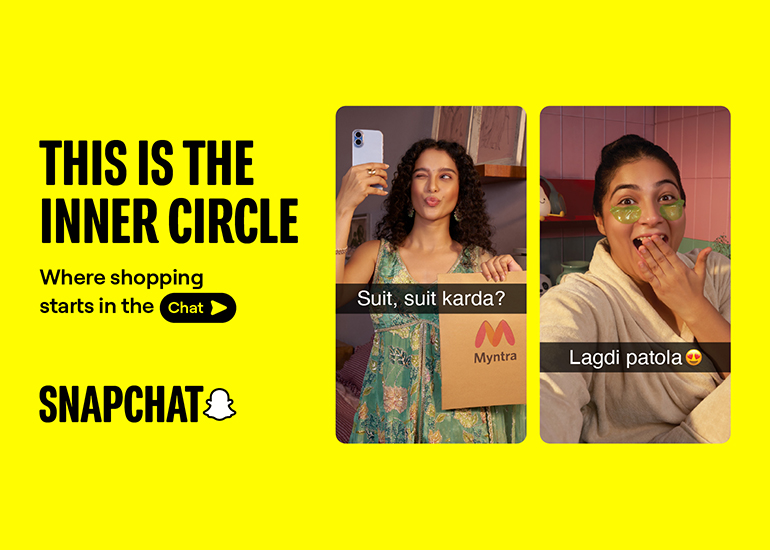
That impact extends beyond creators to how brands engage consumers. We’re seeing brands increasingly collaborate with AR developers to build custom lenses that Snapchatters actively choose to engage with, share, and return to, whether it’s interactive games from Swiggy, virtually trying on sneakers through Myntra’s Sneaker Club or expressing fandom via our Mumbai Indians jersey lens during the IPL, which drove over 100 million swipes. In a market like India, where Gen Z is embracing this boom and visual communication is becoming the dominant language, AR powered by AI is enabling more personal, immersive, and culturally relevant experiences for a digitally native generation.”
Persica Picardo, AR Developer, said, “Generative AI has made augmented reality far more accessible for creators. What once required long build cycles and deep technical expertise can now begin with an idea and a prompt, making it easier to experiment, iterate, and bring concepts to life quickly.
Snapchat is the only platform where I’ve seen this level of end-to-end enablement for AR developers. Lens Studio is free, intuitive, and constantly evolving, which makes it easier not just to learn AR, but to build consistently and at scale. Features like Easy Lens allow developers to create AR experiences within minutes, using generative AI to build assets, effects, and interactions without heavy technical lift. That ease has also opened up more opportunities to work with brands, because you can respond faster, prototype ideas quickly, and tailor experiences for different audiences and moments.
Over time, this has allowed me to collaborate with companies across beauty, fashion, entertainment, and quick commerce, including Amazon Prime Video, Coca-Cola, Nykaa, Ajio, Swiggy and Zepto, creating lenses that people genuinely want to interact with - whether it’s a virtual try-on, a playful activation, or a cultural moment. What started as curiosity for me eventually became a full-time career. I was able to co-found my own AR studio and build a sustainable business around this work. As brands increasingly turn to AR for more immersive storytelling, creators who understand both creativity and technology are finding real opportunities.”
Adobe recently introduced new AI-powered Acrobat and Adobe Express that enable creators to turn documents into podcast-style audio using simple chat prompts.
Apple launched creator studio for video editing, music making, creative imaging, and visual productivity. It included features like, Final Cut Pro, Logic Pro, Pixelmator Pro, Keynote, Pages, Numbers.
Beyond platforms, agencies see AI fundamentally reshaping speed and reliability.
Neelesh Pednekar, Co-Founder and Head of Digital Media at Social Pill said, “Today, creators are using tools like ChatGPT and Claude for scripting and ideation, Midjourney and Leonardo AI for visual concepts, Runway, Pika Labs and CapCut for video creation and editing, and ElevenLabs or PlayHT for voice and audio workflows.”
“For localisation and scale, tools like HeyGen, Synthesia, Dubverse and Rask AI allow creators to translate and dub content across Indian languages quickly, opening up entirely new audiences,” he added.
“What this has fundamentally done is lower friction creators can now test ideas faster, personalise content for platforms, and produce consistently without burnout.”
Pednekar believes this shift benefits brands as well. “From a brand perspective, this makes creators far more reliable partners, capable of delivering speed, scale and quality together. But the real winners will be those who use AI as an enabler, not a replacement. AI can multiply output, but original thought, lived experience and trust remain irreplaceable in the creator economy.”
From a strategic lens, generative AI is also compressing timelines across research and execution.
Nabeel Merchant, Co-founder and CEO of HOWL Digital said, “In India’s complex and fragmented market, the creative process has traditionally been slowed by heavy research cycles, manual insight generation, and long turnaround times. Generative AI has fundamentally altered this equation.”
He added, “Tasks that once took weeks category research, audience cohort analysis, funnel mapping and competitive benchmarking are now executed in days through well-trained AI systems. This reduction in time-to-context directly translates into faster go-to-market and lower cost per output.”
Merchant highlighted localisation as the biggest unlock. “In India, where scale demands localisation, AI-led creativity has unlocked exponential impact. From hyper-local, multilingual campaigns for EV brands across 700 plus dealer networks to financial literacy initiatives tailored to diverse regional cohorts, generative and agentic AI enable precision at scale across language, culture, and format.”
Yet, creators themselves continue to stress balance. Delhi-based doodle artist and illustrator Santanu Hazarika said AI works best as a creative collaborator rather than a replacement. For him, AI accelerates workflows and ideation but cannot grasp emotional depth rooted in vulnerability, conflict and lived experience.
While AI democratises access, Hazarika warned it also risks aesthetic sameness and loss of depth built through years of practice and failure. He views AI as a medium like photography or digital illustration rather than a substitute for artistic intent. Ultimately, he believes the future of art depends on striking the right balance between human intuition and technological innovation.
Adobe’s findings underline this tension. While creators are actively scouting new AI tools through personal research at 74 percent, social media trends at 68 percent and peer recommendations at 54 percent, adoption barriers remain. High cost, unreliable output quality and uncertainty around how AI models are trained continue to slow full-scale adoption. Nearly 78 percent of creators also express concern about their content being used to train AI without permission.
Read more news about Influence Zone, Marketing, PR and Corporate Communication, Internet Advertising, People Movement
For more updates, be socially connected with us onInstagram, LinkedIn, Twitter, Facebook, YouTube & Google News