Redefining automotive marketing through AI, attribution and the after-sales edge
Auto marketers are moving from campaign-led to system-led growth, using first-party data and full-funnel insights to drive performance, say marketers at the e4m Automotive Marketing Summit
 by
by
Published: Mar 6, 2026 12:27 PM | 7 min read
 Follow Us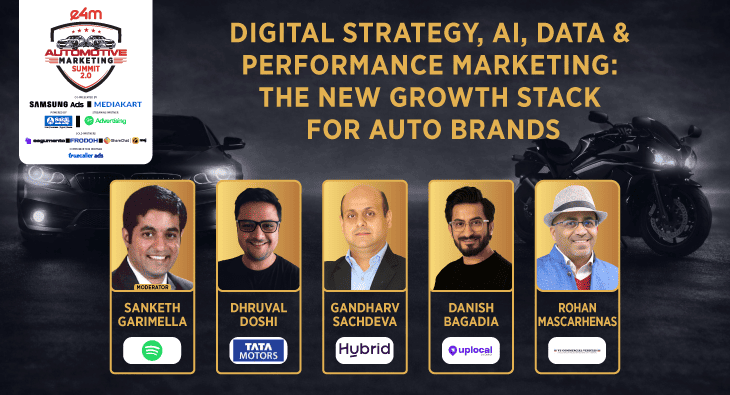

Automotive brands are sitting on more data than ever before. So, growth is not determined by how much is spent anymore but rather by how intelligently systems connect that data across the funnel.
At the e4m Automotive Marketing Summit, leaders from across the auto and adtech ecosystem unpacked the same. They discussed how digital strategy, first-party data and AI are moving from experimentation to infrastructure, reshaping how brands plan, measure and grow.
The session titled “Digital Strategy, AI, Data & Performance Marketing: The New Growth Stack for Auto Brands” was moderated by Sanketh Garimella, Director of Sales at Spotify, and brought together Dhruval Doshi, Head of Digital Marketing, EV & PV, Tata Motors; Gandharv Sachdeva, Country Head – India, Hybrid.ai; Danish Bagadia, Regional Director, DeltaX; and Rohan Mascarhenas, Head – Brand & Marketing Communications, Volvo Eicher..
Setting the tone, Garimella asked what the single biggest shift has been in digital strategy, AI and data.
For Doshi, the change is structural rather than tactical. “The biggest shift is how we move from thinking about digital in terms of channels, metrics and campaigns to how we set up systems, and how MarTech, automation or AI help us put what I call ‘the growth engine’ together,” he said. Strategy, assets, creatives and even media must roll into that system.
Sachdeva viewed the transformation through the lens of advertising. According to him, the shift from traditional advertising to AI-led digital programmatic has enabled far greater granularity. Audience cohorts are now more refined, allowing brands to reach “the right person at the right time.”
“What was once skewed and broad in traditional programmatic buying is now becoming more precise and context-driven,” he added.
Arguing that while brands invest in high-impact formats such as CTV, offline experiences and performance marketing, Bagadia said that the real shift must happen at the “last mile”. “You bought the car, and now what? Or even before you buy the car, you’re researching, interacting on WhatsApp, on the website, or calling the dealership,” he said. The challenge is making that last-mile digital experience as seamless as the offline one.
AI, in his view, enriches this through contextual personalisation, factoring in location, model preference and language to deliver more relevant engagement.
Mascarhenas approached the theme metaphorically. “In the automotive industry, we constantly hear that data is the new fuel and digital marketing is the new engine. But the point is, who’s behind the driver’s seat?” he said. For him, the shift lies in recognising that the customer journey is a blend of physical and digital experiences. “Every physical experience should become more intelligent, driven by AI. And every digital experience should become more human,” he added, suggesting that the convergence of the two defines the industry’s direction.
Shifting the discussion to full-funnel automotive growth, Garimella asked Doshi how managing EV (electric vehicle) and PV (petrol vehicle) portfolios impacts funnel planning at Tata Motors.
“The honest answer is it’s iterative,” Doshi admitted. While mature systems are often discussed, he said the reality is more incremental. Tata Motors benefits from having extensive historical data, even if it does not yet have a perfect single customer view. “We start with whatever quality we have and then iterate on top of that,” he explained, noting that this approach has driven measurable improvements in performance.
From an AI and advertising standpoint, Sachdeva underscored the importance of contextual targeting in combining AI, creative optimisation and engagement. If a user is reading about an electric vehicle versus a petrol vehicle, he explained, AI-driven contextual systems can tailor messaging accordingly. Therefore, creative optimisation becomes more meaningful when rooted in behavioural context rather than broad demographic targeting.
As the conversation turned to making AI-driven marketing more human, Bagadia referenced a statement by Sam Altman that 90% of marketers could be replaced by AI. “I don’t agree with that,” he said. While automation may replace repetitive tasks, he stressed that strategy, creativity and critical thinking remain human responsibilities. “AI can do the when, the where and the who. The human can do the what and the why,” he said, describing it as a collaborative loop where human insight feeds AI execution.
Mascarhenas offered a detailed view from the commercial vehicle segment, likening the customer journey to “an Indian shadi (wedding)”. There is a dynamic pre-sales courtship, a multi-ritual sales ceremony and a long-term after-sales relationship. AI and first-party data, he explained, help demystify this complexity across diverse cohorts, from first-time buyers and drivers to fleet managers and mechanics.
Across the funnel, different forms of intelligence apply. At the awareness stage, Gen AI enables emotional storytelling at scale. During consideration, product facts are converted into digestible nuggets and distributed through marketing automation. In sales, hyperlocal lead generation is complemented by digital tools for dealership staff, allowing them to customise not only their pitch but also financing and vehicle configurations in real time.
Post-purchase, telematics data enables fleet owners to manage vehicles more effectively, creating monetisable value and encouraging repurchase. “At various junctures of the funnel, we can use different forms of intelligence, whether it’s pure data, AI or digital marketing, all combined together,” he said.
On balancing brand and performance marketing, Pandya pushed back against the notion that the two are mutually exclusive. “A brand is a culmination of many experiences the consumer has over their journey, both physical or online, that builds the brand,” she said.
Brand marketing plays a stronger role at the top of the funnel, while performance marketing drives conversion at the bottom. However, performance campaigns need not be purely tactical. For instance, when launching the Kylaq, Škoda identified safety-focused cohorts and created creatives centred on the vehicle’s safety rating for lead generation. “You still maintain your brand ethos, but the performance marketing campaign does the job of lead generation,” she said.
Importantly, she added, brand building continues beyond the ad itself, in the speed of follow-up calls and the quality of the sales pitch. “I slightly disagree that it’s either brand or performance. Each has its role to play,” she said.
Next on the panel, Doshi talked about activating first-party data and highlighted a strategic pivot at Tata Motors. “This year, we made a very big switch from pure-play media to first-party data and augmenting that across the funnel and across customer touchpoints,” he said. The results have been significant, with measurable business impact and strong uplifts observed through controlled testing.
Agreeing with Doshi, Sachdeva added that while first-party data is crucial, knowing when and how to deploy specific data sets is equally important. AI, in his view, plays a role in determining which data should be activated at which stage of the funnel.
While data is universally acknowledged as critical, organisational silos often limit its potential. Data, Mascarhenas observed, is frequently guarded rather than shared. For AI to be meaningfully adopted, companies must rethink ownership and governance. In the commercial vehicle industry, where customers may purchase anywhere from five to 500 vehicles, data usage must be measured and responsible. “In the interest of meeting a short-term business goal, don’t let AI steal your soul,” he cautioned, emphasising ethical checks and balances.
Addressing attribution and cookie deprecation, Sachdeva said contextual advertising provides a future-ready solution. Companies, including Hybrid.ai, are preparing for a cookie-less environment with brand-safe tools and alternative targeting mechanisms. While challenges may arise, he maintained that “the industry is already building solutions for that transition.”
Finally, on unifying measurement across fragmented platforms, Bagadia argued that the challenge is not technological but definitional. “Marketers don’t have a technology problem. They have a definition problem,” he said, referring to inconsistencies around single sources of truth and metric ownership. Clean data pipelines and robust backend “plumbing”, rather than flashy dashboards, determine success. Measurement must be actionable and cyclical, fed back into campaigns with the help of AI to continually optimise outcomes.
Read more news about Marketing News, Advertising News, PR and Corporate Communication News, Digital News, People Movement News
For more updates, be socially connected with us onInstagram, LinkedIn, Twitter, Facebook, YouTube & Google News