How mobile discovery is reshaping consumer decisions
At e4m Screenage 2025, experts across sectors discussed how mobile is reshaping consumer journeys and the e-commerce funnel
 by
by
Published: Dec 3, 2025 4:46 PM | 10 min read
 Follow Us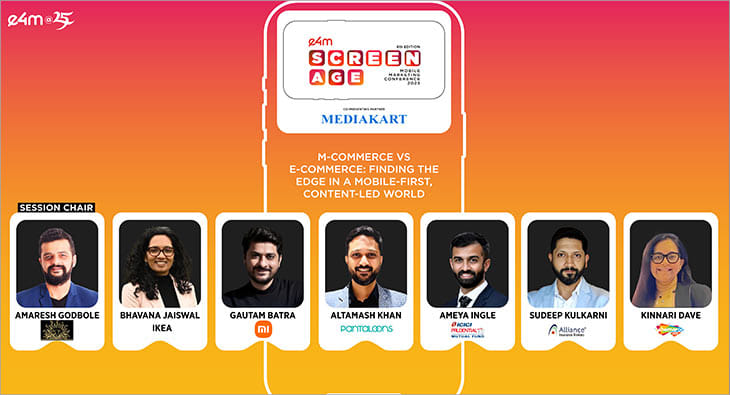

In a mobile-first India where every swipe, scroll and tap can trigger a purchase, the boundaries between discovery and decision-making are rapidly dissolving. At e4m Screenage 2025, category experts from furniture and fashion to finance, insurance and entertainment examined how this shift is reshaping consumer journeys across categories.
Moderated by Amaresh Godbole, CEO, Digital Technology Business, Publicis Groupe India, the session titled “M-commerce vs E-commerce: Finding the Edge in a Mobile-First, Content-Led World” brought together a diverse panel: Bhavana Jaiswal, Country eCommerce Integration Manager, IKEA; Gautam Batra, Associate Director – Marketing, Xiaomi India; Altamash Khan, Head of Media & Digital Marketing, ABFRL Pantaloons; Ameya Ingle, Head – Marketing & Digital Business, ICICI Prudential AMC Ltd; Sudeep Kulkarni, Senior Vice President – Marketing (Brand & Digital), Alliance Insurance Brokers; and Kinnari Dave, Business Head, ShemarooMe.
Beginning the discussion, Godbole noted the unprecedented scale of India’s digital ecosystem. “We have more than a billion screens in the country,” he said, adding that commerce today is shifting from a screen-led experience to one driven by creators and content. “Everything today is potentially commerce, and mobile plays a very important part in that journey.”
To begin, he asked the panel for their one-line take on how mobile commerce is impacting their respective sectors.
Jaiswal explained how mobile has collapsed formerly separate stages of the home-furnishing purchase journey. “Earlier it was discovery, then research, and then the final purchase, all happening at separate steps. Now everything is merged into one seamless journey,” she said.
Batra, speaking from the smartphone category, highlighted mobile’s intuitive ease. “Mobile is just easier,” he said. “Laptops and desktops are acquired; mobiles come naturally. You know your way around it and everything you can do on it, and that’s why it is moving in that direction. It simply makes everything easier.”
From a fashion and retail lens, Khan reinforced the dominance of mobile across the funnel. “For our category, mobile is the platform for everything. Discovery starts on the phone, the decision is taken on the phone, and then you decide where to shop,” he said. Even when the final purchase happens in-store, he added, “the journey of discovery still happens on the mobile device.”
Ingle described a dramatic shift in the mutual fund and financial services category. “Earlier, an agent would come home and sell life insurance, followed by some SIP or mutual fund,” he said.
Discovery happened offline, and decisions would come months later. “Two things have happened. The entire funnel has collapsed, so education to decision-making happens on the same screen; and context-based micro-moments now influence the financial journey.” He explained that mobile allows targeting based on life goals, such as upcoming travel plans, making journeys far more personalised.
Kulkarni pointed out how mobile has bridged long-standing gaps in insurance buying, a category he called “probably the most boring of all”. “Through 20-second reels, explainer videos, snackable content, you can now reach consumers in ways that were not possible earlier.” He added that for low-ticket products like travel insurance, “purchase intent and purchase happen directly on mobile.”
From the OTT space, Dave said mobile personalisation has been decades in the making. “I wouldn’t just give it to mobile but also the telco companies that empowered these devices. The combination of bandwidth and cost has turned that belief into reality.”
The conversation then moved to mobile-led discovery in high-involvement categories, with Godbole saying how today’s mobile discovery feels like a “personal shopper inside Instagram.”
For home furnishing, Jaiswal acknowledged that large screens and store visits remain essential. “It’s not just the touch-and-feel factor; there’s also a mindset that a smaller screen cannot be trusted for expensive purchases,” she said. At IKEA, stores still remain “the pinnacle of the experience”. Yet mobile offers unmatched personalisation. “Customers scan and browse all day on their screens. You know their style preferences, whether they lean towards international, modern, or traditional décor, and the inspiration you offer becomes far more catered.”
She emphasised that home décor is “highly emotional and personal,” and personalised discovery can become a differentiator, driving deeper engagement and consideration.
Continuing the discussion, Khan expanded on how mobile has intensified the pace of discovery and purchase in fashion. “Fashion, by default, follows a simple flow: you discover it, you see it, you want it, and then you purchase it,” he said. “With mobile, it is just scroll, see, want, purchase. The journey has become very short because of the content we consume and the attention spans consumers have today.”
Godbole asked whether Pantaloons sees mobile-only purchases in regions without stores and how mobile interacts with store-based retail where both channels coexist. Khan said the reality is varied. “There’s very little cannibalisation right now because our retail footprint is very large,” he said.
Mobile, retail, and online channels collectively help the brand reach new markets. What is changing, he noted, is the quest for a single customer view. “You need to understand touchpoints and the nudges required for conversion,” he said. With brand loyalty weakening in fashion, mobile becomes a critical tool. “It’s more about format and visual references now. The more touchpoints and nudges we build, the better. Mobile helps us cluster audiences based on intent, value shoppers, deal hunters, and reach them accordingly.”
Turning to Xiaomi, Godbole asked Batra how mobile behaviour affects both product sales and the larger device ecosystem of the brand. Batra said mobile dominates their purchase funnel. “Around 60% of all purchases happen through mobile,” he said. Even in higher-involvement categories such as TVs, consumers browse on mobile to build shortlists before visiting stores.
He added that Xiaomi’s large installed base enables deeper understanding. “Millions of people use our phones, TVs, watches, air purifiers. Of course, we understand our users better and can create nudges on what they might like,” he said. But the larger impact is on product planning.
From the OTT perspective, Dave described content as the product itself. “Every day we put out a new piece of content, and that is the product,” she said. Content drives purchase intent, but purchases also drive content strategy. “It’s a flywheel between the two,” she explained.
A user watches a trailer, makes a subscription decision, and those signals come back to inform what works and what doesn’t. AI is now accelerating this loop. “The flywheel is rotating much faster,” she said. Understanding what viewers watch, don’t watch, where they drop off, and which emotions resonate helps refine decisions. “The same piece of content can evoke different emotions in different people. For us, both content and commerce feed into each other.”
The conversation shifted to AI and agentic workflows, starting with the financial sector. Ingle said AI is transforming their mobile commerce journeys in two major ways. “Our category is not persuasion-driven; it is education-driven,” he said. “A lot of our content now integrates AI so we can create more at scale and personalise at scale.”
The team is also experimenting with agentic AI. “We have agentic agents for social media managers, for brand teams, for compliance,” he said. While compliance teams may resist, he believes the next year will be decisive. “First-party data in our category is extremely rich. AI can trigger numerous nudges and notifications based on the consumer’s life context, and that is extremely powerful.”
Kulkarni added that data is becoming “a new currency” in insurance. With abundant data, the challenge is using it effectively. “AI helps with segmentation and demographics, but the key is personalisation,” he said. Tools like predictive analysis, policy-code comparisons and grievance redressal systems improve responsiveness. “People want immediate action. That’s where m-commerce helps.”
Yet insurance remains largely a push category, he noted. “You won’t scroll Instagram and say, ‘Let’s buy insurance today.’ There is still a lot of awareness and education required.”
The discussion moved towards the growing influence of Gen Z, with Godbole noting that the next wave of consumers are mobile-native, AI-native and known for faster decision-making. He asked Jaiswal whether this demographic presents a unique challenge or opportunity for a high-involvement category like home furnishing.
Jaiswal disagreed with the assumption that Gen Z browses less. “We have a generation that browses more than before. Doom-scrolling isn’t just a phenomenon. It’s becoming a norm,” she said. While the need for instant gratification has increased across shopping and even content consumption, IKEA adapts journeys around these inherent behaviours. “We don’t look at page length anymore. Earlier people stopped after two scrolls; now they scroll endlessly as long as the content is engaging,” she said. The focus, therefore, is on inspiring, engaging and surprising content that keeps users browsing.
However, she added that furniture decisions still require multiple visits. “Patience is less, so we ensure customers can pick up where they left off,” she said.
The conversation turned to the growing role of creators, particularly in categories where education and credibility matter.
Ingle said financial influencers have become significant in the education ecosystem. “About 70% of our customers are now between 18 and 40,” he said. “And you’ll be surprised how many impulse purchases happen in mutual funds as well.” With shrinking attention spans, the brand has heavily invested in videos, content and vernacular formats. “We have about 1,500 videos on our social media; everything from SIPs to PE ratios.”
However, he emphasised that credibility is critical. “Choosing the right financial influencer becomes very important for brand safety. Trust is our biggest currency,” he said. When misinformation occurs, blame falls not on platforms, but on the fund house. As a result, influencer partnerships are now an important part of their marketing mix, especially as young India gravitates towards creators over traditional distributors.
In contrast, attribution between creators and commerce is far more measurable in fashion. Khan said, “In some cases, we build separate attribution models with creators.” The type of content also varies by season.
He pointed to creator-led partnerships as a growing opportunity, including collaborations where influencers launch their own fashion lines with retail brands. “They know their followers, their style and their strength. It’s a very different lens on commerce.”
From Xiaomi’s perspective, Batra highlighted tech’s enabling role. “Tech companies or mobile companies are the reason creators realised they could make money,” he said. While attribution is often indirect, affiliate links and live commerce remain important. For new launches or seasonal moments, he added, “the sum of everything creators do becomes very helpful for a tech company.”
Reflecting on the broader mobile landscape, Dave described mobile as the most intuitive interface users have ever had, and also the most fickle. “As much as it works positively for us, attention spans move fast. It gets you attention quickly and loses it just as fast,” she said.
Kulkarni highlighted two clear advantages of m-commerce: speed and proximity. “All of us have our mobile phones with us, not our laptops. At any point we can pull it out and purchase anything,” he said.
However, for insurance, trust remains a barrier. “Insurance buying still relies on person-to-person conversation,” he said. While discovery and intent-building happen online, verification often shifts to websites, and final purchases may occur after speaking to a contact-centre executive. “It’s product-specific, but speed and proximity still make a huge difference.”
Read more news about Marketing News, Advertising News, PR and Corporate Communication News, Digital News, People Movement News
For more updates, be socially connected with us onInstagram, LinkedIn, Twitter, Facebook, YouTube & Google News