AI agents will explode in next 2-3 years: Lenovo's Shailendra Katyal
At e4m Screenage 2025, Lenovo Vice President and Managing Director for India Shailendra Katyal outlines how devices, ecosystems and AI will redefine how India learns, works and unwinds
 by
by
Published: Dec 3, 2025 1:33 PM | 5 min read
 Follow Us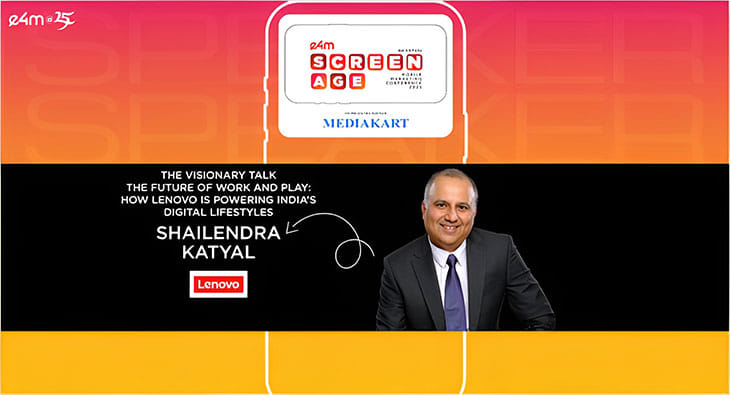

Lenovo’s vision for the future of India’s digital life was in sharp focus at the e4m Screenage 2025 forum as Shailendra Katyal, Vice President and Managing Director for India, delivered a wide ranging address on the forces shaping how people work and play.
Katyal opened by reminding the audience that Lenovo has spent two decades in the country building a portfolio that stretches from Motorola smartphones to enterprise grade servers and storage. His remarks quickly set the tone for a conversation rooted in rapid technological shifts, rising consumer expectations and the accelerating influence of artificial intelligence.
Katyal used a simple question to underline how deeply digital behaviour has transformed. He asked the audience to consider how many apps they had on their phones today compared with a decade ago.
“That is how integral using an application to run our lives has become because of very practical applications on a very accessible device like a smartphone.” But he stressed that the next shift is already at the doorstep. When speaking about AI agents, he told the audience that they are at the same point where the world stood when the internet first emerged. “Right now this is like the birth of the internet.”
He predicted that AI agents capable of performing tasks independently will soon be everywhere. “Will that explode in the next two to three years? Absolutely yes.”
He argued that AI’s acceleration represents a structural change rather than a passing trend. “AI is not a fad. It is a fundamental technology shift and it will remain.” Katyal placed this evolution in historical context and referenced milestones such as IBM’s Deep Blue defeating Garry Kasparov and the rapid rise of generative AI. The adoption of models like ChatGPT, which touched 100 million downloads in a month, marked a clear break from past cycles. He added that machines will progress rapidly from prompt based systems to fully autonomous forms. “Some people are saying it is as early as 2030, some are saying 2035, but it is about 10 years away.”
A major portion of his talk focused on the explosive investment flowing into AI infrastructure. He pointed to the seven hundred billion dollar global spend on data centre capacity and explained that these AI factories are powering the next generation of compute. He contrasted this with India’s sovereign AI mission, which he said stands at one billion dollars and is significantly smaller in comparison. He warned that the energy cost of AI training is enormous, noting that running a single GPU server for eight hours consumes the equivalent of an entire month of energy for a typical household in the United States.
Katyal illustrated the behavioural shift across generations by contrasting his own use of AI with that of his daughter who is in college. “Her consumption of AI is 10 times of mine already.” He said the next generation will not be digital natives but AI natives who will interact with information through autonomous systems and agents. This shift, he warned, will change the foundations of marketing. Machines will make choices about what people consume, buy and watch. “If the task is not being performed by a human and the machine is deciding your coffee or your hotel or your shoes, who are you advertising to.”
He addressed the anxiety around AI’s impact on jobs with a direct message to the industry. “You will lose your job to someone who can use AI better than you.” He explained that AI driven tools are already raising productivity by as much as 20 percent, meaning workers who adopt them will have a clear advantage. He shared examples of doctorless clinics in China and Europe and autonomous factories running without human intervention to show how quickly real world use cases are moving from experimental to operational.
Katyal then spoke about Lenovo’s role in shaping this ecosystem. He described Lenovo’s Pocket to Cloud strategy and said the world is moving towards hybrid AI where personal devices, enterprise systems and public cloud models coexist. He explained that users will want certain sensitive tasks to run locally on devices and that enterprises will build their own secure AI environments. He said Lenovo already offers device side intelligence with AI Now on its laptops and noted that Project Quantum, which will launch publicly in January, is designed to serve as a personal AI twin. “It will actually become your twin and it will give you control from a cross device point of view.”
He concluded by emphasising sustainability and security in the AI era and pointed to Lenovo products such as Neptune designed to reduce data centre energy loads. He reminded the audience that large scale AI adoption demands ethical frameworks and secure environments and said Lenovo is committed to enabling this transition responsibly. Through a mix of future ready devices, intelligent systems and AI driven experiences, he said Lenovo aims to power India’s next chapter of work, learning and play.
Read more news about Marketing News, Advertising News, PR and Corporate Communication News, Digital News, People Movement News
For more updates, be socially connected with us onInstagram, LinkedIn, Twitter, Facebook, YouTube & Google News