Inside the new playbook for Gen Alpha marketing
With Gen Alpha already navigating iPads, creator ecosystems and gaming super-highways, a panel of experts explore how brands must rethink communication for the world’s youngest digital natives
 by
by
Published: Dec 3, 2025 2:37 PM | 9 min read
 Follow Us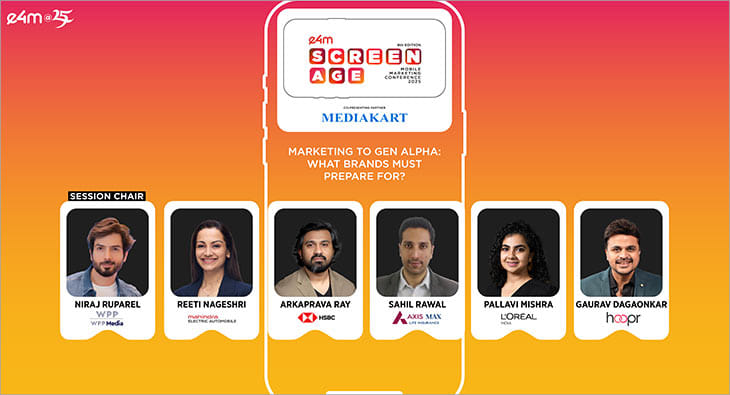

At e4m Screenage 2025, industry leaders unpacked the realities of engaging a generation born into screens, shaped by hyper-connectivity, and soon headed towards independent consumption.
Moderated by Niraj Ruparel, Creative Technology Lead, WPP & WPP Media India, the session titled “Marketing to Gen Alpha: What Brands Must Prepare For” brought together insights from Reeti Nageshri, Head of Business Operations & Strategy, Mahindra Electric Automobile Ltd.; Arkaprava Ray, SVP & Head, Marketing Strategy, Brand Partnerships, Sponsorships & Events, HSBC India; Sahil Rawal, Vice President – Brand Product Platforms Marketing, Axis Max Life Insurance; Pallavi Mishra, Head – Consumer Market Insights (CMI), L’Oréal India; and Gaurav Dagaonkar, CEO & Co-founder, Hoopr.
Ruparel began the session and remarked that Gen Alpha is unlike any audience marketers have faced. “They are screen audiences. They are born with screens,” he said, calling their world “absolutely sci-fi” and noting that brands are learning from them “day in and day out”. He explained that these children were already moving into Wi-Fi-enabled, immersive gaming worlds as early as 2010, and now, as many turn 15, they have become central to modern marketing conversations.
Ruparel illustrated this with a campaign example. “The beautiful work that can happen for these audiences is when you get the worlds to collide,” he said, recalling discussions with the creative team on Ages Federal Insurance. He wanted to avoid traditional fear-led communication and instead push for something progressive.
The breakthrough came when the team realised they had access to Sachin Tendulkar. “This was pretty much India’s first AI campaign,” he said. His immediate thought was to create a Gen Alpha version of the legend. “An eleven-year-old Sachin would go out there and say, ‘I am not afraid of my future; I have prepared for my future. Ages Federal also prepares you for your future’,” he said, describing it as a classic blend of tech, creativity, and iconic storytelling.
Turning to HSBC’s work with Lionel Messi, Ruparel invited Ray into the conversation, asking how such an icon could speak to Indian Gen Alpha audiences.
Ray acknowledged the point. “You made a great point there, and kudos to the team that worked on the piece,” he said, referring to the Sachin example. He explained that while HSBC’s association with Messi was shaped differently, it still connected deeply with young audiences. “At the end of the day, it connects with kids and specifically Gen Alpha,” he said.
He outlined a key insight driving their approach. Adults, he noted, weigh the cost of an experience they want for themselves and often opt out if it feels excessive.
However, the dynamic shifts when children are involved. “If my kid tells me that, dad, I want access to this… I would rather stretch that access, giving my kid that experience,” he explained. Using examples from his nieces and nephews who “pester” him for concert passes, Ray illustrated how decision-making often originates with children, even though the parent ultimately “uses the wallet or the card”.
Mishra, the only CMI on the panel, began by acknowledging L’Oréal’s deliberate stance on this demographic. “We don’t market to Gen Alpha and we do it very consciously.” The company, she stressed, champions the idea of “let kids be kids”, but this doesn’t diminish the urgency. India, she pointed out, is set to become the world’s biggest Gen Alpha market by 2030, which makes preparation non-negotiable.
She explained that much of L’Oréal’s current focus lies in strengthening data systems, building AI readiness and ensuring the organisation can operate in a “hyper-reactive” way. She noted that marketers had arrived late to Gen Z. Stereotypes filled the gaps because brands weren’t prepared.
She then broke down what is known about Gen Alpha. They will be the first truly digital native cohort. “Everything that seems disruptive to us will be table stakes for them,” she said, noting that most will have internet access of some form. But constant access also brings challenges: “There’s going to be an over-stimulation of both sensorial experiences as well as information,” she said. Brands, therefore, would need to find ways to be part of conversations while “decreasing their cognitive load”.
Mishra underlined the generation’s turbulent upbringing; a world of COVID, wars, climate stress and extreme weather. Many are growing up with AQIs in the hundreds and temperatures as high as 50–55°C. She observed that these children are also being raised in more egalitarian millennial households, where gender norms are very different from previous generations. This shift, she said, will fundamentally shape their expectations of communication and brand values.
Turning to strategic implications, Mishra said marketers must plan for a future in which AI is fully normalised. “By the time the Gen Alpha are going to be real customers, AI is going to be table stakes,” she noted. The levelling effect of AI, she added, would reduce barriers to entry for brands, making authenticity and purpose even more critical. She echoed earlier discussions on using technology to simplify the mundane, freeing resources to create “super engaging experiences”.
Ruparel pivoted the conversation by pointing out that while product innovation is essential, marketing innovation will see equally rapid transformation. He invited Dagaonkar to share an example at the intersection of creativity, AI and music.
Dagaonkar began by grounding his view in a fundamental brand objective. “What most brands seek at all points in time is building trust and recall,” he said. Music, he argued, has always held a powerful place in memory. “Ask yourselves, which are the songs you remember end to end?” he asked. “The ones from last year, or the ones learnt in school?”
Drawing from a recent music workshop with children, he observed that young audiences have eclectic tastes: Hanumankind, Anuv Jain, Kishore Kumar. “Music is underused by brands in carving out a place for themselves in the minds of the audience,” he said, noting that Gen Alpha will be an even more crucial cohort for long-term brand building.
He explained that his own six-year-old daughter listens to everything from Demon Hunters tracks on Netflix to regional and global artists. Across India children’s preferences vary widely but share a common desire to participate rather than simply consume. “The Gen Alpha today don’t just want to be communicated to, they want to be a part of that experience themselves,” he said.
Building on Mishra’s point, he floated a potential idea. He imagined a simple experience where a child could create a “pop star avatar” based on their personality, whether socially conscious or aspiring to fashion and beauty. Through licensed music and a touch of AI, the avatar could generate a small clip for kids to share with friends and family. Experiences like this, he said, embed brands early. “If they get exposed to it at this point in time, the brand actually stays with them for a long time.”
Picking up the thread on context-setting, Nageshri expanded on the distinctions between generations. Comparing Gen Z and Gen Alpha reveals a fundamental difference in their relationship with platforms. “If Gen Z was about expressing oneself, because they grew with Facebook and social media, Gen Alpha is more about being included in building something,” she said.
Growing up with co-creation platforms such as Roblox has shaped their instinct for participation. “They love participation. That’s their thing. And they love agency,” she added. Brands that can offer this, she said, will see them become advocates.
Even though children aren’t driving yet, she said they’re “already in the driver’s seat emotionally”. Mahindra tapped into this with the BE.6 and XUV.e9 launch under the Unlimit India theme, positioning them as world-beating Indian EVs and proving it through live performance races. The campaign went viral, nearly four billion views, reflecting a broader shift to a “confident India” that strongly resonates with Gen Alpha’s pride shaped by Chandrayaan, ISRO missions and Olympic wins.
She moved to the second major theme: participation. “You can’t expect them to enter your brand. You have to enter their universe,” she said. During launch interactions, customers’ children had already begun referring to the black variant of BE.6 as the Batmobile. “It was already out, and we picked this up as the insight,” Nageshri said. Acting on it, the team approached Warner Bros and struck a partnership to create the world’s first Batman-inspired BE.6. “Kids loved it,” she said, pointing out that sustainability education in schools meant children were already discussing topics such as EVs and “save water”.
From automotive to finance, the discussion changed to how Gen Alpha is reshaping family dialogue around long-term planning. Rawal reflected on life insurance as “one of the most important products”, but one usually considered only during late-stage investment planning.
He pointed out that Gen Alpha has grown up amid revolutions in smartphones, the internet and digital content. Their exposure has led to significant early knowledge and awareness. Another defining factor is millennial parenting. “One of the parenting habits of a millennial is to raise their kids in an open environment,” he said.
Unlike a decade ago, conversations around mental health, cyber security, finances and life insurance are no longer taboo. “These conversations were never done in a living room setup,” he said, recalling how financial decisions were once made privately by “the man of the house”.
Today, these topics are discussed openly between millennial parents, and increasingly with their children. As a result, insurance-related communication aimed at adults is also being absorbed by younger audiences.
He concluded by outlining three focus areas for life insurance brands: raising awareness in a category with low national penetration; normalising conversations around topics once considered taboo; and using AI and technology “to make our content much more engaging, much more entertaining for the Gen Alphas”, helping them build financial understanding from an early age.
Read more news about Marketing News, Advertising News, PR and Corporate Communication News, Digital News, People Movement News
For more updates, be socially connected with us onInstagram, LinkedIn, Twitter, Facebook, YouTube & Google News
