Micro-drama is India’s new primetime: Prasanna Raman
At e4m Screenage Mobile Marketing Conference 2025, Prasanna Raman of ShareChat & Moj discussed how shifting mobile behaviours are redefining India’s cultural engagement
 by
by
Published: Dec 3, 2025 12:19 PM | 4 min read
 Follow Us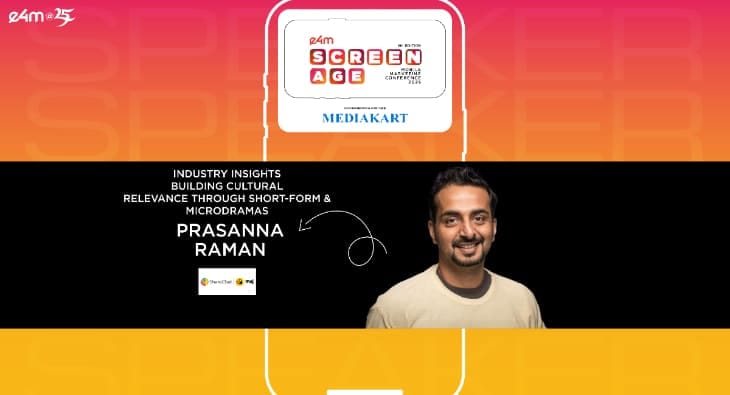

At the e4m Screenage Mobile Marketing Conference 2025, Prasanna Raman, Senior Director - Client Relationships at ShareChat & Moj, unpacked the behavioural shift that’s redefining how India consumes and connects with culture on mobile. He opened with a contextual connection to the previous speaker, revealing the platform’s audience alignment: “for his brands…the audience in this room is probably not the target audience, but people who are in middle India, rural India, and we, as ShareChat Moj, are exactly that.”
But he also acknowledged a contrasting challenge, the looming presence of AI discourse: “the first thing that I'm going to talk about today is AI. And we all heard his views on AI.” That tension became a launchpad for his analysis of a consumer-driven digital evolution.
In tracing the cultural hype cycles of technology, Raman highlighted how AI is the latest in a lineage of buzzword waves that shaped pop-technology consciousness. He walked the audience through decades of fascination, from “computers” in 90s Bollywood dialogue to internet, to big data, and finally today’s AI era, punctuated by a milestone: “Just a little over three years ago, ChatGPT came into our life… literally, three years ago… I'm assuming for a lot of us, ChatGPT was the introduction to AI.”
He then grounded AI adoption into hard behavioural reality, revealing that “almost 92% of the workforce in India is using AI in some shape and form.” In middle India especially, AI isn’t abstract, it is enabling creation, self-expression and video culture at an unprecedented scale.
Raman then shifted to the emerging content structure dominating mobile attention: the rise of micro-drama. In a candid and humorous anecdote from Udaipur, he used a wagging-tail analogy to illustrate how Indians navigate dense, vertical living and vertical digital feeds: “I don't know about dogs in Mumbai, for sure, but definitely the wagging that we are doing is scrolling.” In this scrolling-native world, narrative compression has become a new storytelling grammar, “each episode is 60 seconds, 90 seconds… with a cliffhanger.” This new format, he declared, has achieved cultural takeover: “this makes micro-drama India's new primetime.”
He showcased how brands are embedding themselves inside micro-stories rather than interrupting them, pointing to Blender Sprite’s successful integration. As Raman explained, “our ability to integrate your brand inside the story itself” goes beyond inter-episode ads and into narrative inclusion, where characters, objects, dialogue and immersion carry brand context organically. Creators are beginning to build these dramas using AI tools themselves, from scripting to generation, creating a participatory loop between platform, creator and viewer.
Moving into micro-festivities, Raman underscored a myth that Diwali is India’s single cultural commercial anchor. On ShareChat and Moj, regional observances are exploding with user-generated content and brand activation: “regional festivals like Janmashtami, Onam and Ganesh Chaturthi are getting massive traction… with 50% engagement lift during these micro festivals.” For regional-focused brands and state-specific marketers, these temporal spikes are brand opportunities, if they show up authentically.
This authenticity, Raman argued, is most powerfully enabled by one tribe: regional creators. “Not every creator that comes from South Bombay or South Delhi can actually make it big” because relatability is not aspirational, it is conversational. “People would like to see people that look like them, that talk like them.” These creators are backed by a deeply woven national footprint, “we have around 4,200 pin codes covered… to grab every nook and corner of India.” This regional presence is vital in a country where “language and dialect changes every 50 kilometers,” requires cultural precision, and cannot be served by dubbing a Hindi video into other languages. “One-size-fits-all doesn’t work anymore,” Raman reminded the room.
Closing the session, Raman summarised the framework he wants agencies and marketers to internalize. Brands must “build episodic narratives through micro dramas,” show up amid “micro festivals and rituals” throughout the year, and above all, leverage the “relatability of our influencers to enable participation using AI and user-generated content.” AI, micro-drama, micro-festivities and regional creators are not isolated trends, they are interlocking gears of cultural attention in mobile-first India. Raman left the audience with a QR code and an invitation: bring your brand problems, and ShareChat & Moj will solve them with narrative-driven, culturally-embedded storytelling.
Read more news about Marketing News, Advertising News, PR and Corporate Communication News, Digital News, People Movement News
For more updates, be socially connected with us onInstagram, LinkedIn, Twitter, Facebook, YouTube & Google News