For AC brands, influencers play a key role: Jayant Balan & Pragya Bijalwan, Voltas
Jayant Balan, Head RAC Business, Voltas Limited and CMO Pragya Bijalwan share how the brand is sharpening its marketing strategy for a new-generation buyer
 by
by
Published: Mar 9, 2026 9:33 AM | 7 min read
 Follow Us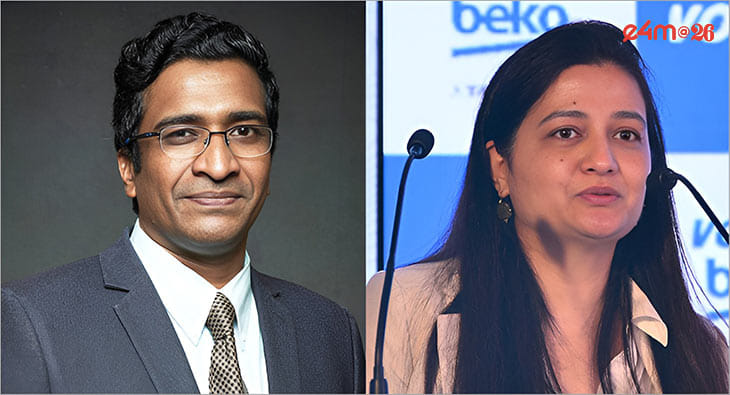

Voltas has always embraced the Indian home and its ethos, weaving comfort into every daily routine and festive celebration. This philosophy is captured in its latest summer campaign ‘Har Ghar Voltas’. The campaign film features real-life mother-son duo actors Neetu Kapoor and Ranbir Kapoor in a playful, relatable moment at home where Neetu fondly recalls how a young Ranbir would often complain about feeling too cold under the air conditioner, sparking the classic and relatable back-and-forth conversations over temperature settings.
Ranbir–Neetu Kapoor: A Relatable Yet Aspirational Duo
Voltas’ latest summer marketing plan reflects the comprehensive offering of the Vertis AI series, featuring brand ambassadors Ranbir and Neetu Kapoor. The campaign captures the innovation, intelligence, and reliability embedded in every Voltas product. “We wanted to create a unique proposition around AI which is easily understandable and relatable. The mother-son relationship feels genuine and warm, just like our association with consumers from the house of Tata,” explained Jayant Balan, Head RAC Business, Voltas Limited.
The duo’s interactions in the ad showcase everyday moments adjusting room temperatures, anticipating comfort needs blending advanced technology with familiar familial warmth. This approach allows the campaign to convey intelligence and sophistication without alienating first-time AC buyers, while the premium visual treatment positions the brand as aspirational yet accessible. It also leverages multi-generational appeal, ensuring both younger and older audiences connect emotionally with the narrative, reinforcing Voltas; promise of comfort that is both smart and personal. Voltas has created three ad campaigns for the Voltas Vertis AI range.
Balan adds, “We wanted to create a unique proposition around AI which is easily understandable and relatable. The mother-son relationship feels genuine and warm, just like our association with consumers from the house of Tata. While the look and feel of the film is premium, it is still very relatable.”
On the marketing front, the brand has moved beyond its long-standing mascot, Mr Murthy, who represented the common middle-class man. “Mr. Murthy has done a wonderful job for the brand. When he was introduced in 2010–11, affordability was the problem. He represented the typical middle-class consumer concerned about total cost of ownership,” says Pragya Bijalwan, Chief Marketing Officer, Voltas Ltd.
Bijalwan also explained that consumer affordability brackets have evolved. “AC has become a hygiene product. The younger generation uses ACs throughout the year for ambient comfort, not just summer cooling.” She added further “The problem statement at hand is how do I drive relevance with a high intent audience? The high intent audience are not the Gen Z's; there are the people who are looking to purchase houses and changing the ACs in the house. This target group are typically the millennials who can afford ACs in the higher price range.”
AI Adaptive Cooling: “A Learning Algorithm Built for India”
At the core of the innovation pipeline is AI Adaptive Cooling designed not as a surface-level feature but as embedded intelligence. Balan shares “There are two factors that we've taken into consideration while designing this product. One is the external ambient. The other. the local weather right down to the pin code. India has around 19,000 pin codes and our algorithm studied weather patterns in each of these areas. We now have an entire database, across pin codes, that the AC understands and is programmed to deliver according to that.”
However, climate is only half the equation. User behaviour is equally critical. “A typical user, switches on the AC at a certain temperature, then modifies the temperature as the day progresses, changes the louvre positions to control the direction and distribution of air flow or turns it off when he's feeling too cold,” Balan explained.
The algorithm understands the consumer usage, couples it with the external conditions and then delivers a standardised, unique experience to the customer exactly as per their needs. He emphasised that this is not conceptual AI layered on top of hardware. “We've built a learning algorithm which takes into account consumers’ preferences and external conditions,” Balan stated. To make this transition easy for consumers across Tier I and Tier II markets, the brand has integrated a connected ecosystem. “We made the product smart and given the consumer an app which is very easy to use. Many of these features are intuitive and explained through the app. Our algorithm is designed to understand and play back an exact experience the consumer needs taking into account weather patterns where the customer resides. That’s why we consistently say we make for India.” Balan noted.
Service Network: Training for Scale and Consistency
With over 30,000 touchpoints and 1,750 service franchises, operational consistency is as important as product innovation. Recently, the company ran. the Voltas Tech Olympics, where service technicians from across the country participated to showcase their skills. The technicians also got an opportunity to understand the available tech better.
The initiative serves two purposes: motivation and upskilling. Balan explains, “We spend a considerable amount of time in training and educating our technicians, creating videos and manuals and learning algorithm s so that they can quickly resolve issues on the field.” The emphasis on training reflects a larger brand philosophy. “Working for a Tata company itself is an experience for a service technician”. This ensures that the experience is consistent with what the brand stands for. In other words, the backend ecosystem is designed to mirror the trust associated with the Tata name, reinforcing brand equity through after-sales reliability.
Balan explained the company’s expansion in manufacturing signals a long-term structural shift. “Voltas was a combination of Volkart Brothers, which was a Swiss trading company, and TAS, which is Tata Sons. Our initial birth was in trading.” However, the scale of recent investment marks a turning point. “The investments that we've made in the last five years, around ₹1,200–1,300 crores in core manufacturing is more than the cumulative investment that we made in the last 70 years.” The company has built, what it calls, India’s largest integrated AC factory in Chennai, capable of producing two million units annually, aligned with the Make in India initiative and a move toward supply chain resilience
E-Commerce: Beyond Sales, Toward Advocacy
Digitally, the brand views online platforms as influence hubs rather than mere checkout counters. It holds a strong position on Flipkart and remains dominant on Amazon. “E-commerce is not just a point-of-sale, it is a point of advocacy. When you're going to buy a ₹35,000–₹40,000 product, you do evaluate what you are looking to purchase,” Bijalwan says.
She added that two-thirds of Indian consumers visit Amazon to evaluate products even while making purchase decisions in-store. This makes search visibility, reviews and content strategy critical. She states, “We have refreshed our brand store on e-commerce. We have a targeted display-led and search-led strategy to ensure that our brand sees the highest level of advocacy and visibility on the platform.”
The post-purchase experience is equally important. “When a consumer purchases our product, the entire query is routed through CRM. Our service team gets triggered and contacts the customer for installation. We do regular social listening on e-commerce and benchmark our positive, neutral and negative mentions. As we got into the season, the percentage of positive comments far exceeded the industry average.” she explained
In a category where 90% of evaluation happens online but 90% of sales happen offline, influencers play a key role. Bijalwan says, “Influencers orient the consumer towards a particular variant before they even step into a shop. The strategy is advocacy-led rather than conversion-led.” On media spends, the brand is betting on Connected TV. She notes, “With content watching patterns have changed with people consuming content on demand, but it's still television.” With a premium target group, Voltas looks at CTV for sharper targeting. “We focus directly on reaching the prospective AC consumer rather than wasting our spends on mass SD and uncertain audiences,” she concludes.
Read more news about Marketing News, Advertising News, PR and Corporate Communication News, Digital News, People Movement News
For more updates, be socially connected with us onInstagram, LinkedIn, Twitter, Facebook, YouTube & Google News
