The OTT battle is changing. Zee 5 may be thinking one step ahead
With a reimagined mobile and Connected TV experience, five distinct entertainment universes, an ambitious English slate and a revamped Free 5, Zee 5 is making a larger play for the Indian household
 by
by
Published: Sep 10, 2026 11:41 AM | 7 min read
 Follow Us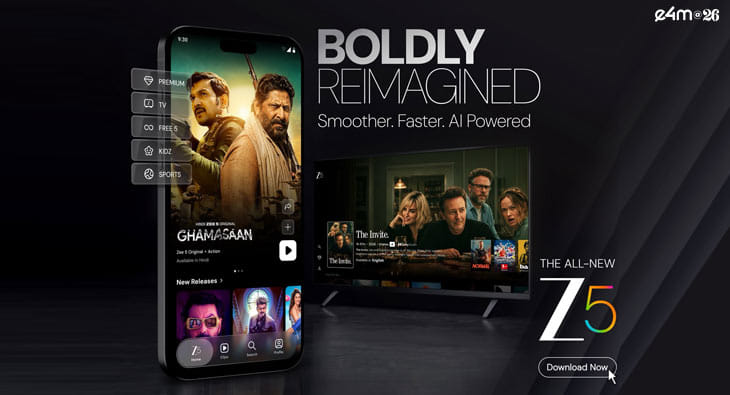

- India's streaming landscape is shifting from mobile-focused content consumption to a greater emphasis on Connected TV, as families increasingly use larger screens for shared viewing experiences.
- Zee 5 has undergone a significant redesign to enhance its Connected TV interface, prioritizing intuitive navigation and personalized content discovery tailored for diverse household audiences.
- The platform has introduced five distinct entertainment categories—Premium Entertainment, Free 5, KidZ, TV, and Sports—to cater to various viewing preferences within a single household, moving beyond a singular audience focus.
- With the expansion of its free entertainment offerings and a new slate of English content, Zee 5 aims to attract a broader audience and establish itself as a comprehensive entertainment destination for families across India.
For much of the last decade, India’s OTT battle has been fought on the smallest screen.
Apps were designed around the individual. Discovery meant scrolling on a phone. Content strategies chased increasingly specific audience cohorts. And the smartphone became the primary gateway to streaming.
But the next phase of India’s streaming story may increasingly play out on a much bigger screen.
Connected TV is moving rapidly from an affluent metro phenomenon to a broader Indian viewing behaviour. The living room is becoming digital, streaming is becoming more communal and the lines between television and OTT are steadily blurring.
It is in this context that Zee 5’s latest transformation becomes interesting.
At first glance, it is a major product overhaul. The platform has redesigned its experience across mobile and Connected TV, with smarter personalisation, AI-led discovery, richer visual navigation and a cleaner, faster interface.
Look a little closer, though, and the choices reveal a broader ambition.
Zee 5 appears to be designing itself not simply for the individual streamer, but for the entire household.
The Connected TV experience may be the bigger story
Much will naturally be said about the new mobile experience. But arguably, the more revealing part of Zee 5’s redesign is what it has done on Connected TV.
The new CTV interface feels deliberately built for the big screen rather than like a mobile product transferred onto television. Content artwork is larger and more immersive. Navigation is more visual and intuitive. Categories are easier to understand from a distance. Discovery requires fewer decisions. The experience has the scale and visual richness one expects from the largest screen in the house, while retaining the intelligence and personalisation consumers increasingly expect from digital platforms.
That distinction matters.
A mobile phone is usually a personal device. A television is not.
The TV in an Indian living room can belong to a seven-year-old watching cartoons in the afternoon, a parent catching up on a television show, a young adult watching an English film or Korean drama, and the entire family coming together later for a movie, entertainment show or major sporting event.
One screen. Multiple audiences. Completely different viewing needs.
That may explain many of the choices Zee 5 has made with the new product.
Instead of forcing all of that content into one endless catalogue, the platform has organised itself around five distinct entertainment universes: Premium Entertainment, Free 5, KidZ, TV and Sports.
On mobile, that makes discovery simpler. On Connected TV, it becomes even more powerful because it mirrors how households actually consume entertainment.
CTV is no longer just a metro story
The timing is significant.
India’s Connected TV market is expanding quickly, and its next phase of growth is increasingly relevant beyond the largest metros. Smart televisions, affordable broadband and streaming adoption are pushing connected viewing deeper into Tier 1 and Tier 2 towns, while free and ad-supported streaming is creating another entry point for households moving from traditional television towards digital viewing.
For streaming platforms, this changes the strategic equation.
The battle is no longer only for the app icon on the consumer’s phone. Increasingly, it is also for the first app a household opens when it switches on its television.
Zee 5 seems acutely aware of that shift.
Its investment in the Connected TV experience suggests that it wants to occupy a much larger share of the living room, across metros as well as the next wave of connected households in Tier 1 and Tier 2 markets.
And its content architecture makes sense in that context.
Premium content across seven languages. Rich television content. Kids’ entertainment. Sports. English films. Korean and Chinese dramas. Anime. Free entertainment. News and creators.
The breadth is designed less like a narrowly defined OTT service and more like a digital entertainment destination for a household.
Five universes, one household
Consider how differently members of the same family can use the platform.
One person could be watching a premium Hindi web series. Another could be catching up on a favourite television show. A younger viewer could enter KidZ for cartoons and animation. Someone else could discover Korean content or anime through Free 5. The English movie viewer now has a new slate of global cinema. And when there is a major sporting event, the same screen can become a shared family experience.
That is a very different proposition from building an OTT service around one content genre or one audience segment.
It also changes the value equation of a subscription.
The real question for streaming platforms may no longer be whether one individual finds enough to watch. It is whether enough people inside the same household find enough reasons to keep returning.
Seen through that lens, Zee 5’s five-universe architecture is not merely a design choice. It is a household strategy.
Free 5 changes the funnel
The completely reimagined Free 5 adds another dimension to that strategy.
Zee 5 is expanding it into a much broader free entertainment proposition spanning movies, series, Korean and Chinese dramas, anime, micro dramas, news and the creator ecosystem.
That gives the platform an entry point beyond subscription.
A consumer may come to Zee 5 without paying anything, discover content through Free 5 and gradually build a relationship with the wider platform.
On Connected TV, the opportunity becomes particularly interesting.
As connected screens penetrate deeper into India, free entertainment can become a powerful bridge between the familiarity of television and the choice of OTT.
For advertisers too, that creates a richer proposition, combining the impact of the largest screen in the house with the segmentation and addressability of digital.
Then comes English
Zee 5 is also adding a very different audience through its new English slate.
The platform is bringing global cinema and digital premieres featuring international talent including Bob Odenkirk, Seth Rogen, Penélope Cruz, Edward Norton, Angelina Jolie, Jude Law, Glen Powell, Scarlett Johansson and Adam Driver.
For a platform already built on premium content across seven Indian languages and rich television content, English cinema expands the reasons why another audience within the same household might open Zee 5.
Again, the household thesis starts to become clearer.
The objective is not necessarily for every member of a family to watch the same thing. It is for every member of the family to find something for themselves. And then, at other moments, to bring them together around the same screen.
From content aggregation to effortless discovery
Of course, breadth alone is not enough.
OTT platforms have spent years expanding their catalogues. The unintended consequence has often been choice overload. More content can sometimes mean more scrolling.
This is where Zee 5’s investment in AI, personalisation and visual discovery becomes important.
The platform says its redesign followed consumer research across both mobile and Connected TV, looking at how audiences discover, browse and engage with content.
The resulting experience appears focused on shortening the journey between opening the app and pressing play.
That sounds simple. In streaming, it is increasingly one of the hardest problems to solve.
If Zee 5 can make a catalogue this broad feel intuitive to a child, a television viewer, a premium OTT consumer and an English-film audience, it may have solved something more meaningful than interface design.
It may have made complexity feel simple.
A different kind of OTT battle
Zee 5 has already been building momentum.
From securing FIFA World Cup rights to launching its content slate across seven languages, the platform has been widening the scale of its entertainment proposition.
The redesigned app, new English slate and revamped Free 5 now bring those pieces into a clearer ecosystem.
And perhaps that is the larger significance of this update.
Streaming in India has spent years fragmenting audiences into genres, languages, demographics and individual viewing preferences.
Zee 5 is now attempting to bring many of those fragments back together inside one platform.
Not by expecting everybody to watch the same content, but by creating different entertainment worlds for different people inside the same household.
Mobile remains critical to that ambition.
But the significant investment in Connected TV suggests Zee 5 also knows where another important battle for Indian streaming is being fought.
In the living room.
If the new experience can turn Zee 5 into the app that one member of the family opens for a web series, another for television, another for English cinema, a child for cartoons and everyone together for sport or a family show, the platform could be redefining what value in OTT actually means.
Not one subscription for one viewer.
One entertainment ecosystem for the whole family.
Read more news about Industry Briefing, Internet Advertising, Marketing, PR & Corporate Communication, Television Media
For more updates, be socially connected with us onInstagram, LinkedIn, Twitter, Facebook YouTube & Google News