TikTok website accessible to some users in India, triggers comeback talk
The app, however, continues to remain unavailable on both Google Play Store and Apple’s App Store in the country
 by
by
Published: Aug 23, 2025 8:10 AM | 6 min read
 Follow Us

The sudden visibility of TikTok’s homepage in India has stirred speculation about the short-video platform’s possible return, though the app remains absent from both Google Play Store and Apple’s App Store. While some users reported being able to access the website, large sections remain non-functional, suggesting that no formal relaunch has taken place.
The company, however, has denied any possibilty of a comeback anytime soon.
"TikTok remains blocked in India, and we're following the government's instructions," said a company official in response to a query from e4m.
Government sources too have dismissed the speculation. “Government of India has not issued any unblocking order for TikTok. Any such statement/news is false and misleading," said a source from the governemnt.
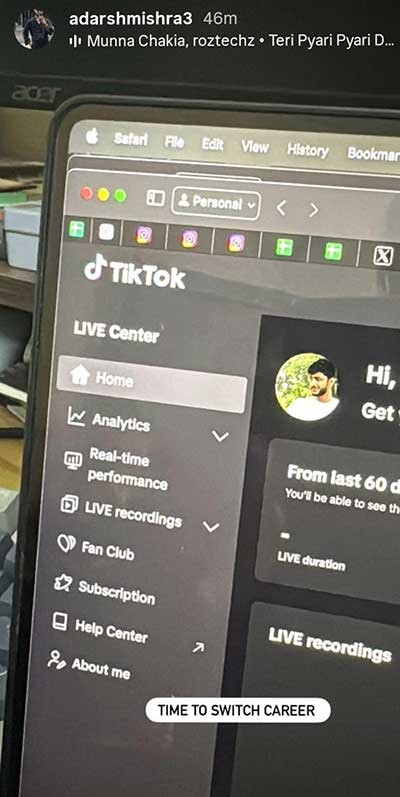
Social media chatter, meanwhile, reflects mixed experiences, with many on X saying they could open the site, while others found it still blocked. This partial availability has been enough to reignite hopes among TikTok fans and creators who once built massive followings on the platform before its abrupt ban.
TikTok was among 59 Chinese apps banned by India in June 2020 following the Galwan Valley clashes. At the time, the Ministry of Electronics and Information Technology cited national security and sovereignty concerns, calling the apps “prejudicial to sovereignty and integrity of India, defence of India, security of state and public order.”
The possibility of comeback alone has stirred the creator space, with many seeing it as a chance to reintroduce massive scale, especially in smaller markets, while also raising concerns about brand budget fragmentation. A comeback could bring fresh opportunities for new talent, generate employment, boost monetisation, and strengthen India’s cultural and narrative presence globally, but it may also force creators and brands to rethink their existing platform loyalties.
A Return Could Reshape the Ecosystem
Shweta Kaushal, Co-Founder at Creatorcult Media, said the buzz cannot be ignored, even if the government has denied any official reversal of the ban.
“The Indian creator ecosystem has matured rapidly since TikTok’s exit, with Instagram Reels and YouTube Shorts filling the gap,” Kaushal noted. “If TikTok returns, it will certainly expand the content economy by reintroducing massive scale, particularly in Tier 2 and Tier 3 markets where TikTok had deep penetration. Brands are better prepared today, with more structured influencer budgets and measurement tools, to leverage such a platform.”
Kaushal added that the effects would not be immediate. “Creators who built themselves on Reels and Shorts will weigh whether to diversify or stay loyal to existing ecosystems. For brands, too, fragmentation across platforms could pose challenges in resource allocation. The biggest upside is increased competition—this will drive innovation and potentially improve creator monetisation. The flip side is that earnings may spread thinner across platforms until TikTok can prove sustainable ROI for both creators and advertisers.”
It won’t just be another app re-launch
Adarsh Mishra, Founder of EmplaceHQ, a talent management and influencer marketing firm, believes TikTok’s return would be nothing short of transformational.
“If TikTok comes back to India, it won’t just be another app launch. It can really reshape how content is made and shared now,” he said. “I think we will see a change in influence, the reach will be bigger, and the content library will look very different and bigger. I also think TikTok is more mature now and hopefully we’ll see new talent rise, not just the same big names shifting from Instagram.”
Mishra argued that TikTok’s comeback would give newer creators a fair chance. “India is still led by one platform, and a comeback will actually give a chance to new creators as well, plus it will see new content and new influence. New people, new influence, more distribution—it’s going to be great. Looking at TikTok’s history, it won’t take most people a long time to reach a good number.”
It can create employment and show our potential
For Instagram creator Ruchika Lohia, who has over 1.2 million followers, TikTok’s possible revival is about more than just content—it’s about livelihoods.
“Even when it got banned, I felt bad for people who were making that much money and their whole living through TikTok, and it just got banned in a second. So I really feel good that it’s coming back again,” Lohia said. “And I feel that it has a huge potential in India because of the population. With social media and internet growing so much, TikTok’s gonna, you know, be a boon to our country.”
She also pointed out the economic potential. “At the end of the day, it is creating employment, indirectly making our country very rich and showing our true potential. If an app can bring money, then why not? So yes, I feel that it will generate more money and more employment. That means a richer country.”
India Needs TikTok for Global Relevance
YouTuber and agency founder Ayushman Pandita, who has 650,000 subscribers and runs GrowthRocket Media, stressed that India’s absence from TikTok had limited its voice on global narratives.
“This is definitely much needed, because apart from the geopolitical tension that India and China had in the past few years, there is a presence of the world’s biggest social media platform in every country. Especially a major country like India,” he said. “Most people globally, especially in western countries, consume short-form content and maximum of their social media content via TikTok. Instagram is actually a secondary platform when it comes to short-form videos.”
Pandita highlighted how India lost out in global perception battles. “When the India-Pakistan war was going on, a lot of Gen Z and Millennials globally were actually in support of Pakistan. That was because Pakistani creators and media were able to spread their side of the narrative on TikTok, while Indian creators had no platform there. Our competitor had a complete monopoly in controlling the narrative. That’s why a lot of people globally felt India was the one who did wrong.”
For Pandita, TikTok’s return would mean more than just reach. “Now Indian creators will have a completely new algorithm and a platform to play with. A new demographic of creators will benefit, and global brands like Nvidia or OpenAI will also find Indian creators more appealing. This is going to be a major opportunity not just for content but also for India’s cultural and political presence on the world stage.”
For now, TikTok remains officially banned in India, and the government insists no change has been made to that stance. Yet, the mere reappearance of its homepage has been enough to spark intense debate among creators, brands, and industry insiders about what a return could mean. Whether TikTok makes a formal comeback or not, the discussions underscore how deeply the app once shaped—and could again shape—India’s digital content economy.
Read more news about Digital Media, Internet Advertising, Marketing News, Television Media, Radio Media
For more updates, be socially connected with us onInstagram, LinkedIn, Twitter, Facebook, YouTube & Google News