TechManch 2025: How AI, teams and mindsets shape the MarTech roadmap
Marketing and technology leaders came together to explore how the rapid adoption of MarTech is transforming performance marketing through personalisation, automation, and AI-driven decision-making
 by
by
Published: Jul 21, 2025 2:01 PM | 11 min read
 Follow Us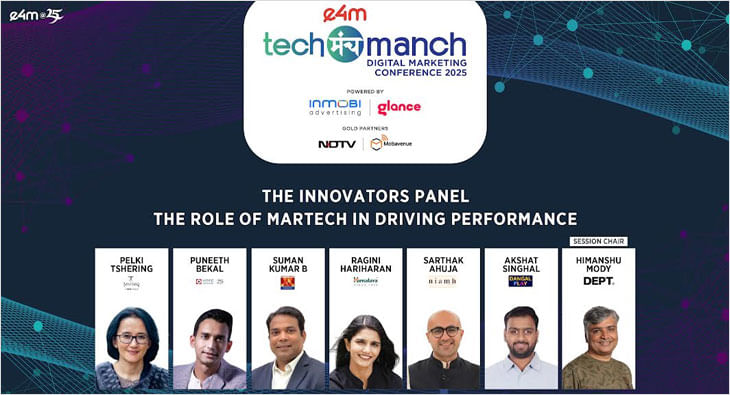

A panel of senior marketers discussed how emerging marketing technologies, from customer data platforms to predictive analytics, are helping brands craft smarter and more scalable campaigns at the e4m TechMach 2025.
The session was chaired by Himanshu Mody, Partner & Head at DEPT India, and featured Puneeth Bekal, EVP and CMO, HDFC Securities; Suman Kumar B, Chief Sales & Marketing Officer, Hindalco Speciality Alumina Business; Ragini Hariharan, Head of Marketing, Himalaya Wellness Company; Sarthak Ahuja, Director, Niamh Ventures; and Akshat Singhal, Head, Dangal Play.
Opening the discussion, Mody said, “To set the context, in a diverse country like India, with different languages, different personas, and different kinds of intelligence, MarTech becomes the most important thing for brands to solve.”
He added that personalisation is now central to performance marketing. “Earlier, it was not possible to deliver that kind of personalisation, but tech has now made it possible and brands are aiming for that holy grail of one-to-one personalisation.”
Remarking on how AI is fundamentally reshaping marketing, he invited the panellists to share their thoughts about the same.
Ahuja observed that many brands are already handing over performance responsibilities to AI. “Meta AI is running performance for everyone and trying to get you the highest ROI,” he said. “There are AI tools optimising your marketing collateral and design collateral for you.”
He added that businesses winning today are those already using these tools, but noted that integration is becoming more top-down. “More of these tools are being implemented not because the user wants to use them, but because the company has decided to implement them, through platforms like Google or Microsoft that you already use.”
Ahuja also stressed the importance of proprietary data and human creativity. “What’s going to be important is the first-party data you have, that’s what will create the edge. And secondly, when everyone uses AI, what becomes all the more relevant is the taste of the person using it.”
Responding to a question on operating in a regulated industry, Bekal said, “My team and I are having the most exciting time exploring AI, right from deep research to implementation.”
He shared how AI is helping map entire strategies. “Today, you can build an entire marketing strategy for a product using a suite of tools, from understanding consumer pain points, market gaps, and competitor strengths, to defining the messaging,” he explained. “That’s just the top of the funnel. We can optimise the full funnel using AI.”
He said their advantage lies in their research-driven approach. “With 25 years of expertise, we’ve built our proposition around a strong research team that does the hard work. The investment decision is still up to the customer.”
He shared a specific innovation. “We’ve created a digital avatar of all our research analysts. Instead of bringing a research analyst to a studio, getting hair and makeup done, and then shooting a video, now they just give us a script. We make it conversational, send it back for sign-off, and in half an hour, the video is ready.”
“It’s a proprietary informational tool we’ve scaled using AI,” he added.
Next in the panel, Hariharan weighed in on the risks and rewards of AI in FMCG marketing, a less-regulated space. “The most exciting part is that AI is helping us reduce the distance between insight and action,” she said. “Earlier, it would take a long time to validate insights, conduct concept and communication tests, and then launch. Now, AI brings efficiency throughout this journey.”
She emphasised the role of creative optimisation. “Everyone’s become a creative person today, thanks to how far AI has come. While we’re not using it for the final consumer-facing creatives, we are using it to turn around outputs quickly, test them, learn, and try again. That’s what makes the creative process so interesting now.”
She added that AI also has a strong role in media planning. “If we can predict what media channels will meet which objectives, we can reduce a lot of media wastage. Currently, we put things out, see if they work, and then adjust. With AI, we can make those decisions earlier.”
However, Hariharan also flagged key concerns. “AI is only as good as the data that feeds into it. Right now, data isn’t pristine. You may end up misreading it, or worse, doing unethical work. That’s the biggest fear until we have clarity around data quality.”
She agreed with the importance of first-party data. “You need to check if external AI insights align with your internal data. There’s so much hallucination in today’s AI tools.”
As the conversation progressed, the panellists explored how they were approaching their MarTech infrastructure, particularly in the context of scale, regulation, and business model complexity.
Mody invited Kumar to elaborate on his approach to building a MarTech ecosystem for the B2B sector. “These days, we’re talking a lot about data and decisions based on data. Technology is giving us data, and AI is helping us make decisions,” said Kumar. “The best decisions come when data meets human intelligence.”
He highlighted the role of CRM and CDP platforms. “CRM is a very critical tool. But more relevant in my business context is the CDP, i.e. the customer data platform,” he said. “In B2C, you work with one mind and one heart. In B2B, where the customers are big and decision-making is time-consuming, you end up working with many minds. CDPs help a lot there.”
Kumar noted that his team uses technology to understand the behaviours of different decision-makers. “There are platforms where we talk about IoT, and we also have something called IOB—the Internet of Behaviours. You can study the behaviours of different decision-makers, process that data, and take some very optimal decisions.”
Singhal offered a leaner perspective. “We don’t have a huge MarTech stack,” he said. “We just use MoEngage for our notifications, and we rely a lot on YouTube Studio.”
He shared that Dangal TV’s YouTube channel recently crossed 50 million subscribers, giving the team a rich dataset to work with. “The amount of data we get is amazing, from real-time user feedback and comments to watch time and drop-off points,” he explained. “We can track when a specific character enters, whether engagement spikes or declines. YouTube Studio has been a great MarTech platform for us.”
Addressing concerns around data sharing within regulated environments, Bekal clarified, “As per compliance, you’re not supposed to share data among companies, so that doesn’t happen.”
However, he noted that outreach is still possible through compliant channels. “If there are certain cohorts in a company that we feel could be our audience, we reach out like any other third-party vendor. Inter-group data sharing isn’t allowed as per open banking regulations.”
]Hariharan explained the decision-making process behind building versus buying MarTech tools. “Anywhere it’s about consumer data privacy or something tied to brand philosophy, we either build it or customise it,” she said. “But when it comes to efficiency, which includes content quality, media optimisation, CRM, there’s so much good tech available that we go after those solutions.”
She added, “No company, except probably some global giants, has the scale to build that level of sophistication internally. So, as long as we’re not compromising on privacy, we’re happy to use external tools.”
“We’re using AI tools to hear conversations happening around the world. It gives us a sense of where consumer intent is headed, not just where it is now,” she said. “With so many brands entering beauty and personal care, understanding the future journey of the consumer is crucial.”
The conversation then shifted to Ahuja, who brought in a unique perspective combining investment banking, content creation, and influencer marketing.
“When you look at a beautiful statue, would you really care whether it was handmade or 3D printed? What matters first is whether it’s beautiful.”
He drew a parallel with MarTech. “In our discussions, we sometimes give too much importance to the tools, rather than the person using them in novel and impactful ways.” He explained that in his investment banking practice, their focus when evaluating companies is on unique consumer insight. “Do they have insight that you can’t find anywhere else, not on Gemini or Perplexity, not even on deep research via Google?”
He emphasised that such insights come from real-world engagement. “That’s where the real edge lies. If you have that, implementing a tech stack is the easy part, you can catch up on that.”
He shared examples from content strategy. “Instagram came out with its own edits app. People might think they don’t need it because they use Adobe or other tools, but that edits app has a key tab on insights and data. It gives more performance metrics than the Instagram app itself.”
He added, “If you can optimise for a 4% shares-to-impression ratio on short-form video, it will go viral. Again, you won’t find that anywhere on Google. For us, it’s all about access to these kinds of insights, not the tool you use to arrive at them.”
As the discussion moved into its final segment, the focus turned to personalisation, scale, and the human side of digital transformation.
Referring to Dangal TV’s 50-million-subscriber milestone, Mody invited Singhal to elaborate on the role of personalisation and content localisation in driving growth.
He highlighted how platform-level innovations have accelerated that growth. “YouTube introduced many new AI-driven features like dynamic thumbnail selection,” he explained. “For each video, we can make three or four thumbnails, and each person sees one based on their preferences. YouTube knows exactly what they like.”
Singhal added that AI-enabled multilingual dubbing helped them scale their content rapidly. “We have over 2,000 episodes of Crime Alert now dubbed in four different languages. Manually, it would’ve taken forever. But with AI, we did it in a week, and new episodes are done within minutes.”
He summed up, “All these new AI features have really helped us grow.”
Kumar offered a human-centric view of digital adoption. “Any successful MarTech implementation comes down to three things: people, data, and the platform,” he said. “You may have the best technology, but it only works if people can adapt to it and use it well.”
He shared his personal journey of improving his own digital quotient. “I used to have a very pathetic DQ,” he admitted. “In January, I decided to go paperless. I was someone who would take printouts, read them in the car, come back and review them again. But I realised I had to change.”
He explained that his company has institutionalised the idea. “We have a concept called digital ambassadors. It’s a mix of Gen Z and others who inspire and educate teams so that technology, when implemented, actually leads to change.”
Without that, he cautioned, even the best tools won’t succeed.
In closing, Mody invited the panellists to reflect on the road ahead, particularly how team structures are evolving as MarTech integrates media, data, and content more tightly than ever before.
Singhal noted how team roles are being redefined. “Earlier, in the research team, many people were there just to extract data and make reports,” he said. “Now, we’re hiring people who can make decisions, because reports are being automated.”
He pointed out that while AI can summarise data, it still falls short of nuanced analysis. “That’s where human intervention is necessary. It’s not that the number of people is reducing—it’s the job profiles that are changing.”
Bekal reflected on the increasingly fluid nature of marketing functions. “It’s tough to define team structures right now because the ecosystem is evolving,” he said. “Just before this panel, I had a conversation with the content team and the performance team, and I realised the performance team can function without content.”
He questioned the relevance of traditional silos. “If the social team can do performance, then what does the brand team do? And with CDPs, analytics flows through the entire funnel, everyone can access insights.”
According to Bekal, the boundaries between sub-functions are blurring. “It’s too early to define watertight roles within marketing,” he said. “It ultimately depends on individuals. Those who have the right mindset and can connect the dots using today’s tools are the ones who’ll drive the future.”
Read more news about Digital Media, Internet Advertising, Marketing News, Television Media, Radio Media
For more updates, be socially connected with us onInstagram, LinkedIn, Twitter, Facebook, YouTube & Google News