e4m TechManch 2025: AI’s role in shaping smarter commerce beyond search
At e4m TechManch 2025, marketers and brand leaders explored how AI is redefining the commerce journey, from reactive search to intuitive, inspiration-led discovery
 by
by
Published: Jul 21, 2025 1:20 PM | 11 min read
 Follow Us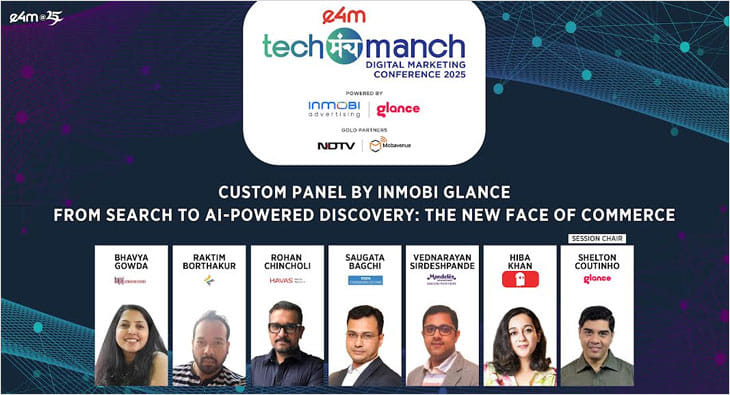

At the e4m TechManch Digital Marketing Conference 2025, brand leaders and marketers explored how AI is transforming the digital commerce journey, from passive search to proactive discovery. The session, presented by Glance, unpacked how brands, agencies and platforms are navigating this shift, leveraging data and AI to drive engagement and conversion.
The panel featured Bhavya Gowda, Deputy Marketing Manager, Bajaj Consumer Care; Hiba Khan, Vice President Marketing, The Souled Store; Raktim Borthakur, AVP, Starcom; Rohan Chincholi, Chief Digital Officer, Havas Media; Saugata Bagchi, Global Head - Digital, Experiential & Content Marketing, Tata Communications; and Vednarayan Sirdeshpande, Director Ecommerce Marketing & Consumer Data, Mondelez International. The session was chaired by Shelton Coutinho, Director of Sales & Business Development, Glance.
Opening the discussion, Coutinho noted the fundamental change in consumer behaviour. “Earlier it was search-led. Now it’s more discovery-led. People want to be inspired,” he said, adding that AI is increasingly embedded in open ecosystems outside of traditional walled gardens. He asked panellists to reflect on this shift and share what excites them most about it.
Chincholi highlighted how the starting point of intent has changed. “Earlier, ads would prompt users to search for a keyword, assuming that search was the beginning of the journey. But today, brands are reaching consumers on platforms of their choice,” he explained.
He pointed to short-form video consumption and influencer marketing as examples where data and science converge to create hyper-relevant experiences. “There are two algorithms at play. One is the public algorithm, like seeing lots of Superman posts if a new film releases. The other is personal, based on what I’m currently exploring, say furniture or Superman merchandise.”
Borthakur clarified that search and AI are not mutually exclusive. “They’re not married, but they’re not divorced either,” he remarked. He noted that around 30% of global search queries now return AI-generated summaries, with that number expected to rise to 70% in the next two years.
He outlined three stakeholders in the journey, the user, the platform, and the advertiser, and pointed to a growing trust in AI agents. “In India, nearly 60% of people trust AI with personal data, like sharing income, expenses, investment goals. AI is not only recommending tools but also designing entire financial plans,” he said.
Adding to the conversation, Bagchi spoke about proactive discovery. “It’s essentially a prediction-based suggestion,” he said. By combining demographic and intent data, marketers can significantly shorten purchase cycles. “Depending on the category, the role of marketing will shift from a support function to an active line of business,” he noted.
Sirdeshpande urged the audience to test AI tools for themselves. “Search for the same topic using different AI platforms like OpenAI or Gemini, and compare the responses with a traditional search engine. You’ll be surprised how provocative AI recommendations can be,” he said.
He reiterated the role of the three key players, i.e. user, platform and advertiser, and outlined how the user journey has shifted. “Earlier it was search, discovery, browse, shop. Now it’s more like discover, browse, shop. AI replaces one element based on intent and context.”
He explained how AI reduces the cognitive load on consumers by aggregating data such as past behaviour, location and trends. “It’s using its own brain to serve up something relevant, reducing the need for consumers to sift through clutter,” he said.
Continuing the discussion, Coutinho turned to Gowda, highlighting how shopping decisions in her category have traditionally been personal and sensory. He asked how the brand is adapting to AI-led discovery while maintaining relevance and emotional connection.
Gowda noted that the hair oil category is inherently personal and experience-driven. “It’s very important for us to be engaging and personal, and AI is helping us do that,” she said.
Traditionally, customers would seek recommendations from their mother or grandmother, and the brand is now using AI to recreate those moments in a visual and relatable manner.
“If I keep one message for all of India, people won’t relate to it,” she explained. “Rather, I use AI to recreate those moments in a more personal and visual way.” She cited a recent campaign that linked weather and AQI data to hair quality concerns. “Wherever the AQI worsened or the temperature crossed 35 degrees, we showed consumers a message saying, ‘Why don’t you check your hair quality and see how the weather is impacting you?’”
This contextual approach made the messaging both personal and impactful. The brand also drove users to quick commerce platforms, generating valuable last-mile data. “We got good results,” she said. “I think we should move away from selling to guiding and inspiring customers using AI.”
Picking up on the theme of inspiration-led commerce, Coutinho turned to Khan of The Souled Store. “Inspiration-first commerce is particularly relevant for you,” he said, noting the brand’s focus on pop culture as personal expression. He asked how AI could be used to inspire discovery and drive customer action.
“In the context of search, we use AI across the funnel, from creative development to ad targeting,” Khan said. But she emphasised that for a D2C brand like The Souled Store, discoverability is critical. “We have around 8,000 products. While many customers associate us with pop culture, more than 50% of our revenue actually comes from non-merchandise products.”
This makes it crucial to connect the right product to the right person. “Search is not just what you type in the bar. It’s also about the results, how they’re ordered, what shows up first. Nobody scrolls anymore,” she said. “Scroll depth is limited, and we can’t show a thousand products with infinite filters. That increases the customer’s cognitive load.”
AI, she said, helps streamline this process. “Internally we call it ‘sort order’, how products appear on the page you land on. That’s driven by AI now.” As an example, she pointed out that India’s climate varies regionally. “Winter doesn’t hit every part of India at once. I’d want to show more full sleeves or sweaters in colder regions.”
She then addressed the shift in search behaviour itself. “People aren’t searching for a black T-shirt anymore. They’re searching for party outfits or ‘what to wear in Goa’. AI needs to understand those contextual searches.”
Referencing earlier internet behaviours, she added, “There was a time we had to type plus-plus or use quotes on Google. Gen Z isn’t doing that. They talk to tech like they talk to a friend, asking financial advice or uploading a photo to get outfit suggestions.”
She concluded by pointing to emerging conversational AI interfaces. “Nobody wants to talk to a brand. People want to talk to people. Amazon launched Rufus, we’re thinking of doing something similar. It’s evolving, and every six months it becomes twice as smart. That’s the journey we’re on.”
Turning to the role of emotional storytelling in commerce, Coutinho posed a question to Sirdeshpande. “With Mondelez, you’ve been building strong brands with emotional connection over the years. What role do you think AI will play now in deepening this love with your customers?”
Sirdeshpande broke his response into two parts: AI in commerce and AI in creativity. “I think we've been successful in terms of leveraging AI because we're at least trying to understand what it can deliver,” he said. “AI is really good at understanding patterns, large data sets, crunching data fast and reproducing outputs quickly.”
However, he added, the human layer remains critical. “What AI doesn’t yet do well is nuance and emotion. The technology is still evolving. Many times, what it produces might not be the right output. It may not fully understand cultural contexts or sensitivities. That’s why we try to marry both: the power of AI for scale and speed, with human insight for emotion.”
He cited examples from recent campaigns. “‘Silk – The Story of Us’ used AI to create half a million unique videos. That kind of scale wouldn’t have been possible with a production house.”
On the commerce front, he acknowledged that Mondelez was still in a test-and-learn phase. “The role of AI here is still evolving and somewhat limited for us. But we are using it in how we deploy search and display campaigns, that’s where we see immediate use cases.”
Coutinho then turned to Chincholi, asking how AI is shaping the way brands deliver content that’s not only personalised and timely, but also trustworthy.
Chincholi was clear: “AI is not just a trend, it’s a responsibility multiplier.” For him and his peers in the agency world, AI is about enabling smarter, more efficient work. “Whether it’s automating minutes of meetings, building dashboards or interpreting platforms’ algorithms.”
He highlighted a guiding principle at Havas: meaningful AI. “Three things matter. First, we’re focused. Activation must be purposeful. Second, we’re tool-agnostic. We don’t prioritise one AI solution over another. We choose based on what fits best within data governance frameworks. And third is responsibility. We make sure clients are fully informed when AI is being used.”
Chincholi also addressed the infrastructure challenges brands face. “Today, data sits across ten dashboards, GA, Facebook, GWI, SimilarWeb, and so on. We’ve built a tool that consolidates these. It brings together first- and third-party data in one place. Once you identify the right cohort, you can push that directly to your execution platforms.”
This, he explained, has transformed how they think, plan and deliver campaigns. “We take ownership. We’re not just execution partners anymore, we co-own the outcomes.”
Coutinho turned to Tata Communications’ Bagchi with a broader question: how can AI create seamless and personalised brand experiences across platforms, from omnichannel to TV?
Bagchi responded by framing the answer beyond just B2B or B2C. “Let me try and create a middle path and talk about the customer as an individual,” he said. “Whether it’s a walled garden interaction or an open one, the customer leaves digital footprints behind.”
Over the past year and a half, his team has explored this extensively. “To create an omnichannel experience that is meaningful, relevant and contextual, agentic AI is emerging as the way forward,” he explained. “These agents, built on LLMs, can deliver specific workflows. But increasingly, ecosystems of AI agents are forming, by design and organically, which can talk to each other.”
Bagchi gave a practical analogy: “Earlier, if you called a bank and got transferred, you had to start over each time. Now, with smart contact centres, your history and transaction data is visible to the agent, so the conversation can pick up where it left off. That’s the shift AI enables.”
Bringing in the agency lens, Borthakur added, “AI today is everywhere. But the culture within your agency must be AI-focused. That’s a step we’ve taken very strongly, training our people to become more AI-forward in day-to-day work.”
He stressed the importance of transparency. “Whether it’s using generative AI for copy or visuals, it must be married with predictive analytics. When managing a large product portfolio, ecosystem-integrated AI helps immensely.”
He emphasised that predictive analysis can identify high-performing SKUs before campaigns even begin. “People managing accounts don’t always think that way, but if you train them, the entire ecosystem becomes AI-led.”
Her concluding point: “Tools are easy to get. Everyone will have them. But it’s culture that drives meaningful AI adoption. That’s what makes a real, end-to-end difference.”
Read more news about Digital Media, Internet Advertising, Marketing News, Television Media, Radio Media
For more updates, be socially connected with us onInstagram, LinkedIn, Twitter, Facebook, YouTube & Google News