e4m TechManch 2025: Precision, empathy, and the future of CX
At e4m TechManch 2025, CX leaders across telecom, retail, pharma, and tech explored how AI, data, and design are redefining omnichannel engagement
 by
by
Published: Jul 21, 2025 1:32 PM | 11 min read
 Follow Us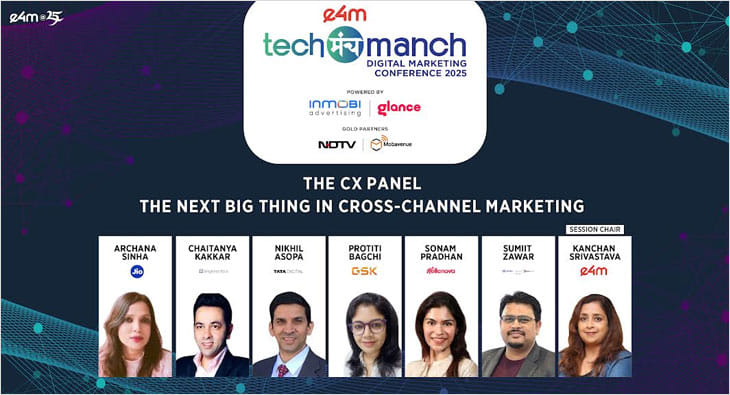

What does the future of customer experience look like when data, design, and technology intertwine?
That was the central question explored by a powerhouse CX panel at e4m TechManch 2025, where leaders from across industries came together to map the evolving customer journey. The discussion moved beyond surface trends, diving into how AI, hyper-personalisation, regionalisation, and automation are reshaping cross-channel engagement, from discovery to retention.
Featured on the panel were Archana Sinha, Lead – Customer Experience, Jio Home Business, Reliance Jio Infocom; Chaitanya Kakkar, VP, New Business Development, Single Interface; Nikhil Asopa, SVP & Head – Customer Service, Tata Digital; Protiti Bagchi, Associate Director – Global Lead for Content & Marketing Excellence, Digital Transformation, GSK; Sonam Pradhan, Head – Media & Digital Marketing, Kellanova; and Sumiit Zawar, VP Marketing, Route Mobile. The session was chaired by Kanchan Srivastava, Senior Editor & Group Editorial Evangelist, exchange4media Group.
Kicking off the conversation, Sinha spoke about her work at Reliance Jio, noting the challenge of ensuring consistent customer experience across India’s billion micro-markets. “It’s a big responsibility to deliver a standardised experience that still aligns with how the customer wants to move,” she said.
She shared that Jio’s customer framework is built on three powerful moves. The first is real-time responsiveness. She illustrated this with an example: “Imagine you’re watching a movie and the internet goes off. You check the MyJio app, and it shows everything’s fine. That gap in real-time insight breaks the customer’s trust. If information isn’t real-time, the service loses its meaning.”
The second pillar is standardisation across all channels, be it digital, voice, or field support. “We’ve ensured that the language and experience remain consistent across platforms. Our 20 different performance systems are integrated into a single Jio data lake, enabling real-time performance reporting,” she explained.
Sinha then spoke about the need for local customisation. “Even if your digital experience is perfect, it won’t work if it doesn’t reflect regional nuances. We found that 20% of customers weren’t using digital channels simply because they couldn’t understand the language. Senior citizens, for example, prefer regional languages. So we’ve integrated that into our framework,” she said.
The third focus area is proactivity, i.e. solving problems before customers report them. “We’ve moved from AI to ambient AI to understand customer moods and context. Say you’re on a Zoom call and the internet drops. Our system detects it, generates an auto-ticket, and assigns an engineer before the customer even responds,” she explained.
Adding to the conversation, Kakkar highlighted the issue of fragmented customer data. “There are around 16.5 billion searches happening daily, and 90% are unbranded. While brands aim for an omnichannel journey, the real challenge is achieving a unified, personalised experience,” he said.
He cited a use case where a customer tried to contact a store after finding it on Google but received no response, only to discover the store was shut. “Brands may have the right website or payment method, but do they have a hyperlocal view of what’s happening? Every customer is a new data point. Our platform works to bridge these gaps, ensuring accurate, unified information across search, social, and microsites,” he added.
Asopa addressed the challenge of delivering a unified experience across Tata Digital’s diverse verticals. “Tata Neu spans everything from groceries to Air India. The way to handle that is to attend sessions like these, learn from others, and apply those lessons. It works,” he said.
He broke the strategy into two parts: common core elements like empathy, accountability, and customer centricity, and category-specific experiences. “Whether it’s a ₹100 grocery item or a ₹50,000 Taj hotel stay, core values remain the same. But category dictates the delivery. Medicine delivery, for example, is urgent and time-sensitive, while jewellery purchases have completely different expectations,” he explained.
He also outlined how automation is handled internally. “We automate journeys based on category. Bots work for some use cases, but when critical things like medicine deliveries are delayed, only a human touch can address the urgency. It’s not a one-time setup, we constantly monitor feedback and adjust the level of automation accordingly,” he said.
As the conversation turned to the intersection of customer experience and compliance, Bagchi shared how the pharmaceutical industry navigates this delicate balance.
She broke the discussion into two parts: customer experience, which she sees as universal across sectors, and compliance, which is more nuanced in regulated environments. “Customer experience is not about a one-time interaction. It’s a sum of all interactions that shape your product, your service, and how the customer connects with your brand,” she said.
In the context of pharma, Bagchi outlined three core pillars for delivering exceptional CX.
“First is building trust. Our products impact people’s lives. It’s often life or death. Our customers are doctors, often seen as next to God. So, we have a responsibility to provide valuable, relevant, and timely content that supports their decision-making.”
She then spoke about the importance of real-time personalisation in a fast-evolving scientific ecosystem. “Every day there’s new research, new clinical trials, and a flood of misinformation. Relevance, speed, and precision are crucial.”
Her third pillar focused on data-driven optimisation. “Any campaign you run must be continuously optimised based on historical data, insights, and what truly matters to your customers. If done right, CX becomes a true market differentiator.”
On the compliance front, Bagchi stressed its vital role in preserving both reputation and integrity. “I have immense respect for our legal and compliance teams. They set the guardrails, especially for that one-in-a-million scenario that could go wrong. In pharma, lawsuits don’t just cost money. They impact brand credibility.”
She outlined four key strategies for balancing innovation with compliance. Know your frameworks inside and out, communicate with transparency, foster a culture where risks are openly raised, and adopt proactive monitoring through regular audits and documentation.
“Compliance is everyone’s job,” she concluded. “It’s all about balance, between communication and caution.”
When asked how cross-channel insights are used to drive habitual digital engagement, Kellanova’s Pradhan brought a fresh perspective.
“I think I’ve got one of the most interesting categories,” she smiled, before engaging the audience in a live thought experiment. “Close your eyes for a second. Imagine a bowl of Pringles on the table while you're listening to this panel. You're not hungry, but that thought just made you want to munch, right?”
“That,” she continued, “is what we aim for in snacking. It's not about hunger, it’s about emotion.”
She explained that the snacking category thrives on being relevant in the right moment. “Whether it’s during a sports match, a midnight scroll through reels, or an impulsive grocery run, we have to be there, at the right time, in the right space.”
Pradhan also pointed to the problem of decision fatigue. “Today’s consumer is overwhelmed with choices. The toughest thing isn’t choosing between brands. It’s making a choice at all. So, our job is to reduce the mental load.”
Her formula? Be relevant. Trigger the right emotion. And make decisions easier for the consumer.
Next on the panel, Zawar reflected on how conversational messaging has evolved into a central driver of customer experience.
“At Route Mobile, we help brands engage with customers on the right platform, at the right time,” he began. “From one-way SMS and email to two-way rich messaging, voice, and chat. We enable it all.”
He highlighted how the shift to conversational commerce has changed consumer behaviour. “We’re no longer browsing apps or websites to discover things. We’re chatting with brands.” He recalled how complaint-driven engagement on platforms like Twitter has given way to ongoing, contextual conversations. “Brands now live in your message inbox. They’re talking to you about what’s next, not just reacting to problems.”
AI plays a crucial role here, Zawar said. “Data from multiple sources feeds into AI models, making conversations more context-aware. We’ve moved from multichannel to true omnichannel. The customer’s Eureka moment can happen anywhere, on Instagram, a highway hoarding, or a WhatsApp message.”
Zawar stressed the need for immediacy. “Nobody wants to go through three interfaces anymore. If I want something, I just say, ‘Hey, can you send me this?’ That’s the expectation now.” He illustrated how brands are adapting: “Mumbai Metro lets you buy tickets directly on WhatsApp. Tanishq sends personalised suggestions and lets you checkout from chat. Everything from search and payment to cart is within one conversation.”
He added, “We’re evolving from support into deeply personal brand conversations. And that’s where the future lies.”
As the session drew to a close, the spotlight shifted to metrics, loyalty and the long-term view of CX in an AI-first, fast-moving ecosystem.
Addressing what really matters when every touchpoint is digital, Sinha shared a forward-looking perspective grounded in real-world experimentation at Reliance Jio.
“It's not going to be an overhaul. It’s a progression,” she said. “For long, we’ve focused on transaction closure time, VOC scores and resolution speed. But going forward, it’s about emotional intelligence in real time.”
She outlined a scenario where AI gauges the customer’s tone on a call and automatically routes them to an advisor high in empathy. “We’re experimenting with that internally. It's not about instant resolution. It’s about de-escalating frustration and offering comfort,” she explained.
Sinha also spoke about predictive personalisation powered by behavioural patterns. “If a customer’s broadband usage is spiking, we should be able to proactively nudge them towards a better plan, without them asking,” she said. “It’s not about privacy breaches, it's about using data responsibly to improve service.”
Kakkar addressed the fragmentation challenge. “Data is available. But usability is the real hurdle,” he said, referring to the siloed nature of media, CRM and retail teams. “Each team has its own KPIs, and unless you bring them onto a unified view, it’s not actionable.”
He pointed to their own product, HyperX.ai, as an example of intelligent data use. “It transcribes calls, analyses sentiment and surfaces behavioural insights. Imagine knowing after a call that this customer may purchase a car in six months, that’s the future.”
On loyalty in a super app world, Asopa offered a pragmatic view. “Points and offers still matter. Look at Singles Day, Black Friday, Tata Neu’s reward leagues. Discounts are the magnet but retention is the key.”
He pointed to Taj Hotels as a case in point. “You spend ₹50,000, you earn 6,000 NeuCoins. If you can use those coins seamlessly across categories, that's value. But if the app fails to deliver a good experience, those points are meaningless.”
“Good CX isn’t just pre-purchase or checkout. It’s across the journey. Even Tata IPL tickets given through the app are a form of experience. It all adds up,” he said.
Bagchi circled back to the pharma perspective, urging the audience not to lose sight of accuracy in the race for speed. “In healthcare, you don’t just have to be real time. You have to be right,” she stated. “The impact on lives makes it non-negotiable.” She emphasised audience understanding as the first step, especially HCPs and patients, and content design as the next. “Is your content snackable, interactive, easy to search? Can it be understood by a layperson?”
In conclusion, she said, “Pharma content can be dry. But if you can simplify it, tell a story, and make it relatable, then patients understand their options better. That’s what builds trust, and loyalty.”
Read more news about Digital Media, Internet Advertising, Marketing News, Television Media, Radio Media
For more updates, be socially connected with us onInstagram, LinkedIn, Twitter, Facebook, YouTube & Google News