Gemini gets ‘Personal Intelligence’, can access information from Gmail, drive
The aim of Personal Intelligence is to increase relevance and make conversations more personalised by pulling in details scattered across a user's accounts
 by
by
Published: Jan 17, 2026 11:53 AM | 4 min read
 Follow Us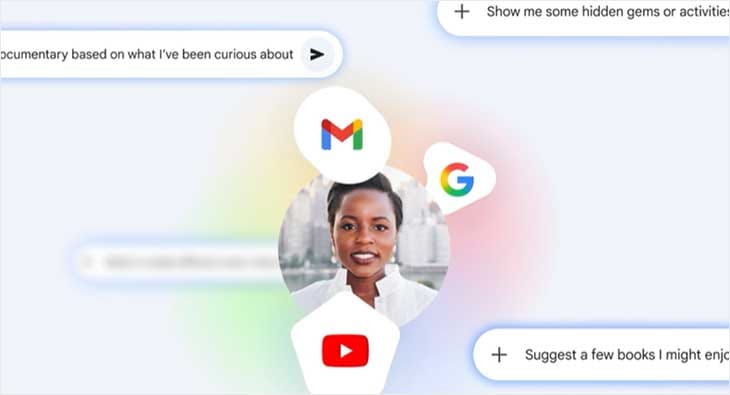

Google has introduced Personal Intelligence, a beta, opt-in feature for Gemini AI which allows the system to draw on users' personal data from connected Google services like, Gmail, Google Photos, YouTube history, and Search activity to deliver more contextual responses.
The aim of Personal Intelligence is to increase relevance and make conversations more personalised by pulling in details scattered across a user's accounts. For example, it might reference past emails for travel plans, photos for visual context, or viewing habits for suggestions.
Josh Woodward, VP, Google Labs, Gemini & AI Studio, via a blog post and video shared around the launch, described a real-world scenario from his own experience: while waiting in line at a tire shop to replace tires on his 2019 Honda Minivan, he realized he didn't remember the exact tire size. He asked Gemini, which not only retrieved the specs but went further, suggesting options like all-weather tires by referencing family road trip photos from Google Photos. . It also pulled his license plate number from a photo and identified the vehicle's specific trim level from Gmail records, helping him complete the transaction without leaving the line. LLLLLLLLLLLLL
Gemini gets ‘Personal Intelligence’, can access information from Gmail, drive Google has introduced Personal Intelligence, a beta, opt-in feature for Gemini AI which allows the system to draw on users' personal data from connected Google services like, Gmail, Google Photos, YouTube history, and Search activity to deliver more contextual responses. The aim of Personal Intelligence is to increase relevance and make conversations more personalised by pulling in details scattered across a user's accounts. For example, it might reference past emails for travel plans, photos for visual context, or viewing habits for suggestions. Josh Woodward, VP, Google Labs, Gemini & AI Studio, via a blog post and video shared around the launch, described a real-world scenario from his own experience: while waiting in line at a tire shop to replace tires on his 2019 Honda Minivan, he realized he didn't remember the exact tire size. He asked Gemini, which not only retrieved the specs but went further, suggesting options like all-weather tires by referencing family road trip photos from Google Photos. . It also pulled his license plate number from a photo and identified the vehicle's specific trim level from Gmail records, helping him complete the transaction without leaving the line. https://x.com/joshwoodward/status/2011471375521710130?s=20 “Our goal is to improve your experience while keeping your data secure and under your control.” Google has stated that Personal Intelligence is optional and can be switched on or off by users, with controls over which services Gemini can access. The company has also said that personal content used by Gemini is not meant for training its general AI models. As features like this become more common, they show how AI assistants are increasingly acting as extensions of users' own knowledge and memories, pulling together pieces of personal information to handle routine tasks more fluidly. In tying AI directly into services people already use to communicate, store and remember things, companies are trying to make AI more useful - and harder to disentangle from daily digital life.
https://x.com/joshwoodward/status/2011471375521710130?s=20
“Our goal is to improve your experience while keeping your data secure and under your control.” Google has stated that Personal Intelligence is optional and can be switched on or off by users, with controls over which services Gemini can access. The company has also said that personal content used by Gemini is not meant for training its general AI models.
As features like this become more common, they show how AI assistants are increasingly acting as extensions of users' own knowledge and memories, pulling together pieces of personal information to handle routine tasks more fluidly. In tying AI directly into services people already use to communicate, store and remember things, companies are trying to make AI more useful - and harder to disentangle from daily digital life.
Read more news about Digital Media, Internet Advertising, Marketing News, Television Media, Radio Media
For more updates, be socially connected with us onInstagram, LinkedIn, Twitter, Facebook, YouTube & Google News