e4m Confluence 2025: Experts decode AI, future of contextual storytelling and more
At the e4m Confluence 2025, media leaders decoded how brands can balance creativity, context, and authenticity to stay relevant in an age overflowing with content
 by
by
Published: Nov 12, 2025 2:51 PM | 6 min read
 Follow Us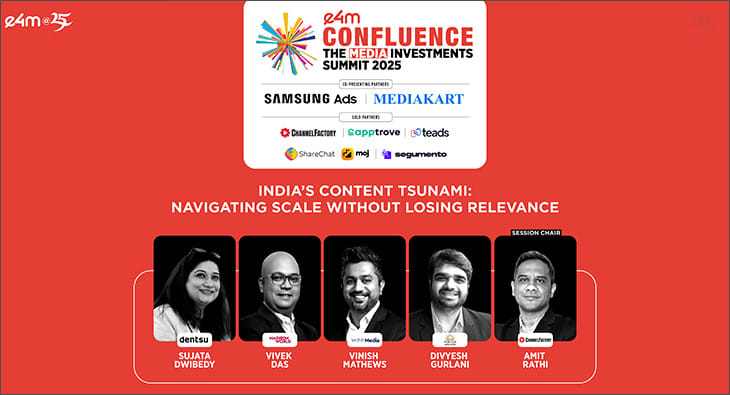

India today stands at the epicenter of a content explosion. With OTT platforms mushrooming, short-form videos dominating screens, and regional creators commanding massive digital audiences, the country is witnessing what experts aptly call a content tsunami. But amid this unprecedented scale, the challenge confronting brands is both urgent and complex. How do you stay contextually relevant and culturally resonant when impressions multiply faster than trust?
At the e4m Confluence 2025, an insightful panel titled “India’s Content Tsunami: Navigating Scale Without Losing Relevance” brought together some of India’s most influential media leaders – Sujata Dwibedy, CEO, dentsu X India; Vivek Das, Chief Digital Officer, Madison Media; Vinish Mathews, Head Team Fulcrum, South Asia, WPP Media; and Divyesh Gurlani, Senior Vice President & Business Head APEX India, Publicis Groupe India. The session was chaired by Amit Rathi, Managing Director India, Channel Factory.
The Tsunami of Content and the Quest for Authenticity
Opening the discussion, session chair Amit Rathi set the tone by painting a vivid picture of India’s digital landscape. “Every scroll, every stream, every creator is shaping the next second of someone’s attention,” he said. But in a world where “the content never stops,” he asked, “what really cuts through? Is it creativity, consistency, or context?”
Responding to that, Sujata Dwibedy emphasized that brands today can’t afford to stand apart from the creator ecosystem they must dive right in. “Because creator content is becoming so dominant today, we have to take part in it,” she said. “At Dentsu, we treat the creator economy as part of our media strategy itself, not as a one-off campaign. We co-create, we script partially, but we always leave space for the creator’s own storytelling.” For Dwibedy, authenticity is born from collaboration, not control. “Audiences today relate to authenticity. They find it beyond advertising it’s the resonance of someone like them using a product,” she added, highlighting how creators humanize brands in ways that polished commercials often can’t.
Data, AI, and the Context Conundrum
Vivek Das of Madison Media reframed the so-called content tsunami as an opportunity, not a threat. “The content tsunami is not a challenge; it is a new canvas,” he remarked. Das identified three guiding principles for navigating this wave: authenticity, context, and trust.
“There is an authenticity-and-scale paradox that brands must solve,” he said. “At Madison, we’re investing heavily in data, technology, and AI not to replace human judgment, but to augment it.” He explained that Madison’s approach focuses on “growth-first conversations,” powered by technology like Gemini’s Giga, an AI-based creative generation engine. “Context is super critical,” Das stressed. “We work with legacy trust brands like Asian Paints and Titan, but also with mid-market Indian clients closer to the UGC revolution. So, for us, cultural and contextual relevance is not optional; it’s essential.”
The Rise of Co-Creation and Contextual Fit
Divyesh Gurlani built upon this idea, noting that “it’s not about reach anymore, it’s about relevance.” He explained that advertisers are now empowering influencers rather than dictating to them. “Don’t just give them a story, let them write it,” he said. “They know their audience better than we do. Give them the freedom to tell your brand story in their voice, in their style.” Gurlani added that metrics must evolve beyond impressions and reach. “We’re tracking contextual fit and sentiment; those are what drive true brand affinity,” he explained.
Vinish Mathews from WPP Media echoed this sentiment, outlining the frameworks WPP is developing to ensure meaningful collaborations. “At WPP, we’ve built an influencer planning platform called Inca,” he said. “It rates influencers on authenticity, genuinity, and consistency helping us identify creators who can be trusted.” Mathews also highlighted the importance of brand clarity: “Before choosing influencers, brands need to define their own tone and voice. Once that’s established, you can map back to the right creators and let them build the story in their space.”
Brand Narratives in a Fragmented World
Rathi steered the discussion toward whether brands are losing control of their narratives in a fragmented content world. Dwibedy responded candidly: “Brands have no choice but to become part of the creator’s narration. If we don’t participate, the story will still be told just without us.”
She explained how Dentsu X empowers creators with brand knowledge and ethos to ensure messaging consistency. “We even build tools where creators are rewarded based on performance metrics, including lead generation,” she said. “That’s how deeply integrated co-creation has become.” Gurlani agreed, adding that the balance between media buying muscle and content intelligence has shifted dramatically. “Earlier, you could buy scale through inventory,” he said. “Now, scale without context means nothing. Data-driven insights and cultural segmentation are what truly drive impact.”
The Regional Revolution
As the conversation shifted toward India’s linguistic and regional diversity, the panelists unanimously agreed that vernacular content is the real growth engine.
Das cited studies showing “regional content sees 30% higher engagement than English content.” He explained Madison’s “India First” approach building data and tech stacks specifically for Indian audiences rather than adapting global solutions. “We’re collaborating with AI-first companies that are building for India, not just translating global models,” he said. Mathews expanded on the idea of “three Indias” India One, Two, and Three emphasizing that “brands must identify where their consumers are, and then decide whether they need mega influencers for reach or micro-influencers for authenticity.”
AI: The Double-Edged Sword
No modern media discussion is complete without addressing artificial intelligence. Rathi pointed out that “by next year, 60% of online content will be AI-generated,” raising concerns around brand safety and trust.
Vinish Mathews tackled the issue directly: “The first step is to define what brand safety really means for your brand,” he said. “It’s not one-size-fits-all. You can now train AI agents to identify the right contexts, scenarios, and content types aligned with your brand’s values.” Das added that AI should be seen as a collaborative force rather than a replacement for creativity. “Machines can create the message,” he said, “but humans must preserve the meaning.”
Read more news about Digital Media, Internet Advertising, Marketing News, Television Media, Radio Media
For more updates, be socially connected with us onInstagram, LinkedIn, Twitter, Facebook, YouTube & Google News