AI didn’t kill sales. It exposed what great salespeople actually do
Guest Column: Senior business leader Taranjeet Singh writes that as AI makes sales execution faster, human judgment and the ability to build trust are becoming real differentiators
 by
by
Published: Sep 2, 2026 8:41 AM | 6 min read
 Follow Us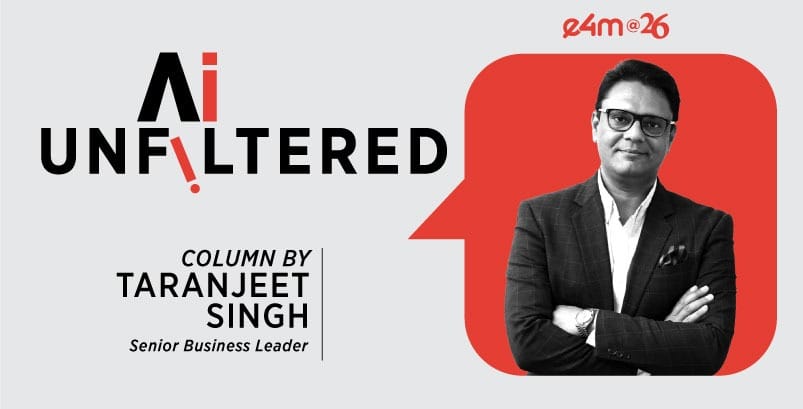

- The role of salespeople is evolving as AI tools can now handle tasks like creating presentations, analyzing data, and drafting pitches, reducing the importance of traditional production skills.
- The key differentiator in sales is shifting towards human judgment and decision-making, as AI cannot interpret nuanced situations or build trust with clients.
- Experience and the ability to navigate complex interpersonal dynamics are becoming increasingly valuable in sales, as AI streamlines the execution of basic tasks.
- Companies need to focus on training salespeople in skills that AI cannot replicate, such as reading a room, handling conflict, and understanding organizational politics, to enhance their effectiveness in an AI-driven environment.
For years, the best salesperson in the room was often the one with the best deck, the sharpest numbers and the most polished pitch.
That is changing.
Not because those things stopped mattering.
Because they stopped being scarce.
AI can now build the deck, pull the numbers, research the account, draft the pitch and personalise it to the prospect, often in minutes.
So the uncomfortable question for anyone in sales and revenue today is:
If the production work is no longer the differentiator, what is?
The answer is something much harder to automate.
Judgment.
The work that's disappearing was never the job
I made this point in my last column, but it is worth repeating because it changes how we should think about what being "good at sales" actually means.
The proposal. The forecast. The account research. The first version of the presentation.
These were never really the job.
They were the entry fee.
They mattered because they took time and required skill. A salesperson who could turn around a sharp, customised proposal overnight looked exceptional.
Today, AI can help almost anyone do that in twenty minutes.
The entry fee has collapsed.
And when the entry fee collapses, the real differentiator becomes much easier to see.
What remains is how well you make decisions when the answer isn't obvious.
What AI can't read
AI can tell you a deal is slowing down.
It can tell you the emails aren't being answered. It can see that engagement has dropped. It can flag that a champion who was highly active three weeks ago has suddenly gone quiet.
But it can't reliably tell you why.
Has the champion lost internal support?
Has a competitor reached the CFO?
Has the project been deprioritised?
Or are they simply buried in work and reading too much into the silence could actually damage the relationship?
That distinction is not just a data problem.
It is a judgment call.
And good salespeople make hundreds of these calls during a deal.
When to push.
When to wait.
When to challenge the client.
When to stop talking.
When to bring someone senior into the conversation.
And sometimes, when to walk away.
AI hasn't reduced the number of decisions required to close serious business.
It has simply removed much of the production work that used to sit around them.
And that means we are going to get a much clearer view of who is good at sales.
Trust isn't a data point
There is another thing AI can assist with, but cannot manufacture.
Trust.
A client believing that you will tell them the truth even when the truth is inconvenient for you.
That isn't built in one meeting.
It is built over time.
It comes from the salesperson who says, "I don't think our product is the right fit for this particular requirement."
Or the one who tells the client about a delivery problem before the client discovers it themselves.
Or the one who doesn't oversell simply because there is a number to hit at the end of the quarter.
AI can optimise the sales process.
It can help you understand the customer better.
It can even tell you what you should probably say next.
But it can't build the accumulated trust that comes from hundreds of human interactions.
It can't sit across the table from an angry client and figure out whether they need an apology, a solution or simply five minutes to vent.
That is still human territory.
And ironically, as AI gets better, that territory becomes more valuable.
Sometimes the best sales decision is to slow down
I remember a deal, years ago, that should have closed and didn't.
Every signal on paper was green.
Budget approved. Timelines agreed. The champion was enthusiastic in every meeting.
But something in the room felt off during the final review.
A hesitation before certain answers. A slight over-eagerness to move past questions about implementation.
Nothing dramatic.
Nothing that would have triggered an alert.
But enough to make us uncomfortable.
So we slowed down instead of pushing for a signature.
We went back and asked harder questions directly.
We eventually found a competing internal priority that nobody had disclosed.
It cost us two weeks.
It saved the relationship.
The deal closed properly a month later, on terms that held.
That instinct to slow down at exactly the moment every commercial incentive is telling you to speed up is difficult to put into a dashboard.
It is even harder to turn into a prompt.
And yet it can be the difference between a deal that closes and one that unwinds three months later.
Experience matters more when execution becomes cheap
This is the part I think businesses need to pay more attention to.
Production skills have a ceiling.
Once everyone has access to AI that can create a good presentation, being 10% better at creating presentations doesn't create much of a competitive advantage.
The gap closes quickly.
Experience works differently.
Every deal teaches you something.
Every difficult negotiation adds another pattern.
Every lost customer teaches you something about what you missed.
Every boardroom, every culture, every difficult stakeholder and every uncomfortable conversation adds to a mental library that becomes increasingly valuable over time.
That is why the best salespeople I've worked with tend to become more valuable as their careers progress.
Their advantage was never that they could build a better deck.
It was everything they had learned from being in the room.
So what should companies train for?
This is where I think many sales organisations are going to have to rethink their approach.
We still spend enormous amounts of time training people on product knowledge, pitch mechanics, presentation skills and sales methodologies.
All important.
But increasingly, these are areas where AI can provide significant assistance.
Far less time is spent deliberately developing the skills that AI struggles with:
Reading a room.
Handling conflict.
Understanding organisational politics.
Knowing when a customer isn't telling you the real objection.
Knowing when to push and when to hold.
Knowing when the deal is genuinely alive and when everyone is just pretending it is.
These aren't soft skills.
They are commercial skills.
And they are likely to become some of the most valuable skills in the AI-enabled sales organisation.
AI hasn't made salespeople obsolete. It has made mediocrity easier to spot.
That, to me, is the bigger story.
When everyone has access to the same production tools, the gap between a good salesperson and a great one becomes harder to hide.
The great salesperson isn't necessarily the one with the best AI prompts.
They are the one who knows what to ask, what to ignore, what to challenge and when to act.
The salesperson who uses AI to prepare better but uses human judgment to decide what to do next.
Because AI can make you faster.
It can make you better prepared.
It can make you more productive.
But it cannot make the judgment call for you when the room goes quiet.
And perhaps that is the most interesting thing AI is doing to sales.
It isn't taking the human out of the profession.
It is making the human more valuable.
Read more news about Digital Media, Internet Advertising, Marketing News, Television Media, Radio Media
For more updates, be socially connected with us onInstagram, LinkedIn, Twitter, Facebook, YouTube & Google News