2025: The year retail media took over India’s ad playbook
This year, retail media emerged as the channel that finally closed the loop between advertising and sales
 by
by
Published: Dec 22, 2025 9:17 AM | 9 min read
 Follow Us

In India’s advertising ecosystem, retail media has transformed from a performance niche into one of the fastest-growing segments over the last few years. What quietly began as experimental spends on Amazon and Flipkart steadily moved to the centre of media plans. By 2025, retail media had evolved into a core growth lever spanning marketplaces, quick commerce and food delivery platforms.
This year, retail media has emerged as the channel that finally closed the loop between advertising and sales. It wasn’t just another digital format; it became a solution to some of the most persistent gaps marketers have faced for years. By moving beyond clicks and impressions to demonstrate measurable impact on actual sales, retail media bridged long-standing structural gaps between media exposure and business outcomes.
The year 2025, in particular, proved to be a breakout moment. Retail media didn’t just grow; it came of age. The shift was visible across the ecosystem, especially on quick commerce and delivery platforms, where advertising moved closer than ever to the moment of purchase.
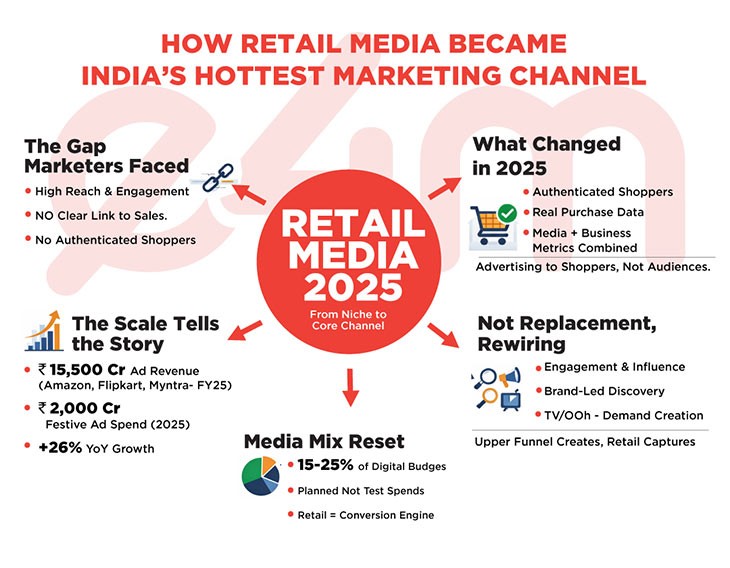
The numbers back this story. In FY25, combined advertising revenues for leading commerce platforms, Amazon, Flipkart and Myntra, crossed ₹15,500 crore, reflecting a strong 26% year-on-year growth. Retail media also dominated the festive advertising narrative. During the 2025 festive season, e-commerce and quick commerce platforms together generated over ₹2,000 crore in advertising revenue, marking nearly 25% growth over the previous festive period.
According to WPP’s This Year Next Year (TYNY) report, retail media ad revenues in India are projected to grow 26.4% in 2025 to around ₹24,280 crore, and are expected to cross ₹30,000 crore by 2026, accounting for nearly 15% of total ad revenue. At that scale, retail media now ranks among the largest digital channels in the country’s advertising market.
What fundamentally changed in 2025 was not just measurement, but mindset. As per Karthik Shankar, Head of Digital Investments, WPP Media India, “Retail media became core in 2025 as it uniquely merges media and business metrics, offering direct measurement of ad spend impact on sales. This convergence allows brands to precisely track return on ad spend (ROAS) and conversion lifts, proving its direct contribution to commercial outcomes.
Out of all the lessons that 2025 taught the advertising industry, one became unmistakably clear: retail media didn’t just grow fast, it fundamentally transformed how brands think about performance marketing.
Together, these developments made one thing evident. Retail media emerged as the hottest marketing channel of 2025, not just in terms of growth, but in its ability to solve several marketing challenges.
Also read:
India’s retail media boom now runs on fulfilment, not discounts
India’s ad spend to cross Rs 1.8 lakh crore this year; retail media growing fastest: TYNY
Retail media steals festive spotlight with Rs 2,000 crore AdEx
India’s retail media growth: Will new players find room against Amazon and Flipkart?
Retail Media Moved From Experiment To Essential
Several structural and behavioural shifts converged in 2025 to push retail media from the margins to the mainstream. Consumers were spending more time inside commerce ecosystems, quick commerce platforms were normalising instant fulfilment, and brands were under growing pressure to justify every marketing rupee with tangible business outcomes. At the same time, rising digital clutter and diminishing returns on traditional performance channels made it harder for marketers to rely solely on reach or engagement metrics. Retail media emerged at the intersection of these pressures, offering brands a channel that aligned media exposure with real buying behaviour.
According to industry experts, retail media’s biggest advantage in 2025 was its ability to solve a long-standing problem: the disconnect between advertising exposure and actual sales. Retail platforms offered something uniquely powerful — authenticated shoppers, real purchase data, and measurable outcomes. Brands realised that they were no longer advertising to audiences, but to shoppers with clear intent. As a result, retail media stopped being treated as an add-on and became a core part of the marketing mix, closing the loop on the customer journey from discovery to delivery.
Manish Sharma, President, Arena India, part of Havas Media Network India, explained, “Across our client base, 2025 was the year retail media became planned, not opportunistic. What used to sit as test budgets under performance marketing started getting allocations at the start of the year.” He added that for many brands, retail media came to account for 15–25% of digital budgets, and in categories driven by launches or strong commerce dynamics, even more.
What stood out was not just the scale of this growth, but the way it reshaped media mixes, he added. Upper-funnel channels were increasingly tasked with building desire and shaping perception, while retail media assumed the role of conversion and validation, effectively connecting brand storytelling with commercial impact.
Notably, experts also point out that retail media’s rise has pulled performance dollars away from stagnant traditional channels and fragmented digital silos, nudging the industry toward a more unified, outcome-oriented ecosystem. “It wasn’t disruptive; it was evolutionary,” Sharma said. “It exposed the limitations of broad-reach tactics in a ROI-obsessed era.”
In effect, 2025 became the tipping point where retail media’s ascent forced brands to fundamentally rethink spend allocation across both digital and traditional media. Rather than simply shifting budgets away from platforms like Meta or Google, retail media catalysed a broader reassessment of how performance is defined and measured. Search evolved into a more brand-led channel, discovery moved meaningfully higher up the funnel, and social found renewed relevance in driving engagement, influence and long-term brand impact, instead of being evaluated only on last-click conversions.
On the traditional side, retail media did not replace television or out-of-home advertising, but it significantly altered their role.
Adding to this, Shankar From WPP Media India, shared that clients significantly increased their investments in retail media in 2025, driven by its growing technical sophistication and business maturity. “This shift also compelled brands to fundamentally rethink their supply chain, assortment, and allocation strategies, breaking down traditional silos between trade and media functions,” he said.
How Retail Media Became the Last-Mile Conversion Engine For Brands
For several brands, retail media has emerged as a uniquely efficient channel in 2025 because it reached consumers at the moment of intent. Unlike traditional digital advertising, which often targets users well before they are ready to buy, retail media allowed brands to influence decisions right at the point of purchase.
“For us, retail media is like a demand-capture channel,” said Rajat Jadhav, Co-Founder and CEO of Bold Care. “Social and search continue to play an important role in awareness and consideration, but retail media brought last-mile conversions.” Jadhav added that the rise of retail media made media planning more fluid and performance-led, reflecting a broader shift away from rigid budget silos that once separated discovery from conversion.
For brands like Zippee, retail media clearly emerged as one of the most effective marketing channels in India in 2025, largely because it solved a problem brands had been grappling with for years, wasted ad spend.
According to Madhav Kasturia, Founder and CEO of Zippee, a quick-commerce logistics platform, traditional digital advertising was becoming increasingly expensive, cluttered, and difficult to attribute. “Retail media moved advertising closer to the point of purchase,” Kasturia said. “Brands could finally reach consumers when intent already existed — not weeks earlier on Instagram or YouTube. That shift alone improved ROI, attribution, and confidence in spends.”
For many D2C and FMCG brands, retail media in 2025 became less about top-of-funnel awareness and more about distribution leverage. It enabled brands to buy visibility exactly where purchase decisions were being made, rather than hoping earlier impressions would convert later.
Brands consistently pointed out that the ability to influence discovery at the moment of consideration, when shoppers were already in a buying mindset, made retail media far more efficient.
Adding further perspective, Anjana Ghosh, Managing Director, Scale Sherpas, who brings over 33 years of experience in consumer-focussed businesses and spent 13 years at Bisleri, noted that in 2025, brands’ media mixes shifted sharply towards retail media as e-commerce and quick-commerce platforms evolved into stronger, data-rich environments.
“These platforms offered precise targeting, direct consumer access, and comparatively lower costs, a powerful proposition at a time when profit margins were already under pressure due to rising operational costs. Naturally, brands diverted budgets towards retail media because it appeared more efficient and immediately measurable,” she said.
However, Ghosh also highlighted a crucial nuance. While retail media grew rapidly, most brands were not increasing their overall media spends, they were reallocating budgets, often away from traditional media, simply because margins did not allow for incremental investments. “General Trade still accounts for nearly 80% of India’s buying consumers, making it impossible for brands to ignore,” she explained. “So even as retail media rises, General Trade remains the real volume engine. The smartest brands are balancing both, leveraging digital retail media for engagement and precision, while relying on General Trade for scale and sustained market share, where Below-The-Line (BTL) activities continue to play a critical role.”
Ultimately, retail media didn’t just emerge as one of the top marketing channels of 2025; it addressed long-standing inefficiencies in how advertising translated into real business outcomes. As the channel moves from rapid adoption to deeper integration across media, commerce, and distribution, the bigger question now is what this shift means for brands and e-commerce in 2026.
Read more news about Digital Media, Internet Advertising, Marketing News, Television Media, Radio Media
For more updates, be socially connected with us onInstagram, LinkedIn, Twitter, Facebook, YouTube & Google News