The Creative Question: Are we outsourcing imagination – first to influencers, then to AI?
Prathap Suthan, Chief Creative Officer & Managing Partner at Bang In The Middle, discusses how creative processes are shifting, with algorithms and influencers influencing audience engagement
 by
by
Published: Nov 4, 2025 9:29 AM | 6 min read
 Follow Us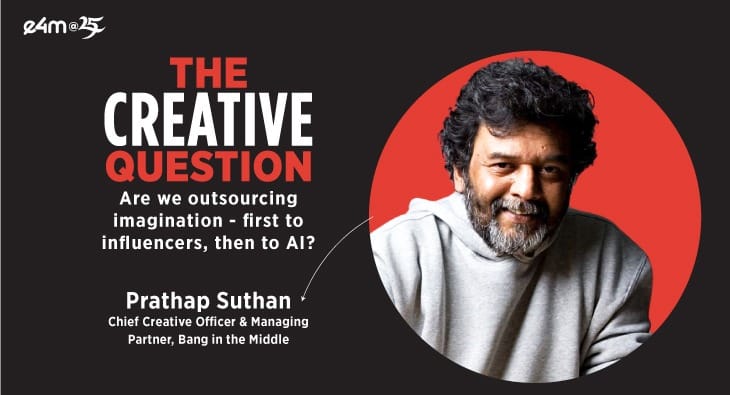

With Prathap Suthan, Chief Creative Officer & Managing Partner, Bang In The Middle
“The entire machinery that is currently there in this world is aiming at making our people into lambs,” says Prathap Suthan, without pause. With little or almost no brains.
The veteran creative, who has seen Indian advertising evolve from the print era to the age of prompts and pixels, doesn’t shy away from calling out what he sees as a dangerous drift, one where creative conviction is being replaced by algorithmic convenience, and audiences are being trained to consume faster than they can think.
“We use AI, but we use AI how AI should be used, to help people achieve more and deliver better work. But the main thinking in the agency is still done by people,” he says. Yet outside the agency world, he believes a worrying number of marketers are surrendering thought to machines. “Clients don’t realise the value that ideas bring them. If you think ChatGPT or Gemini can give you ideas, you’re mistaken. It all depends on who’s sitting there and writing the prompt. Put an average mind in front and you’d get mediocrity. Put a bright and interesting mind to guide it and you’d get superior work.”
At the heart of his concern lies not the technology itself, but the mindset it’s breeding, one that mistakes automation for intelligence. “If you don’t have that wiring in your head, you’ll never get the machine to give you the idea, or the thought process itself,” he adds.
Read On: Piyush led from the front and transformed Indian advertising: Prathap Suthan
The Rise of “Everyone’s an Influencer” Advertising
For Suthan, AI is only one half of the problem. The other is the content culture that rewards noise over nuance. “If there’s an influencer, and she’s a great chef, that means, she’s good at chefing. But she’s not good at copywriting. If she was, she would’ve been a copywriter,” he quips.
“Ninety to ninety-five percent of influencers have no business pushing any product,” he says flatly. “They can’t speak for it, they have no credible authority over that subject. If you’re a travel person, talk about travel. But the moment you start selling me shoes, I have a problem. But the moment you start selling me bitcoins and fintech, I have a problem.”
He’s quick to clarify that it isn’t cynicism, but context, that’s missing. “A sportsman telling me about shoes makes sense. But I don’t want a singer telling me about engine oils.” What this influencer overflow has done, he believes, is flatten the creative hierarchy, letting personal reach overpower brand relevance.
The result: an oversupply of sameness. “You have a kid of 23 with 700k followers because she speaks with an accent. Interesting to watch her, yes, but she’s the last authority on selling luxury real estate,” he laughs, then pauses. “I’m just worried about the people who watch it, and fall for those products.”
Audiences in Auto-Pilot
In his view, the creative ecosystem today feeds on audience inertia, on people who scroll, not stop. “We are being fed this, and everyone realises it,” he says. “We’ve become dumber, we are fattened with all sorts of unjust expectations and the system is getting fatigued by the minute.”
When asked whether brands are complicit, he doesn’t hesitate: “Yes, because they are no longer buying bold ideas. Because they are trying to be everywhere and reach everyone."
"The client has to be brave enough to buy bolder and differentiated work. But many of them sadly assume they are the ultimate authority in imagination. And it’s messing up brands - because they don’t work inside guardrails. Clients never really excel in the pursuit of creative thinking - they surely can’t recognise it. But when by virtue of hierarchy, the fact that clients are paymasters, if they ride the agency to their bidding, the ultimate loser is the brand."
That self-assuredness, he explains, is what’s hollowing out agency creativity. “By accepting that the agency and agency minds had a bright idea, they feel their own importance is diminished. So, the product ends up trying to please algorithms instead of audiences.”
Read On: Creator Economy vs Traditional Agencies: Coexistence, collaboration or competition?
AI and the Future of Thinking
Suthan is deeply aware of the paradox AI presents, a tool that can think faster than humans, yet risks erasing the very need for human thought. “Every company, whether a client or a banker or a medical shop, has to say, AI, not at the cost of human jobs. Because you won’t have anybody left to sell to,” he warns.
He describes a future where “AI copies from AI” and data recycles itself into meaninglessness. “If everything is AI-driven, then what’s the need for human beings? Humans will only be needed to switch machines on and off, and that’s scary.”
For him, the danger isn’t dystopian, it’s already here. “AI is covering up deficiencies across industries. But as people lose jobs, economies lose customers. When people can’t spend, who will you even advertise to?”
The Creative Soul, Reconsidered
Through the humour, sarcasm and sharp one-liners, Suthan’s argument remains consistent: creativity is a human act, not a data-driven one. “Technology can’t be an idea. Ideas are what make brands live and breathe. If you don’t see their worth, your brands will suffer,” he says.
Advertising, he insists, was once the “pretty aspect of India”, the art that made an ugly world look beautiful. Today, it’s caught between aesthetic fatigue and creative outsourcing. “We continue to be the custodians of aesthetics, but if we lose that, advertising itself will become ugly.”
In a world where every post is an ad, every creator a brand, and every idea a prompt, Suthan’s warning lands like an echo of sanity, “We have to stop outsourcing imagination, first to influencers, and now to machines. Because once imagination leaves the human mind, there’s no getting it back.”
Read more news about Internet Advertising India, Marketing News, PR and Corporate Communication News, Digital Media News, Television Media News
For more updates, be socially connected with us onInstagram, LinkedIn, Twitter, Facebook YouTube & Google News