RMG ad clampdown to hit festive AdEx; H2 growth to be 3–4%: Harsha Razdan
South Asia CEO Harsha Razdan tells e4m that dentsu remains resilient, clocking Rs 500-crore-plus in media billings across 140 clients and maintaining double-digit growth
 by
by
Published: Nov 3, 2025 9:02 AM | 16 min read
 Follow Us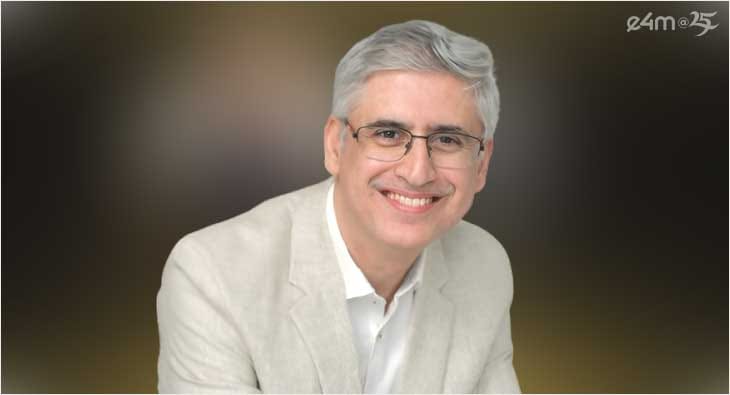

India’s festive ad market is likely to fall short of expectations this year, with dentsu South Asia CEO Harsha Razdan projecting AdEx growth of only 3–4% in H2 2025, largely due to the ongoing real-money gaming (RMG) advertising restrictions. In a conversation with exchange4media, Razdan said the clampdown has created a structural gap in spends, muting the overall momentum despite a strong start to the festive season.
While BFSI, auto, and commerce sectors continue to perform well, he noted that FMCG spends were initially hit by GST-related disruptions and are yet to fully recover. “It’s going to be difficult for the industry to achieve the projected numbers this year,” Razdan said, adding that growth could rebound in 2026 as the market stabilises.
Despite the broader slowdown, dentsu has maintained double-digit growth, Rs 500-600 crore in YTD billings from marquee new media wins, with 140+ new clients under its “One dentsu” model, he says.
Razdan also touched upon the CCI compliance overhaul, global acquisition chatter, and dentsu’s AI-led transformation, reaffirming that India remains the network’s fastest-growing and already profitable market. “The future belongs to agencies that combine technology with human insight,” he said.
Edited excerpts-
With a rich background in FMCG and consulting, your move into the advertising sector was a significant shift. What were the most challenging aspects of this transition, and how have your previous experiences shaped your approach to leading dentsu?
Leadership, to me, is all about being people-first. In a service industry, whether it’s consulting or the advertising, media, and creative world, it ultimately comes down to people.
In that sense, I’d say there isn’t much dissimilarity. If I was managing people there, I’m managing people here. The second similarity is my belief that the client always comes first. It may sound obvious and commonsensical, but what I mean is client-first from the client’s perspective, not just ours.
In an agency setup, where multiple brands coexist, we often tend to sell what we have; creative agencies focus on creative propositions, media agencies on media solutions. But it’s equally important to step into the shoes of the CMO or the Chief Digital Officer and view things from the client’s side.
The third aspect I’ve always believed in is being growth-oriented. I know our industry has seen its share of ups and downs, but for me, the challenge and opportunity lie in shaping the right mindset, helping people believe that we can build strong careers and growth stories together. That’s been central to how I’ve tried to settle in.
I must add that the industry leaders have been extremely warm, as have the clients. The fundamental principles of being client-first, people-first, and growth-driven have guided me throughout and they continue to do so.
Any challenges that you had to overcome in this transition?
I was already prepared for challenges. Now that you ask me, on a lighter note, there were quite a few people who told me after two years of joining that they hadn’t been sure I’d still be around, whether in the industry or even within our framework. But I’ve always believed that if you genuinely add value to people’s lives and help them build better careers, there’s no reason you won’t succeed.
So, I wouldn’t really call it a challenge. I expected a few questions to come my way, as they do for any newcomer, but that’s part of the process. I’ve never been fazed by it. The challenges I faced here were no different from those I’ve encountered in any other organization I’ve worked with.
Upon joining dentsu, you encountered a fragmented agency structure. Can you discuss the steps you took to streamline operations and establish a cohesive brand identity?
Over the last two and a half years since I came in, my focus has largely been on consolidation, ensuring that we truly operate as ‘One Dentsu’. We were among the first groups in the industry to roll out the ‘One Dentsu’ operating model in late 2023. In fact, India implemented it in November 2023, within my first six months. The goal was to bring our top 75–80 clients under a unified structure, with a single approach and one key account manager handling each client relationship.
The Japanese model calls this framework EIGYO, and we decided to implement the same in India, grooming people to become holistic client-servicing leaders. Now, as we move into the next phase, late this year and early next, we’re focusing on differentiation. The building blocks are in place: the structure, the operating model, and the basics. The question now is, how do we stand apart?
When we talk about integration, it’s true that we’ve run with multiple brands. But at the end of the day, what matters most is the client. The client doesn’t care about our titles, whether someone is a manager, a vice president, or a semi-CEO. What they care about is the quality of output and the strength of client servicing. My principle has been clear: de-layer the organization and bring younger talent to the forefront.
The more we empower young people, the more we unlock potential. Dentsu has immense talent, and it was important to make people feel they could contribute meaningfully to the company’s growth. Once that belief set in, many began to truly flourish. For instance, I personally review our top 75–80 clients every six weeks. The people presenting these updates are often one level below my leadership team, individuals who, before I joined, might never have interacted directly with the CEO. Now, they have the confidence to present ideas, share experiments, and take ownership. We challenge them when performance lags and appreciate them when it excels.
This culture of empowerment has been my biggest learning; it has not only unleashed confidence and capability but has also directly contributed to the success of our model.
We’ve just wrapped up Diwali, and while the festive momentum will carry through Christmas and New Year, the main phase is over. How has the season been so far? Are there any standout categories or trends you’re seeing? FMCG was slowing down, but with the recent GST slab changes, broadcasters and publishers are reporting early signs of recovery. Are you seeing a similar turnaround, and what’s been the overall trend this festive season?
Very clearly, it’s been a positive trend overall. You’re right that in the FMCG segment, the initial hiccups were largely due to GST-related issues, since a lot of billings couldn’t happen to retailers and consumers. Naturally, marketers who had already invested significant amounts were left wondering why billing wasn’t moving. That led to some short-term disruption, but we began seeing green shoots from October onwards.
It could have been stronger, but those were mostly operational and teething issues that affected the industry. Beyond that, the sectors that have not slowed down at all are BFSI and commerce/D2C, both of which have done exceedingly well. Auto has also performed well, benefiting in part from GST. It’s a bit of a double-edged sword for auto, some manufacturers see GST benefits as a cue to advertise more, while others, seeing strong sales, prefer to spend less. But overall, the sector has held up strongly.
So, I’d say these three- BFSI, auto, and commerce have been the upstream growth drivers. FMCG will catch up, but it had its own transitional issues.
On the whole, the last one and a half to two months have been positive, though it could certainly have been better.
But if I look at the second half of the year, the AdEx growth appears quite muted. Due to the RMG ban, AdEx has taken a significant hit. So, I’d estimate very low single-digit growth in AdEx for H2.
Overall, I’d describe it as a muted second half for advertising growth, largely because of the gaming sector’s decline, even though BFSI, auto, and commerce remain bright spots.
According to dentu's ad spends' report, the Asia-Pacific region is projected to see a 6% growth in ad spend, with India leading at 7.9%. Given the current economic climate and FMCG budget adjustments, do you believe these projections are attainable? What factors will influence this outcome?
I think it’s going to be quite difficult to achieve the projected numbers, especially given the significant impact of the RMG gap. The second half will definitely take a toll, and I’d be genuinely surprised if growth crosses 3–4%. I don’t see the numbers stacking up the way they were initially expected.
For the full year, overall growth will likely be much lower, though hopefully 2026 will bring better prospects. At this stage, there’s not much anyone in the industry can do, it’s a structural slowdown we all have to navigate.
Following a challenging 2023, dentsu India's media practice reportedly won and retained around 80 accounts in 2024.Can you elaborate on the key factors and strategies that contributed to this significant turnaround in new business and client retention? Is 2025 following a similar trajectory?
The client wins were largely driven by the simplified operating model we put in place. As I mentioned earlier, the One Dentsu model was rolled out in November 2023. We were among the first in the industry to implement such a unified structure, even as others began exploring similar synergies across brands. The principle behind this model is simple: one client, one face, at least for large accounts.
Once you start breaking down silos, both between teams and between brand leaders, the organization automatically becomes simpler and more client-centric. I also began, from early 2024 onward, personally reviewing our top 75 clients every six weeks. That brought sharper focus because, earlier, we weren’t truly looking at portfolio selling. We talked about it, but it often meant teams working as acquaintances rather than true partners.
This approach paid off in 2024, and 2025 has been even stronger, with double-digit growth across businesses.
Structurally, each top client has a client lead supported by a cross-functional “sandwich” team which includes creative, media, tech, and sports representatives layered within. The client lead acts as the top and bottom layer of that sandwich, holding everything together.
Our growth over the past year has come from this balanced portfolio approach. While creative has been challenging across the industry, media has performed strongly, and our tech and new business verticals- sports entertainment, consulting services, B2B, and retail media, have truly taken off.
Earlier, dentsu worked in silos; today, I actively move people across divisions. A strong creative planner may shift to media; a senior woman leader from media might move to tech or creative. If you’re good, you’ll learn fast; if not, the system will self-correct.
I’m a firm believer in rotation and internal mobility. If you don’t rotate people, they’ll eventually leave for another company. Instead, we give them opportunities within Dentsu to explore new skills and functions. This has led to a positive mindset shift, people now see a cleaner, de-layered setup where they can try different things. Your past brand or function doesn’t restrict you anymore. If you have talent, we’ll give you the space to grow.
You mentioned that this year you’ve been seeing strong double-digit growth. Is there a specific number you’d like to put to it, at least for the first half of the year?
We have maintained strong double-digit growth, supported by approximately Rs500-600 crore in YTD billings from marquee new media wins, alongside significant momentum in Creative, Social, Content, SEO, Martech, and Experience Solutions, where billings are not typically recorded. With 140+ new clients joining us across the network this year, our focus remains unwavering - to drive long-term value, foster deep client partnerships, and shape a growth narrative anchored in innovation, integrity, and measurable impact.
dentsu has been integrating AI to enhance efficiency and creativity. How do you see AI transforming the advertising landscape, and what measures is Dentsu taking to stay ahead in this technological evolution?
As of today, AI as a function sits directly under me. The teams and funds sit under the CEO’s office because I’ve realized that pushing AI-led initiatives often meets resistance. It’s not about expertise in AI, many simply fear it could replace their jobs, without realising it can actually make their work smarter and more meaningful.
Whether it’s creative, media, finance, or HR, AI can automate repetitive work so people can focus on higher-value tasks. In creative, it can handle manual production; in media, it can plan and optimize; in finance or HR, it can streamline processes. That’s why I’ve kept AI close to me—to ensure adoption happens consistently and confidently.
We review AI projects every week, and hands-on monitoring has helped embed it into our culture. Globally, Dentsu has several AI tools, but like everywhere, the real challenge is human resistance. On the creative side, our global tool Mugen is already in place, and an India-specific version is about to go live. On the media side, automation and AI-based planning tools are already operational, though not formally announced yet.
By November, around 30% of our work will be touched by AI, meaning AI influences that portion of our workflow. My goal is to reach 70% by Q1 next year, with measurable positive impact. In technology, automation and AI have already reduced manual coding, letting teams do more with fewer resources. In HR, AI-based CV scanning now handles shortlisting efficiently, freeing people for qualitative evaluation.
I’ve chosen to keep AI with me because insecurity can hold people back. My message to the team is simple: don’t fear AI, fear stagnation. If you keep improving yourself, AI will amplify your capabilities, not replace them. Growth depends on evolution, and the company grows when every individual becomes a better version of themselves.
At dentsu, our philosophy rests on evolution, technology, and humanity. We’ve evolved through automation, and now through AI, to meet the changing demands of the business. Technology is transforming the world at an unprecedented pace, and every professional must adapt to it. We’re conducting internal assessments to identify those less comfortable with tech and helping them upskill because avoiding it is not an option.
Ultimately, our business will always be about people and creativity. If we can combine that human insight with the power of AI and technology, we’ll have the golden formula for the next chapter of growth.
Looking ahead, what are the key areas of growth and innovation you foresee for dentsu in the next 5 to 10 years? How do you plan to navigate potential challenges in the evolving advertising landscape?
From a dentsu perspective, our pivot is very clearly around technology and the human element, what I like to call human surprise or human insight.
We believe the story lies in portfolio management across the value chain for the client whether it’s the CMO or the Chief Digital Officer. Globally, Dentsu calls it Media++; I interpret it as ensuring we become the CMO’s closest partner, someone who understands and solves problems across every aspect of their marketing ecosystem.
And you can’t be that trusted partner by doing just one thing. You have to solve more and more client challenges, because today’s CMO is already managing multiple priorities; tomorrow, that number will double, and the day after, it will quadruple. The CMO cannot have ten different partners for ten different problems. They need one strategic ally who can help navigate that entire maze.
That’s where Dentsu comes in, to be that trusted partner, that extended arm of the CMO, offering cross-portfolio solutions built on a foundation of technology.It is nothing but an integrated portfolio approach, powered by technology. Because technology is what’s reshaping the world and every service we offer must be built around it.
Last but not the least, dentsu’s global business has been the subject of recent discussion and speculation regarding a potential sale of its international operations. While dentsu Group's President has stated the company aims to rebuild its international business independently, the agency is also considering various strategic options. From your perspective, how are these discussions impacting dentsu's operations and morale in India, and what is your outlook on the company's future global strategy?
That’s a very common question across the industry today. Every company, large or small, is evaluating how the market and overall landscape are evolving. I’d say dentsu has been brave and honest in acknowledging the need to evolve and become a better version of itself. We’re a 124-year-old company, and we’ll continue to adapt in ways that make sense for the future.
From a global standpoint, there are ongoing evaluations, possible partnerships, affiliations, and other strategic considerations. I’m not directly involved in those discussions, but I’m confident that the global team will arrive at the right answers.
From an India perspective, however, I can say this with conviction: India is the fastest-growing market for Dentsu globally. I keep telling my colleagues and team members that the pace at which we are transforming, our culture, our propositions, our ways of working, shows how rapidly we are evolving. We should view our growth and careers through the lens of what’s happening in India, and continue to build around that momentum.
Whatever the global outcomes, we remain part of that journey, but India’s story will continue to be one of growth and progress. The global leadership knows this. They’ve set a goal of achieving profitability across all markets by 2027, we’re already there. We’re growing faster than most other regions, and culturally, we’re aligned with what our global CEO and Chief People Officer’s envision for the organization.
So, my message to our people has been straightforward: focus on what you can control. Use your opportunities within dentsu, embrace AI, and keep upgrading yourself. Be a better version of yourself tomorrow than you are today. If you keep doing that, it won’t matter what changes happen at dentsu or in the industry, you’ll always be an asset that everyone wants to work with.
In that sense, you don’t just build a career within dentsu; you build a version of yourself that’s valuable across any industry. The key is to stay focused on your work here, on your impact, and on how you can shape the future from where you stand.
Read more news about Internet Advertising India, Marketing News, PR and Corporate Communication News, Digital Media News, Television Media News
For more updates, be socially connected with us onInstagram, LinkedIn, Twitter, Facebook YouTube & Google News