Hall of Ads: Fevikwik - ‘Todo Nahi, Jodo’
A Piyush Pandey masterclass in humour, heart, and adhesive storytelling
 by
by
Published: Nov 6, 2025 8:22 AM | 5 min read
 Follow Us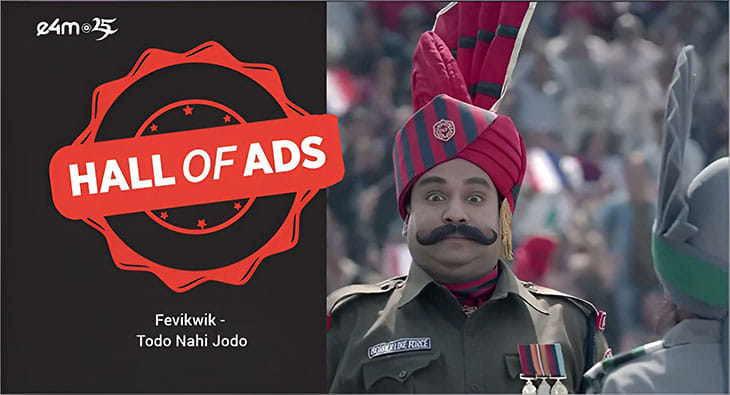

There are ads that make us laugh. There are ads that make us cry. And then there are the rare few that do both, making us feel something about each other, while quietly selling the most ordinary of products. Fevikwik’s “Todo Nahi, Jodo”, conceived under the legendary Piyush Pandey at Ogilvy, belongs in that hall of fame.
The 40-second film opens on the ceremonial Indo-Pak border parade - all pomp, percussion, and perfectly synchronised swagger. Two soldiers face off across the line. There’s tension, pride, theatre, until a comic crack cuts through it all. One soldier’s shoe sole comes loose. For a brief, human second, the parade halts. His rival, without a word, bends down, pulls out a small tube of Fevikwik, and fixes the problem. The crowd roars. The glue sets. The metaphor lands, 'don’t break, bond.'
It’s a simple story. But simplicity is exactly where Piyush Pandey’s genius lives.
Read On: Iconic ads by Piyush Pandey: The adman who rewrote India’s advertising story
Pandey has always believed that advertising should be about people, not products. His world is made up of familiar faces, earthy humour, and the small acts of decency that define India. From the Fevicol bus that refuses to break apart to the cricketing one-liners that built brand love for Cadbury Dairy Milk, his ads have always found poetry in the everyday.
“Todo Nahi, Jodo” continues that legacy. It takes a military parade, a symbol of division, and uses it as a stage for connection. The insight is subtle but striking: in a world obsessed with breaking news and breaking differences, here’s a brand that celebrates fixing.
That single creative inversion, 'Adhesive as Empathy', elevates the film from a product demo to a parable.
Though he was the creative brain, “Todo Nahi, Jodo” feels unmistakably Pandey in direction, rhythm, and restraint. There’s no dramatic voiceover, no celebrity cameo, no attempt to emotionally manipulate the viewer. Instead, every laugh, every pause, is earned through observation.
Pandey once said in an interview, “Good advertising is not about shouting; it’s about talking to people in a way that makes them listen.” This ad embodies that philosophy. The humour is soft, the tone affectionate, and the execution rooted in realism, the dusty parade ground, the stiff uniforms, the controlled movements, all help build credibility before delivering the emotional payoff.
The result? A story that feels lived-in, not written.
Read On: What Piyush Pandey once said on crafting iconic ads
Released on a high-visibility India-Pakistan cricket broadcast, the film was strategically timed to tap into a moment of shared national emotion. Cricket, like the border, unites and divides in equal measure. To use that moment to tell a story of lightness, of humour, and of togetherness was a masterstroke in timing.
Fevikwik’s brief was simple: remind people of its instant-bonding power. Ogilvy’s solution was to remind people of something much bigger, that bonds, once made, can transcend boundaries. That’s the difference between a tactical ad and timeless advertising.
Shot economically with minimal dialogue, the film relies heavily on physical comedy and expressive acting, traits that mirror Pandey’s theatre roots. Every element, from the exaggerated march to the awkward pause before the fix, lands like a beat in a perfectly written play. The glue is real, the laughter is real, and the emotion feels honest.
Few brands have mastered the art of emotional product demonstration like Fevikwik. Over the years, the brand’s humour-driven campaigns have shown how adhesive can fix everything, from broken cups to broken egos. But this film stretched that metaphor across borders, literally and figuratively.
The ad manages to hold three ideas in perfect balance:
- Product truth: Fevikwik works instantly.
- Human truth: People, even adversaries, share moments of kindness.
- Cultural truth: India’s biggest divide can also be its richest source of shared humanity.
That’s what makes it artful. It’s not preaching unity; it’s winking at it.
The Pandey Effect
To discuss this film without celebrating Piyush Pandey is impossible. His fingerprints are on every frame, the rhythm of dialogue, the warmth in humour, the visual simplicity. Pandey’s advertising voice has always been distinctly Indian, unapologetically colloquial, emotionally literate, and deeply rooted in observation.
His genius lies not just in writing great lines but in listening, to people, to culture, to how Indians talk, laugh, argue, and care. “Todo Nahi, Jodo” feels like a summation of that worldview.
It’s also a reminder that Pandey’s best work never separated the commercial from the cultural. He understood that brands live within society, not outside it. Fevikwik here becomes more than a product, it becomes a metaphor for India itself: imperfect, loud, sometimes broken, but always capable of repair.
Two decades on, “Todo Nahi, Jodo” still circulates on social media as one of India’s favourite short ads. It continues to be screened in advertising schools and brand workshops, not for nostalgia, but as an example of creative discipline.
Read On: Piyush Pandey's legacy: Ads that made India
Because this ad teaches us something fundamental about communication:
- That emotion doesn’t need length. That humour can be empathy in disguise. That a brand can be patriotic without waving a flag.
- And that great advertising, as Pandey’s life work shows, is never about noise, it’s about nuance.
As the industry continues to chase viral metrics and algorithmic hits, Fevikwik’s Todo Nahi, Jodo stands tall as a reminder of what timeless creativity looks like: clear idea, clean craft, and a whole lot of heart.
So yes, it’s an ad about glue. But it also quietly glues us to something bigger, the idea that in this divided world, even 40 seconds of humanity can still stick.
A fitting tribute, perhaps, to the man who taught India that great advertising doesn’t just sell - it binds.
Read more news about Internet Advertising India, Marketing News, PR and Corporate Communication News, Digital Media News, Television Media News
For more updates, be socially connected with us onInstagram, LinkedIn, Twitter, Facebook YouTube & Google News