From big budgets to bare minimums: Is creative minimalism the new ambition?
As budgets shrink and AI reshapes workflows, Indian agencies are embracing restraint –but is simplicity a creative choice or just clever cost-cutting?
 by
by
Published: Nov 11, 2025 8:41 AM | 8 min read
 Follow Us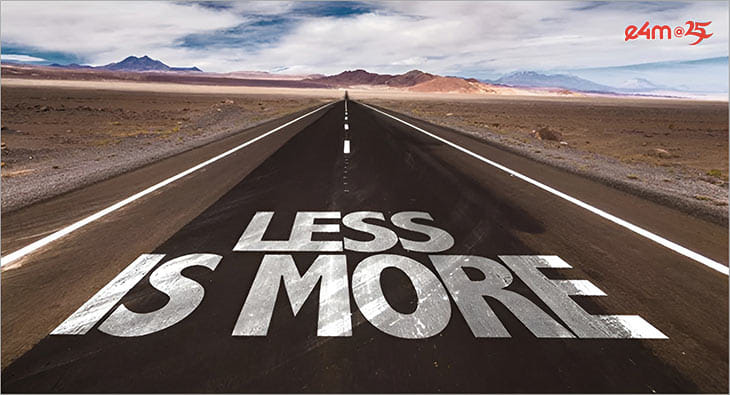

The advertising industry has long navigated a complex relationship with excess. For years, a “big idea” was often defined by large budgets, high production values, celebrity involvement, and campaigns designed to feel grand in scale. However, in the wake of pandemic-driven budget constraints and shifts in media consumption shaped by algorithms, a new perspective has emerged: “less is more.”
Originally driven by budget constraints, the move toward doing more with less has developed into a broader creative philosophy. Creative minimalism, focused on refining ideas to their core elements, is now being recognised as an intentional strategy rather than a cost-saving measure.
The Heinz Ketchup ‘Look Familiar?’ ad offers a clear example. The ad showed how French fry boxes all around the world are shaped like the Heinz logo, mostly because you “can’t have fries without it”. There were no celebrity endorsements or elaborate visuals, just a simple, clever idea. The question is whether such restraint represents creative ambition or simply creative efficiency.
The answer, as most things in advertising, is layered. Sumanto Chattopadhyay, former Executive Creative Director at Ogilvy South Asia, offers a measured take on the Heinz ad, saying, "The Heinz ad reinforces 'branding' to some extent and tells us that the product is consumed everywhere. I don't think it went beyond that. We refer to hoardings as a reminder medium. This was akin to that, a reminder ad. It's functional, but does it create brand love? Does it have appetite appeal? I'm not too sure about that."
Read On: Are advertising agencies gradually evolving into entertainment studios?
Chattopadhyay’s point cuts to the heart of the debate. Minimalism can demonstrate mental availability, but can it stir emotion? "It's a great idea to do more with less, especially in the era of 'always on' social media. But unless you also create memorable hero pieces from time to time that transcend the mundane, your brand will lose its sheen."
There's an implicit warning in that observation. If every piece of communication is optimised for efficiency, where's the room for magic? Where's the Ramesh-Suresh combo in 5 Star or the Happydent palace? These weren't just campaigns; they were cultural events. They demanded craft, conviction, and crucially, cash. Strip those away, and you risk flattening the emotional landscape of the brand.
When simplicity becomes a signal
There is also a growing branding argument for creative restraint. In a landscape crowded with loud and overstimulating content, simplicity may signal confidence, and restraint could be perceived as a form of sophistication. Brands such as Apple, COS, and Tanishq, for instance, have embraced more understated storytelling. The work is carefully crafted, but the tone remains calm, focusing on clarity, space, and respect for the audience’s intelligence rather than a hard sell.
Pranoy Kanojia, Vice President of Strategy at Enormous Brands, sees both sides of this tension. "This is always an interesting debate. There are many takes to this. We have long heard the adage that creativity shines in constraints. That is, when you restrict the means, ingenuity sparks, forcing one to look outside the box and hence come up with pathways that are novel and thus interesting," he says.
His agency has turned tight budgets into creative opportunities more than once. "We at Enormous have many times delivered beyond budgets and turned great ROIs for clients. We took it up as a challenge to create something powerful and lasting where there were many different constraints on the production, like budgets, location, etc."
But he's equally clear that not everything can, or should, be done on the cheap. "We also believe that, as in the words of Sir John Hegarty, ‘creativity is 80% idea and 80% execution’. Production is vital to bringing the idea to life. Some ideas definitely need the exact ingredients to leave a certain kind of envisioned impact. A Lahori Zeera couldn't have been made without the right director and production team to bring it to life." It's a reminder that craft still matters. That some stories need texture, tone, and technical excellence to land with the weight they deserve.
Read On: Are 20-second ads killing creativity in advertising?
The discipline of constraint
Priyank Dattani, Associate Creative Director at White Rivers Media, believes the pressure to do more with less has actually sharpened the work. "Doing more with less can sharpen ideas because constraints force you to focus on the emotional core of a story rather than decorative flourishes. We've seen campaigns where a single, simple insight, executed honestly, outperforms a high-gloss spot that tries to do everything," he explains.
The logic is sound. When you can't rely on spectacle, you lean harder on the idea. You interrogate it more deeply. You kill what doesn't serve it. However, Dattani is quick to draw a line, saying, "There's a real risk if cost-cutting becomes the brief. You lose craft, you shortcut testing, and the work starts to feel recycled. The sweet spot is disciplined constraint, protect the idea and the craft that lifts it, cut what's showy, not what's essential." That distinction matters. There's a difference between minimalism as a creative choice and minimalism as a cop-out. The former is intentional. The latter is just cheaper.
Look at Amul's print work over the years: minimal design, hand-illustrated topical humour, zero production fuss, and the best wordplay in the game. Yet it's one of the most culturally embedded campaigns in Indian advertising history. Similarly, if we take Fevicol's long-running series of print and video ads, many of which rely on a single visual joke and a tight tagline. The craft is invisible, but it's there. The restraint isn't accidental; it's deliberate. That's the kind of minimalism that earns respect.
AI and the rise of thoughtful speed
The discussion around creative minimalism is incomplete without considering the influence of AI. Over the past two years, automation has transformed agency workflows, affecting not only execution but also ideation. Tools capable of generating variations, visual layouts, prototype scripts, and tone analyses at scale have fundamentally reshaped the pace and rhythm of the creative process. For some, that shift represents a threat. For others, it opens a new creative dimension. Dattani falls in the latter group. “AI is not about replacing intuition, it's about accelerating iteration so human judgment gets to the interesting questions faster,” he says.
In other words, AI isn't replacing the creative; it's clearing the deck so the creative can prioritize what’s important: the human decisions that make work resonate. He further adds, "That often leads to cleaner, more purposeful executions because we can test tone and format quickly and stop the stuff that doesn't land. The trick is to use AI to broaden the thinking, not to substitute for the human decision that makes a piece of work honest."
It's a nuanced position, and one that reflects a broader industry maturity around technology. The initial panic that AI would hollow out creativity is giving way to something more useful: the realisation that speed and volume aren't the enemy of depth if the briefs and the thinkers are sharp enough. The danger, of course, is when speed becomes the goal itself. When brands churn out content for the sake of presence, not impact. That's where minimalism can tip into monotony.
The expectation trap
Kanojia points to a rising issue on the client side regarding expectations. "I have seen too many clients come to expect small-scale scale cheap, and chirpy productions to achieve bigger objectives for the brand. They have learnt from social media that smaller budgets can also make things go viral. But they forget the things that go viral are because of the idea and how it was delivered," he points out.
The viral logic has warped planning conversations. Clients see a lo-fi Instagram reel blow up and assume all content can, and should, work that way. "They must plan their budgets better, and know better what it takes to create a certain kind of creative product. Everybody quoting Nike and Apple advertising in their briefs must also know they work with Hollywood A-lister directors."
It's a fair callout. The romanticisation of scrappy creativity often glosses over the infrastructure, talent, and craft that even 'simple' work requires. A one-take film still needs a great director. A static post still needs a sharp art director. Minimalism doesn't mean no production; it means smarter production. And that still costs.
Read On: Plug, Play and Buy: How AdCP is automating the future of advertising
Where does this leave us?
The rise of creative minimalism is more like a recalibration. It's the industry learning to do better work in a more constrained, more scrutinised, more AI-augmented environment. t the same time, it presents a challenge: can agencies hold the line between efficiency and emptiness? Can they use simplicity as a creative tool, not just a budget hack? And can brands be crafted to feel confident and clear, rather than just economical?
The answer will depend on how the industry defines ambition going forward. If minimalism becomes an excuse to stop swinging for the fences, the work will suffer. But if it's used to strip away the clutter and focus on what actually moves people, it could mark the beginning of a more honest, more human era of advertising. One where the idea, not the invoice, is the real measure of creativity.
Read more news about Internet Advertising India, Marketing News, PR and Corporate Communication News, Digital Media News, Television Media News
For more updates, be socially connected with us onInstagram, LinkedIn, Twitter, Facebook YouTube & Google News