Startup team orders Rs 2.9 lakh graphics card online, receives detergent
The buyer also pointed out discrepancies in the package, alleging that the manufacturer’s seals had been cut and re-taped, and that a suspicious barcode label had been affixed to the box
.png) by
by
Published: Mar 24, 2026 6:50 PM | 5 min read
 Follow Us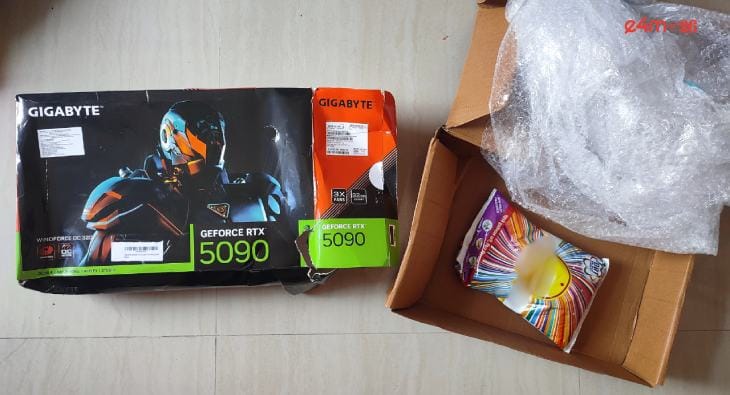

In a bizarre online shopping incident that has quickly gone viral, a man claimed he received a packet of detergent instead of a high-end graphics card worth Rs 2.9 lakh. The case, which surfaced through a post on X and Reddit, has sparked widespread discussion around delivery lapses and online shopping risks.
He shared an unboxing video online as evidence on X and Reddit and raised concerns about how such a discrepancy could pass through warehouse checks.
Unboxing evidence shows a total security failure:
Outer bag was sealed, but internal GPU box arrived with heavy physical damage.
Manufacturer seals were SLICED open and taped over.
Fake aftermarket barcode "X002IVLPDX" slapped on the front. pic.twitter.com/WQNf7VORWX— Swagat Nayak (@autocarrrot) March 22, 2026
The Order and the Delivery
According to the buyer, he had ordered a GIGABYTE RTX 5090 graphics card. The order was placed through Amazon’s Fulfilled by Amazon (FBA) programme, which means the product was supposed to be stored, packed, and shipped directly from an Amazon warehouse, a service generally considered more reliable and safer than third-party shipping.
The package was delivered and, on the surface, the outer Amazon shipping bag appeared to be sealed. The internal box was far from intact. It had sliced manufacturer seals that were poorly re-taped and a fake aftermarket barcode, suggesting the package may have been tampered with before it even reached the customer. Inside the GPU box, there was no graphics card, just bubble wrap and a 1 kg packet of laundry detergent.
Red Flags Everywhere
The buyers quickly flagged something else that supported their case: the weight printed on the shipping label. The shipping label listed the parcel’s weight as just 1.56 kg. A real RTX 5090 graphics card with its retail packaging typically weighs between 2.5 to 3 kg.
The math doesn't lie, but Amazon’s "investigation" does:
— Swagat Nayak (@autocarrrot) March 22, 2026
Their own shipping label lists the weight as 1.56 kgs.
A retail-boxed RTX 5090 weighs nearly 3 kilograms.
1.56kg is exactly the weight of detergent + packaging. How did this pass warehouse scans? pic.twitter.com/BQKb7VCl5s
The invoice raised additional concerns too, showing 0% IGST on a Rs 2.9 lakh electronics purchase, which is legally incorrect since such transactions in India attract 18% GST.
This was not an isolated incident, and the pattern was visible in plain sight on the product page itself.
We aren't the only ones. Multiple buyers reported the same detergent scam this week. Amazon’s official reply: "This item was fulfilled by Amazon, and we take responsibility". So why deny mine? pic.twitter.com/6fnLEF8QIN
— Swagat Nayak (@autocarrrot) March 22, 2026
A user highlighted how the price of the card should have been a warning sign from the start. The typical market rate for an RTX 5090 in India is around Rs 4 lakh, but this listing had it for significantly less at Rs 2.9 lakh.
How did you actually think you'd get an RTX 5090 for just ₹2.9 lakhs? You never once considered that everywhere else it's almost double that price, and the official starting price is around ₹4 lakhs.
— ????? ??. ? (@sivbay) March 23, 2026
This is exactly why I never trust products that are advertised at suspiciously…
There was another case where a user received a sugar packet after ordered GPU 5090 for 2.68 lakhs.
Today i also get 1 packet of sugar when order GPU 5090 2.68 lakh pre paid pic.twitter.com/TZepM3rhNG
— Johnson Augustine (@JohnsonAugusti4) March 23, 2026
Amazon’s Response
Despite submitting the unboxing video, photographs, and invoice details as evidence, the buyers hit a wall. Amazon’s Executive Customer Relations team, after initially promising a resolution, sent an email stating that the “correct product was shipped” and refused the refund.
What the Internet Had to Say
The story spread quickly across X and Reddit, drawing hundreds of reactions from users who were equal parts outraged and unsurprised. Some shared their own similar experiences, while others questioned the authenticity of the unboxing footage.
One user wrote: “A similar thing happened to me 2 years ago when I ordered a pair of Nike shoes of 3.7k and received a non-branded shoes, I instantly applied for a refund and still haven’t received it.”
https://x.com/Divyans52405196/status/2035801421724144101?s=20
Another was more sceptical: “I checked your video, it looks super edited, I demand to see the original video.”
A third user chimed in with their own experience: “Had a very similar experience when I bought my GoPro 12. The seller had actually disabled the return option, and when the package arrived, the box was already partially opened. To my shock, the original GoPro had been swapped out for a cheap camera.”
A fourth had practical advice: “I am not saying u r wrong but a Rs.2.9L item and you didn't even manage to record the unboxing properly. Never do that again.”
The incident has once again brought attention to concerns around packaging integrity, seller accountability and delivery checks. As online shopping continues to grow, such instances often prompt conversations around trust, verification and consumer safeguards.
(Note: The authenticity of the claims made in the original post has not been independently verified.)
Read more news about (internet advertising India, internet advertising, advertising India, digital advertising India, media advertising India)
For more updates, be socially connected with us onInstagram, LinkedIn, Twitter, Facebook YouTube & Whatsapp