Artificial Intelligence: The elephant in the room or the enabler of the future?
At the e4m PR & Corp Comm Summit 2025, industry leaders had an interactive and thorough discussion on how AI is transforming communications, reputation management, storytelling, and leadership
 by
by
Published: Dec 23, 2025 3:46 PM | 7 min read
 Follow Us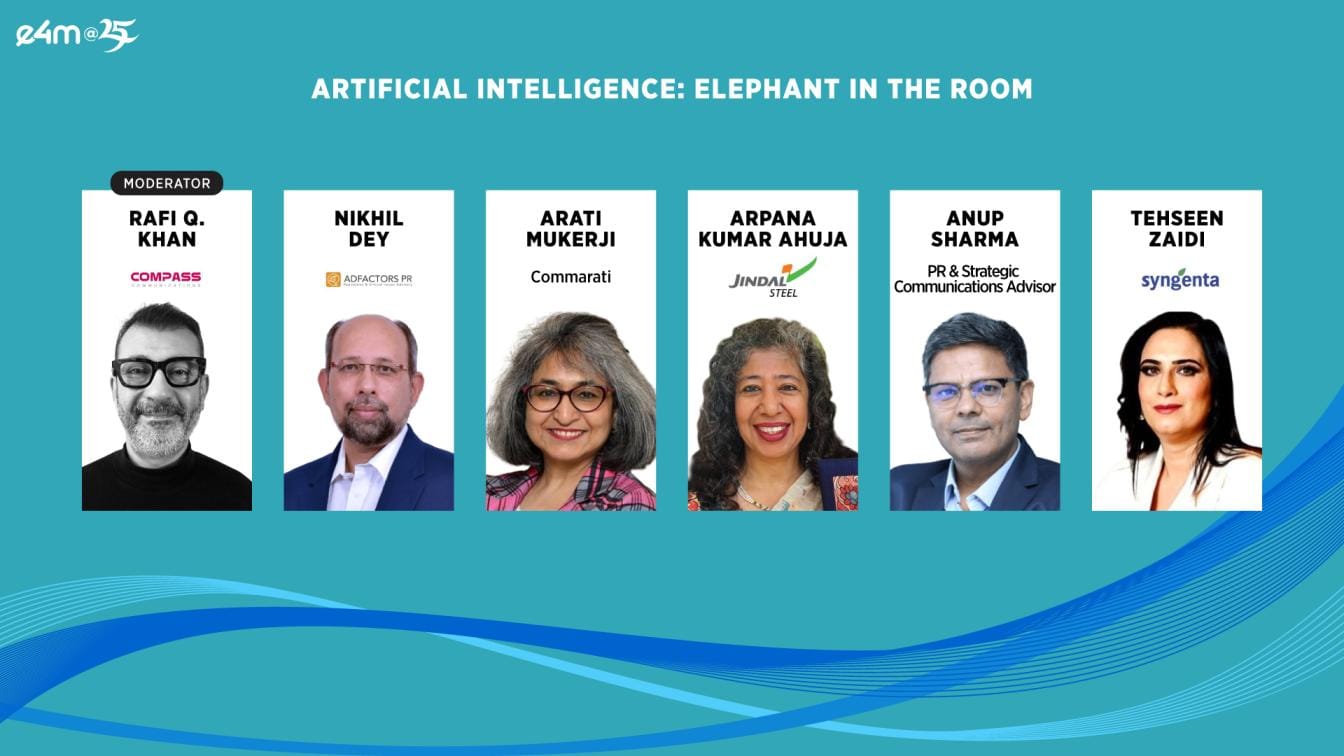

Artificial Intelligence may be the most talked-about force reshaping communications today but is it something to fear, or something to harness? This central question anchored a compelling fireside chat at the e4m PR & Corp Comm Summit 2025, where industry leaders came together to unpack how AI is transforming reputation management, crisis communications, storytelling, leadership, and trust. Moderated by Rafi Q. Khan, Founder, Compass Communications, the session brought together a diverse and experienced panel:
- Nikhil Dey, Executive Director, Adfactors PR
- Arati Mukerji, Founder, Commarati
- Arpana Kumar Ahuja, EVP & Head - Corporate Brand & Communications, Jindal Steel Ltd.
- Anup Sharma, PR & Strategic Communications Advisor
- Tehseen Zaidi, Communications Specialist - IT Digital, Syngenta Group
Opening the discussion, Khan set the tone for a deep, reflective conversation: AI is no longer a distant concept but it is already embedded in how communicators think, plan, and respond.
Crisis Communications in the Age of AI
Khan began by turning to Arati Mukerji, whose career spans the evolution of communications from typewriters to real-time AI dashboards. Drawing from her extensive experience in crisis communication and reputation management, Mukerji reframed the AI debate, “I don’t think it’s an elephant in the room. It’s an enabler,” she said firmly. Mukerji introduced the idea of contextual unification, describing how today’s audiences are exposed to enormous volumes of information across platforms like social, digital, policy, and media, all converging simultaneously. AI, she explained, is helping communicators make sense of this complexity. “Data is shifting the game, from reactive crisis management to predictive analytics and scenario building,” she further added.
Arati highlighted how AI-powered tools are already transforming crisis response through sentiment analysis, influencer mapping, and real-time dashboards that track stakeholder behavior during volatile situations.
“Speed is now the currency of credibility. AI enables real-time analytics, but more importantly, real-time communication personalized for different stakeholders in the same crisis.”
However, Mukerji cautioned against blind reliance on machines. Ethics, bias, and human judgment must remain central, stating, “There has to be a human in the loop for everything. AI brings intelligence, but wisdom, ethics, and character come from us.”
She also pointed out algorithmic biases embedded in AI systems and stressed that while tools to correct these biases are emerging, the industry is still in its early learning phase. “Trust, influence, and reputation will remain the three pillars every brand needs to operate on. We have to re-imagine ourselves, re-imagine the discipline, re-imagine everything that we are trying to do.”
Why PR must own context, not just copy
Picking up from Mukerji’s insights, Khan directed the conversation to Nikhil Dey, asking what communicators must do to remain indispensable in an era where AI can generate content in seconds.
Dey challenged the long-held assumption that PR is primarily about content creation. “If we see ourselves only as content creators, we are limiting our own relevance,” he said. He warned of what he called the fast-foodisation of content, where AI-driven speed and volume risk diluting depth, meaning, and strategy, highlighting an important observation, “Content today is cheap, fast, and abundant, just like fast food. But over time, it becomes unhealthy if not consumed thoughtfully.”
Dey illustrated his point with a personal anecdote from his son’s wedding, where he used AI to research legal requirements for officiating the ceremony but consciously chose not to outsource the emotional narrative. “Delegation is smart. Abdication is dangerous. I delegated the research to AI-but I didn’t abdicate the responsibility of meaning,” he briefed.
According to Dey, AI should free professionals to focus on judgment, empathy, and narrative intelligence, not replace them. “The moment we abdicate our humanness, we lose what makes communication powerful,” he stressed.
How to build AI-Ready communication teams
The conversation then shifted to organizational readiness, with Arpana Kumar Ahuja offering a corporate perspective shaped by leading communications at scale. Ahuja emphasized that AI adoption cannot be siloed, it must be cross-functional. “In our organization, communications, IT, legal, and the chief AI officer work together to define guardrails,” Ahuja underscored.
From deepfakes to early-warning systems, AI is now embedded in Jindal Steel’s crisis playbooks. Yet, she stressed that tools alone are not enough. “It’s good to know the tools and prompts. But the real skill is interpretation, understanding what the data actually means.”
Using a powerful aviation metaphor, Ahuja cautioned against over-automation, “You need to know how to fly to have a co-pilot. Otherwise, it becomes autopilot—and that’s where crashes happen.” She argued that the real challenge is not AI capability, but human adaptability and defined that the elephant in the room is not AI. It’s our inability to reimagine ourselves.”
As long as communicators retain moral courage, narrative clarity, and purpose, AI will amplify not diminish their impact.
Storytelling across cultures
Bringing a historical lens to the discussion, Anup Sharma traced the evolution of communications from fax machines to zero-click news environments, “Narratives have always been managed earlier through wire services, now through AI-generated synopses. If you don’t evolve, you don’t survive,” he said bluntly.
Sharma recounted early digital experiments and how narratives were managed even when technology failed, reinforcing that storytelling has always adapted to disruption. “Today, news doesn’t come in the manner we want. It gives you a synopsis. The question is: Are we promoting it right? AI can give you data, structure and speed but storytelling still depends on knowing the face you are speaking to.”
He stressed that AI-driven summaries and zero-click consumption make narrative precision more critical than ever, explaining, “If today you don’t use AI in a regular format, you are dead. But if you use it without thinking, you are equally dead.”
Trust, authenticity, and the limits of automation
Tehseen addressed one of the most pressing concerns which was trust in an era of deepfakes, bots, and information overload. “AI should be an enabler, a co-pilot with authenticity and credibility. We shouldn't entirely bank on AI,” she asserted.
Sharing a real-life incident, Zaidi described how a deepfake email in her CEO’s voice surfaced during an internal AI training session. “That moment forced us to pause and ask, where are we heading?”
“At Syngenta, we are not allowed to use ChatGPT, we have our own app called SynGPT to protect our data. AI usage is tightly governed, with proprietary tools and strict verification processes. We cross-check, verify, and validate everything. You cannot blindly trust a machine,” she asserted.
Zaidi was unequivocal about AI’s limits in leadership communication and crisis response, “AI can give you data. But only a seasoned communicator understands ground sentiment, government nuance and stakeholder psychology. I will take help from AI to write my original story. My words, my thoughts, that trust and authenticity cannot come from a machine.”
She guided communicators with caution, stating, “The day you give charge to AI for everything is the day you invite disaster for yourself and organisation.”
The Final takeaway
The discussion concluded with the thought that AI is here to stay but it is not here to lead alone. Instinct, empathy, experience, and courage will continue to define effective communication. Technology may help find the match but as one analogy aptly put it, only human touch can never be replaced. AI is not an elephant looming over the profession, but a powerful force waiting to be guided ethically, intelligently, and humanely by communicators who understand both data, innovation, and authenticity.
Read more news about PR and Corporate Communication News, Internet Advertising, Marketing News, Digital Media News, People Movement News
For more updates, be socially connected with us onInstagram, LinkedIn, Twitter, Facebook YouTube & Google News
