Communications for a Purpose: Building Meaning, Trust & Impact
A thought-provoking fireside chat on purpose-led communications unfolded at e4m PR & Corp Comm Summit 2025 with Girish Balachandran of OnPurpose, in conversation with Jyotsna Dash Nanda, DS Group
 by
by
Published: Dec 19, 2025 1:33 PM | 5 min read
 Follow Us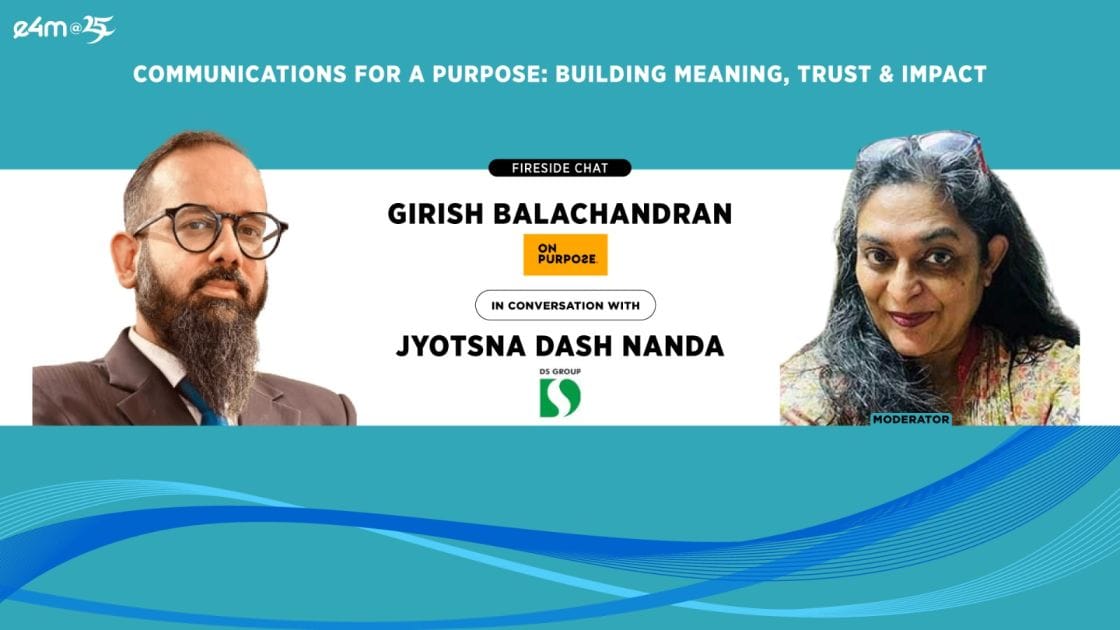

Purpose is no longer a buzzword, it is a responsibility. In an era of shrinking trust and rising inequality, communication has the power to either create real change or merely perform it. Setting the tone for this powerful conversation, the fireside chat on 'Communications for a Purpose: Building Meaning, Trust & Impact' brought together Girish Balachandran, Founder, OnPurpose, in conversation with Jyotsna Dash Nanda, AVP - Corporate Communications, DS Group, at the e4m PR & Corp Comm Summit 2025.
Opening the fireside chat, Jyotsna challenged the room with a fundamental question of "How many of us truly understand what purpose or purposeful communication really means?"
Moving ahead, she first introduced Girish Balachandran, Founder of OnPurpose and traced his journey in India’s corporate landscape. She recalled how Girish returned to India from London around the time when the 2% CSR mandate came into force, witnessing firsthand the evolution of purpose-led work in the country.
Continuing from what Nanda explained, Girish shared his observation on the evolution of purpose, stating that purpose began as a fashionable buzzword but has now entered a far more complex phase. "In the last ten years, purpose has become nuanced and it has also faced a backlash, particularly from the West," he explained. He cited global developments where large investors pulled back from ESG-driven initiatives due to concerns around shareholder returns.
"We’re at a very interesting intersection today. Funding for purpose seems to be drying up, but inequality and social needs are growing at an alarming pace. The need for purpose has never been stronger, even as support for it weakens," he emphasized.
He asserted that this tension raises a fundamental question for communicators - Do corporates see purpose as something that helps profit, or as something that comes at the cost of profit?
Taking the conversation deeper, Girish challenged the industry to introspect on how purpose is communicated. "Do you actually do PR for work that is truly for a purpose, or are you amplifying activity that merely looks good on paper?" he asked. He pointed to examples from the pandemic era, where donations often received disproportionate amplification. "Sometimes, the money spent amplifying the contribution is far more than the contribution itself," he illustrated, underscoring the ethical dilemma between purpose and profits communicators often face.
Jyotsna built on this by asking Girish to share examples where communication had led to tangible, meaningful change.
To this, Girish stressed that purpose-led work is rarely about quick wins. "The change we’re trying to drive is systemic and multi-generational. It’s not something you can run as a one-year campaign, submit an award entry for, and move on," he said. He highlighted that purpose communication is less about transformation and more about culture. "This is about changing mindsets that have been hardened over decades. It’s cultural work, not cosmetic work."
He quoted a powerful example from OnPurpose’s work with the NGO breakthrough, which focuses on ending violence and discrimination against women. One of their campaigns sought to introduce disclaimers in films stating that gender-based violence is unacceptable, similar to warnings shown for smoking or alcohol. “We timed this around the release of films that sparked conversations on toxic masculinity and domestic violence, and we brought celebrities and influencers into the dialogue,” Girish explained.
While acknowledging that problematic portrayals persist in cinema, he highlighted a significant milestone, "Kerala became the first state to adopt this disclaimer in Malayalam cinema, following a signature campaign to the Ministry of Information and Broadcasting. It’s a small step, but an important one."
The conversation then shifted to one of the most pressing challenges in purpose-led communications which is measurement.
Jyotsna posed a question many in the room resonated with - How do we define KPIs for success of purpose driven communications when the outcomes we seek are not immediate or easily measurable?
Girish explained that while media metrics like share of voice may work for visibility-driven objectives, true purpose requires outcome-oriented measurement."If the objective is change, then your metrics have to represent that change, not just coverage, but outcomes," he said.
He cited Sesame Street, OnPurpose’s first client, as a compelling example, explaining, "When Sesame Street asked us how to address childhood obesity in India, the metric wasn’t media coverage. It was whether, over time, there would be a reduction in BMI among children aged three to five. That kind of change takes a generation."
"Purpose cannot be rushed, and it cannot always be packaged neatly for awards," he further added.
As the discussion drew to a close, Jyotsna raised a concerning question around ethics and boundaries in PR and how communicators can draw the line between genuine purpose and purpose washing. To this, he firmly responded, "One of our biggest challenges is identifying what is authentic purpose. Often, we are asked to amplify five percent of good work while ninety-five percent of the business causes harm." He warned communications against becoming ignorant participants in purpose washing, while also acknowledging the economic realities agencies face. “We are service providers. Purpose doesn’t always pay well, and sometimes we have to balance purpose with profit just to keep the lights on. That tension is real.”
Summing it up, he offered a defining lens, stating, "If you’re using purpose to make more profit, that’s purpose marketing. If your purpose comes at the cost of profit—that’s where authenticity begins."
Concluding the discussion, Girish turned to the younger professionals in the room and advised, "I was once asked if PR can be a force for good. My response is that it shouldn’t even be a question. People should automatically believe that we use the power of our craft to make the world better. We may not have done a great job ourselves, but the responsibility now passes to you to shape a more responsible, ethical future for this industry."
Read more news about PR and Corporate Communication News, Internet Advertising, Marketing News, Digital Media News, People Movement News
For more updates, be socially connected with us onInstagram, LinkedIn, Twitter, Facebook YouTube & Google News
