Every Crisis is an Opportunity in Communications: Lessons from the industry leaders
At the e4m PR & Corp Comm Summit 2025, a fireside chat on the theme of Every Crisis is an Opportunity in Communications explored the nature, role, and leadership perspective on crisis communication
 by
by
Published: Dec 22, 2025 1:18 PM | 5 min read
 Follow Us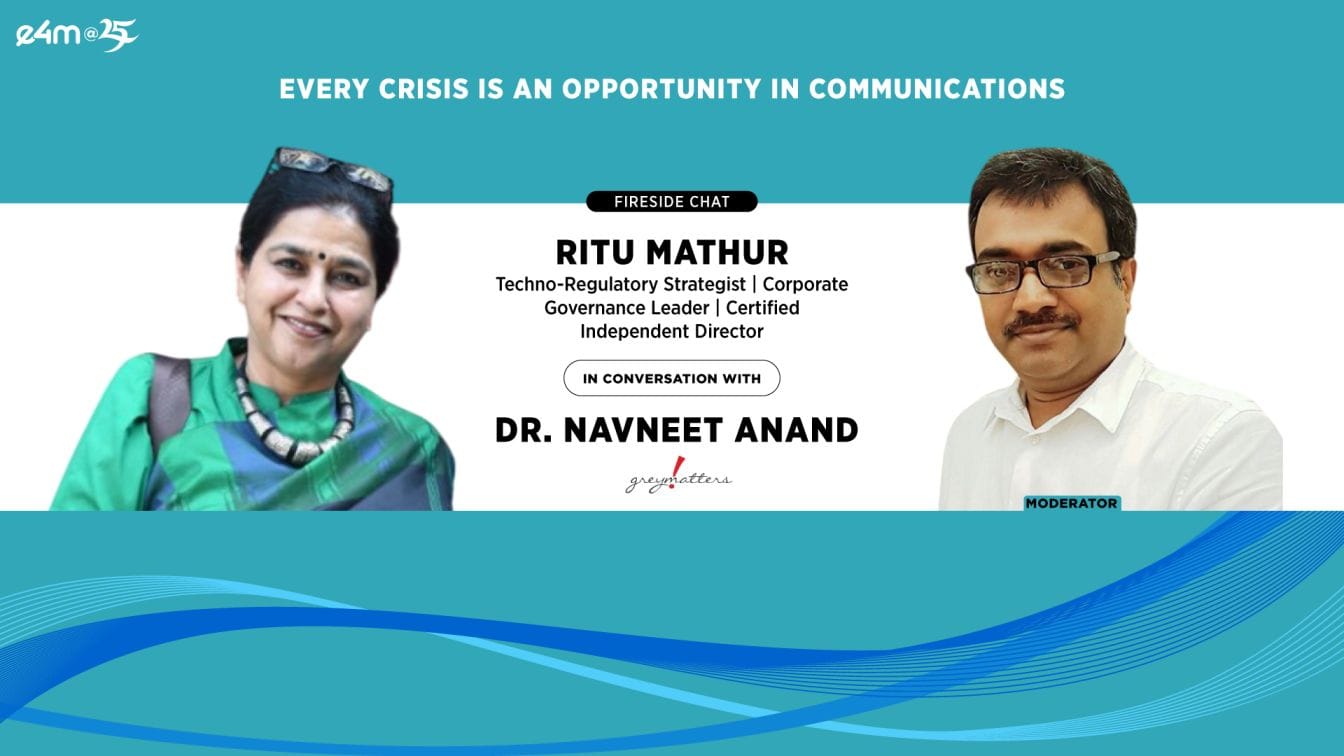

Crises rarely arrive with a caution sign and when they do, they disrupt operations, leadership intent, organisational values, and the authenticity of communication itself. Nowadays, how leaders respond in crisis moments often matters more than the crisis itself.
At the e4m PR & Corp Comm Summit 2025, a compelling fireside chat unfolded on the theme ‘Every Crisis is an Opportunity in Communications’, bringing together two seasoned voices of the communications industry - Ritu Mathur, Techno-Regulatory Strategist, Corporate Governance Leader and Certified Independent Director, in conversation with Dr. Navneet Anand, Founder & Director, GreyMatters Communications. The entire session thoroughly moved between theory, lived experience, leadership lessons and the evolving role of technology, offering the audience a nuanced, deeply human perspective on crisis communication.
Opening the conversation, Anand referred to the turbulence of the preceding weeks and pointed to two incidents that had shaken public confidence, first was the Indigo crisis and the tragic fire at the Birch Romeo by Lane Club in Goa.
Taking the conversation forward, Navneet posed a fundamental question - Is every crisis an opportunity and asked Mathur to share her perspective on what differentiates crisis communication strategies that succeed from those that fail.
Mathur began by sharing instances from her time in Japan, she introduced the audience to the Japanese word for crisis - Kiki. “The word Kiki has two Kanji. One means danger, the other means opportunity. That is the beauty of a crisis. Crisis is not always an opportunity. It depends entirely on how you handle it,” she explained.
For Ritu, communication is the fulcrum on which crisis tilts either towards failure or opportunity. “If communication is successful, your brand gains momentum and trust with the public. If it isn’t, the damage can be long-lasting,” she cautioned communicators.
Illustrating her point, Ritu exemplified instances from her own professional journey, stating, “Tata has always owned up to crises. Look at the Taj during the 26/11 attacks, they didn’t hide behind corporate statements. They went on the ground, helped victims, and took responsibility.” she asserted. She described this approach as human-first communication, where empathy and accountability matter more than carefully worded press releases.
Another example she cited was the leadership transition during the ousting of Cyrus Mistry. “Even after retirement, Ratan Tata stepped in as interim chairman, not for power, but for stability. That is how a crisis becomes an opportunity for trust and brand credibility,” she mentioned.
Building on this, Navneet shared global case studies that underline the cost of poor leadership communication. Recalling the BP Deepwater Horizon oil spill, he pointed out how then-CEO Tony Hayward’s insensitive remarks amplified the crisis and eventually cost him his role. In contrast, he highlighted Samsung’s handling of the Galaxy Note 7 battery explosions. “No noise, no grandstanding. They grounded flights, issued refunds globally within 24 hours and earned public goodwill,” he underscored.
The conversation then took a deeply personal turn. Navneet asked Ritu how her own life experiences both professional and personal shaped her leadership during crises.
Ritu responded, “My leadership was not tested in boardrooms or war rooms. It was tested by life.” She spoke candidly about facing workplace harassment at a time when no legal framework existed to support victims. “I was isolated. I was fighting a system, but I knew my silence would be taken as acceptance,” she exemplified. Her ability to document facts, navigate investigations, and stand her ground built resilience that later translated into her professional life.
“You have to be human and true to your own voice. That is what carries you through every crisis,” she bravely addressed.
Navneet responded by sharing wisdom passed down from his father, who often guides him that failures are the pillars of success. Quoting Harivansh Rai Bachchan, he said, “Jo man ka ho, woh achha; jo na ho, aur bhi achha.”
To this, Ritu also added a philosophical layer from Indian scriptures, “Aham Brahmasmi which translates to you must look within and believe in yourself. That belief works everywhere: corporate or personal.”
As the discussion shifted towards the future, Navneet shared that despite the rise of social media, digital platforms and influencers, crisis preparedness is still not embedded as a strategic imperative within organisations. In regard to this, he asked Mathur to share her perspective on how communicators should become more receptive and prepared to deal with crises in 2026 and beyond.
Ritu addressed, “Crisis is the best test of leadership. It makes or breaks leaders.” She stressed that humanity and ethics must be woven into the DNA of organisations. “Ethics cannot be personality-driven; they must be process-driven. Transparency and integrity are non-negotiable if you want to handle future crises,” she emphasized.
With AI dominating conversations across the industry, Navneet asked Ritu about the role of technology in crisis management. Drawing from her telecom background, she traced the evolution from human-led data analysis to AI-driven insights. “AI should be treated like a team member. Delegate tasks to it, but never outsource wisdom.
“BI should always precede AI- Basic Intelligence before Artificial Intelligence,” Anand further added.
Drawing from decades in telecom and policy advocacy, an industry full of crises, Ritu emphasised that crisis response cannot be templated. “Each crisis demands listening first, carefully and deeply. These are the experiences communicators learn from on-ground experience. There is no one-size-fits-all, even if AI tempts us to believe so.” Balancing stakeholders, customers, regulators, governments and the public requires judgement built through experience, not algorithms alone and we should use human intelligence and our wisdom to handle these crises.
The fireside chat stood out as one of the summit’s most introspective sessions, reminding communication professionals that while tools, platforms and technologies will evolve, human intelligence, ethics and inner conviction remain the most powerful tools in any crisis.
Read more news about PR and Corporate Communication News, Internet Advertising, Marketing News, Digital Media News, People Movement News
For more updates, be socially connected with us onInstagram, LinkedIn, Twitter, Facebook YouTube & Google News