Governance has moved from being tactical and procedural to being strategic and purposeful
Ritu Mathur, Director & Head- NFCG, Confederation of Indian Industry shares her experience, vision and a thoughtful look at the leadership India needs for the decade ahead
 by
by
Published: Dec 1, 2025 10:30 AM | 16 min read
 Follow Us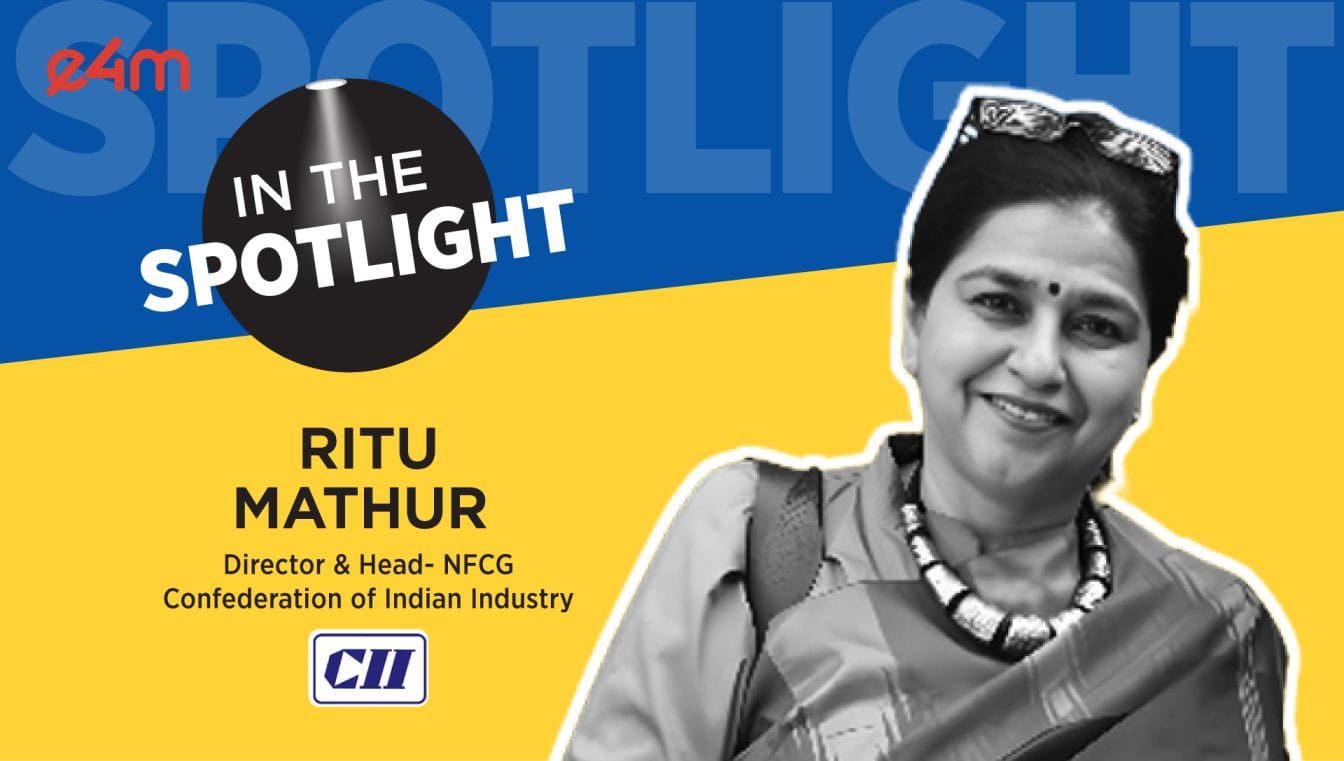

Some leaders build organisations, Ritu Mathur, Director & Head- NFCG, Confederation of Indian Industry builds ecosystems.
At the crossroads of governance, technology, policy, and culture, she has spent over three decades shaping how India thinks, regulates, innovates, and leads. A Certified Independent Director and seasoned techno-regulatory professional, Mathur has mastered the rare art of translating complex mandates into actionable strategies that help businesses stay compliant yet future-ready.
Yet, behind the technocrat is a culturally rooted storyteller. A computer engineer and AoTS scholar from Japan, Mathur also champions India’s artistic heritage. For her, governance and creativity are not opposites but parallel pursuits of discipline, harmony, and purpose. This is the story of a leader who bridges worlds of policy and business, tradition and innovation, structure and soul to redefine what modern Indian leadership can be.
In this 'In the Spotlight' series, we explore the experiences that have shaped Ritu Mathur’s unique leadership journey from the early influences that defined her professional philosophy to her front-row view of how corporate governance in India has evolved over the decades. We explore her perspectives on where governance is headed in the next ten years, and what India can learn from global practices she has observed while working closely with the Ministry of Corporate Affairs and international partners. She also shares her thoughts on what Indian corporations can do to embed inclusivity into their organisational DNA, the key priorities that should drive the next phase of governance reform, and her advice for young professionals aspiring to build careers in communications, governance, policy, and leadership.
.jpg)
Excerpts:
How did your early years shape your professional philosophy and leadership style?
Born as the eldest child in a middle-class family, to an IAS father and a homemaker mother, my early years were deeply influenced by the dynamics of a joint family living. Looking back, I realize that those formative experiences became the foundation of my leadership philosophy. Growing up in a large household where resources were shared and opinions often differed, I learned early the value of inclusion, collaboration, and consensus-building. Financial constraints taught me to appreciate the importance of prudence, discipline, and resourcefulness. These principles continue to guide my professional life.
As the eldest among several cousins, leadership came not through authority, but through responsibility. I often found myself mediating conflicts, making group decisions, and, inevitably, owning up when things went wrong. In the hindsight, these seemingly simple moments were early lessons in accountability, empathy, and decision-making. These qualities form the essence of effective leadership even today. They taught me that leadership is less about control and more about earning trust and inspiring cooperation.
A defining chapter in my career came when my father’s posting took us to Japan during my years in high school. Studying at an international school was a revelation and it expanded my worldview in ways I could never have imagined. Surrounded by classmates from diverse nationalities, cultures, and belief systems, I experienced true pluralism for the first time. Every classroom debate and group project became a masterclass in understanding differences as complementing and not as contradiction. The exposure to a global community at such a young age instilled in me a deep respect for diversity, dialogue, and dignity. These values have guided my personal choices and professional conduct ever since.
In many ways, these experiences of leading cousins in a bustling Indian household to navigating a multicultural classroom in Japan became the twin anchors of my leadership journey. They taught me that whether in life or in leadership, what truly matters are not where you stand, but how you listen, adapt, and uplift others along the way.
How has the corporate governance discourse evolved in India since you began your journey, and where do you see it heading over the next decade?
When I began my career, corporate governance in India was largely viewed through a compliance lens with a control-based framework designed to ensure adherence to rules and regulations. Over time, however, the narrative has evolved from one of control to one of enablement. Governance is no longer seen merely as a mechanism to prevent wrongdoing, but as a strategic enabler of trust, resilience, and long-term value creation.
We have witnessed a profound transformation in the way governance is understood and practiced. It has evolved from the letter of the law to the spirit of good governance. What was once a checklist-driven exercise has become a deeper reflection of organizational character. The focus today is not on ticking boxes, but on building cultures anchored in ethics, transparency, and intent. Boards and leaders increasingly recognize that governance is not about avoiding penalties, it is about earning trust, creating credibility, and ensuring accountability that strengthens stakeholder confidence.
Governance has moved from being tactical and procedural to being strategic and purposeful. It now defines the corporate performance by shaping how organizations approach sustainability, innovation, risk, and social responsibility. The best-governed companies today are those that view governance not as a constraint, but as a compass that aligns purpose with performance and value creation.
Looking ahead, the next decade will be defined by the rise of AI-enabled governance, where intelligent systems will offer real-time risk detection, automated compliance, and data-driven insights that significantly elevate board decision-making. At the same time, companies will need to make ethical AI oversight a core board responsibility. Overall, India’s governance discourse is moving toward a culture of responsible, technology-augmented leadership and AI will increasingly become the silent but powerful ally shaping more resilient and transparent corporate behavior.
.jpg)
You’ve been a part of the global platforms like B20 ESG Action Council and G20 Anti-Corruption Working Group. What were your key takeaways from these experiences?
It was both an honour and an education to be a part of the B20 ESG Action Council and the G20 Anti-Corruption Working Group and witness how governance is evolving globally. My biggest takeaway was the transformative power of technology and collaboration in shaping the future of responsible business.
At the B20, we saw how digital innovation and data-driven tools can enable transparent ESG reporting, track sustainability performance, and strengthen trust across global supply chains. Technology is no longer just an enabler of efficiency; it is an enabler of integrity. The Council’s recommendations focused on harmonizing global ESG standards and using digital platforms to make sustainability both measurable and actionable.
At the G20 Anti-Corruption Working Group, the conversations reaffirmed the need for inclusive and technology-enabled anti-corruption frameworks. Digital tools such as e-governance systems, open data platforms, and AI analytics are now central to preventing corruption, enhancing accountability, and ensuring public trust.
But perhaps the most enduring lesson was the power of collaboration between governments, businesses, and the civil society. When transparency is driven by technology with shared ethical values, governance is not just a regulatory construct, it is a global movement toward fairness and accountability.
Having worked closely with the Ministry of Corporate Affairs and global partners, what differences or similarities do you see in governance priorities across geographies?
The governance frameworks across the world are based on the foundation of trust, transparency, and accountability. What distinguishes them is the unique path each nation takes to embed these principles into its corporate culture fabric and regulations.
Across geographies there is a clear recognition that governance is not just about compliance, but about culture, purpose and long-term value creation. Transparency, independent oversight, and broader stakeholder engagement are common threads. The influence of global capital markets means that emerging and developed economies alike are aligning their frameworks around investor expectations and sustainable business practices.
However, there are still contextual nuances. The U.S. still has a stronger orientation towards shareholder returns and market discipline, whereas stakeholder-value models are more pronounced in Europe and increasingly in Asia. Cultural dimensions also play a crucial role. Japan emphasizes loyalty, consensus and long-term relationships; Europe emphasizes social welfare and sustainable development; India and other emerging markets emphasize inclusion, regulation and growth facilitation.
Across the geographies, governance is converging into a strategic and ethical framework that transcends mere regulatory compliance. Organizations are treating governance not just as a set of rules but as a culture integral to sustainable leadership. This cultural embedding fosters resilience, stakeholder trust, and long-term value creation essential in today’s complex, interconnected business ecosystem.
.jpg)
What are the biggest challenges in communicating complex regulatory or governance issues to diverse audiences?
One of the biggest challenges is translating highly technical frameworks into narratives that resonate with audiences who have very different levels of familiarity and very different stakes in the outcome. For example, while a CFO may understand the nuances of related-party transaction rules, frontline employees or retail investors may only grasp their significance when framed in terms of fairness and trust. Similarly, explaining something like ESG disclosures or AI-governance guidelines to the public requires shifting from legal jargon to real-world impact of how it affects product safety, data privacy, or environmental responsibility. The communication must balance accuracy with clarity, simplify without diluting intent, and use relatable examples such as how stronger cybersecurity norms protect customer data or how transparent climate reporting influences investor confidence. This ensures that complex governance conversations remain accessible, credible, and meaningful across all stakeholder groups.
Another vivid example is the rollout of mobile number portability (MNP). On paper, it was a regulatory reform designed to enhance consumer choice and market efficiency. But on the ground, it required extensive stakeholder communication- from operators adapting their systems, to consumers understanding the process, and regulators ensuring fair play. The success of MNP depended less on the regulation itself and more on how clearly its intent and benefits were communicated. Adoption became seamless when people saw it as empowerment rather than disruption.
These experiences taught me that effective communication in governance isn’t about simplifying the law, it’s about contextualizing its purpose. Governance becomes meaningful when it speaks not just compliance, but purpose.
As a techno-regulatory professional, how do you see technology influencing governance and compliance frameworks today? What role should board and senior leaders play in staying ahead of the curve?
Since I began my career as a computer engineer and later transitioned into policy and governance, I’ve had the unique vantage point of seeing how technology has moved from being a tool of efficiency to becoming a cornerstone of governance. Over the years, I’ve seen compliance evolve from a manual, control-based process to a data-driven, insight-led discipline that enables transparency, agility, and foresight.
With AI and Data analytics we now have the ability to anticipate risks, not just respond to it. For boards and senior leaders, this shift demands a new kind of literacy — one that goes beyond understanding technology to using data intelligently for predictability, innovation, and ethical execution. Today the role of boards and senior leaders is no longer just about oversight, it’s about foresight. Governance today demands leaders who can anticipate change, not merely respond to it.
Boards must move beyond reviewing quarterly results to interpreting trends in technology, geopolitics, sustainability, and societal expectations. Staying ahead of the curve means understanding how artificial intelligence, data governance, and digital ethics are reshaping risk, reputation, and responsibility.
Senior leaders must also champion a culture of continuous learning and ethical innovation. As AI and automation transform decision-making, the most effective boards will be those that combine digital fluency with moral clarity and ensuring that technology serves the humanity.
What more can Indian corporations do to make inclusivity part of their DNA?
Inclusivity, to me, has never been just a policy goal, it’s a culture. This starts with inclusive hiring pipelines for example, partnering with universities in smaller towns, second-career programs for women returning to work, and targeted recruitment of people with disabilities with accessible workplace design. Technology, too, can play a transformative role such as AI-based hiring and analytics that reduce bias and digital learning platforms that democratize access. But the real transformation happens when inclusivity is woven into everyday decision-making, not treated as an initiative.
Indian corporations today have made commendable progress. There are diversity charters, board mandates, and gender representation policies that are gaining ground. But to make inclusivity part of their organizational DNA, it must evolve from policy to practice, and from metrics to mindset.
The next leap for businesses lies in moving from diversity as a number to inclusion as a norm. Creating ecosystems where everyone, regardless of background or identity, can contribute meaningfully and thrive. True inclusivity isn’t an HR agenda; it’s a leadership responsibility and a governance priority.
Finally, inclusivity becomes part of the corporate DNA when it shows up in products and customer experience for instance, banks designing accessible digital apps or consumer brands featuring diverse representation in marketing. When inclusion shapes how a company hires, develops, leads, and designs, it becomes not an initiative but an identity.
Which of your professional achievements are you most proud of, and why?
Among the many milestones in my leadership journey through telecom and governance, a few achievements stand out for their impact and alignment with core values of transformation, resilience, and ethical stewardship.
One of the professional milestones I’m proudest of dates back to my early years in the telecom sector, when I joined the Telecom Regulatory environment during the very initial stages of liberalization. It was an exciting yet uncertain time — the sector was evolving rapidly, and all of us were learning in real time, drawing from global best practices while adapting them to India’s unique geographical, political, and socio-economic diversity.
What made those years so meaningful was the delicate balance we had to strike between complex regulatory mandates and dynamic business imperatives. The Regulator and the Licensor were focused on easing the framework and enabling new technologies, while businesses were eager to innovate and lead the market. The real challenge was ensuring that compliance didn’t stifle creativity, and innovation didn’t breach regulation.
For instance, when we rolled out a major regulatory-mandated tariff restructuring, I led the effort to translate dense TRAI guidelines into simple, customer-friendly messaging and internal playbooks, making sure thousands of field staff could explain the changes with confidence and reducing customer complaints during a high-impact transition. Another example was steering a governance and compliance revamp during a network-expansion phase, where I helped harmonize processes across operations, technology, and sales to ensure that rapid growth did not compromise regulatory discipline. I’m also proud of championing digital adoption on the ground, such as training field teams to use analytics dashboards for quality-of-service metrics, which improved issue resolution and boosted customer satisfaction. These achievements stand out because they combined technical complexity, regulatory sensitivity, and large operational teams and turned them into opportunities for clarity, ownership, and stronger organizational performance.
Looking back, I realize my technical training helped me bridge the gap between regulation and innovation, translating policy intent into practical solutions. What guided me most was a belief that governance and business need not be at odds; they can co-exist and strengthen each other with clarity, collaboration, and ethical intent.
.jpg)
What do you think are the key priorities for the next phase of corporate governance reform in India?
As India stands at the intersection of technological transformation and global integration, the next phase of corporate governance reform must move beyond compliance and focus on conscious, tech-enabled, and ethically guided governance.
The priority would be to ensure that governance frameworks evolve with advances in data, digital infrastructure, and artificial intelligence. Technology today can significantly strengthen governance through predictive analytics for risk management, AI-driven compliance monitoring, and data transparency that builds investor and public trust. However, these tools are only as effective as the integrity of the intent behind them.
Therefore, as AI becomes an integral part of corporate decision-making, AI ethics must become a central pillar of governance. Boards will need to understand not just what technology can do, but what it should do. Establishing clear ethical guardrails for data use, algorithmic accountability, and privacy protection will be critical to maintaining stakeholder confidence and societal trust.
Equally important is the need to re-skill boards and leadership teams to become digitally fluent and ethically agile. Governance reform must focus on enhancing board capacity to interpret data-driven insights, anticipate technology risks, and align innovation with the organization’s purpose and values.
India has the opportunity to pioneer a model of governance that is both digitally progressive and morally grounded, one that uses technology not as a compliance instrument but as a catalyst for transparency, inclusion, and sustainable growth. The future of governance will not be defined by how much data we collect, but by how responsibly and intelligently we use it. That, I believe, is the true next frontier of corporate governance reform in India.
What advice would you give to young professionals aspiring to make a mark in communications, governance, policy, and leadership?
The world is changing faster than ever — technology, data, and AI are reshaping how we make decisions, influence systems, and lead people. My foremost advice is: be ready to unlearn and relearn continuously. The future will belong to those who can combine technological fluency with human wisdom.
Embrace emerging technologies, understand global trends, and cultivate data literacy. Ethics, empathy, and purpose should be your anchors and your integrity will be your greatest differentiator.
Secondly, develop a global perspective with local sensitivity. Governance and policy are no longer confined by borders; every decision has cross-sectoral and international implications — from sustainability to digital privacy to inclusion. Stay curious about global challenges, but learn to interpret them through the lens of your own country’s needs and values.
And finally, lead with clarity and courage. In my own journey, I’ve learned that leadership is not about having all the answers, it’s about asking the questions, creating space for diverse voices, and standing firm on principles when it’s easier to compromise. The most enduring leaders will be those who use innovation not just to build progress but to build trust.
Read more news about PR and Corporate Communication News, Internet Advertising, Marketing News, Digital Media News, People Movement News
For more updates, be socially connected with us onInstagram, LinkedIn, Twitter, Facebook YouTube & Google News