OOH Advertising: Why it is the last unskippable medium
Experts at Goafest spotlight how OOH is evolving into a tech-powered, insight-driven, creative canvas that’s impossible to ignore
 by
by
Published: May 22, 2025 7:08 PM | 4 min read
 Follow Us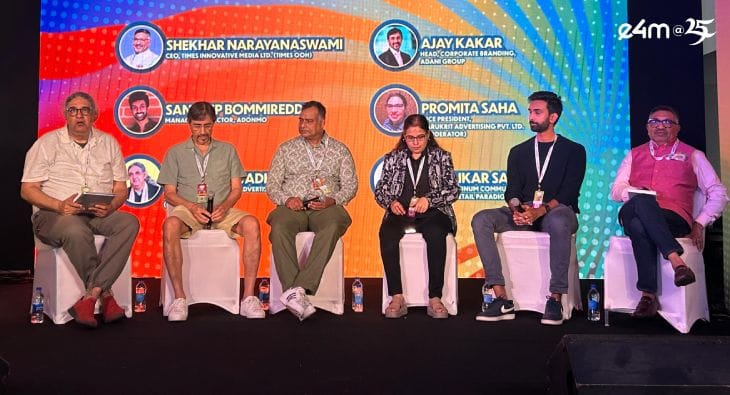

In an age where consumers are surrounded by content they can scroll past, skip, or mute, out-of-home (OOH) advertising remains one of the few formats that commands undivided attention. The Goafest session, “Ignite the Attention – The Last Unskippable Medium,” brought together leaders across the advertising value chain to spotlight how OOH is evolving into a tech-powered, insight-driven, creative canvas that’s impossible to ignore.
Opening the discussion, Praveen K Vadhera, CEO of IOAA, pointed to a disconnect between reported and real market size. “Most of the agencies came out with about Rs 4,000 crores, but we've always felt this was hugely under-reported,” he said. A more thorough study with EY revealed the number is likely closer to Rs 6,000 crores, with a real potential of Rs 9,000-10,000 crores annually.
A major driver of this growth is the rise of measurability. Platforms like Roadstar have enabled agencies to speak the language clients understand: impressions, reach, and frequency.
However, the conversation quickly moved beyond numbers. Ajay Kakar, Head- Corporate Branding of Adani Group made a powerful case for redefining what OOH even means: “We think of ourselves as hoardings, we think of ourselves as sites. We do not think of ourselves as out of home—though that’s our meaning.” His view: life itself is lived out-of-home, and the medium must reflect that breadth of experience.
This experiential definition of OOH found resonance across the panel. Shekhar Narayanaswami, CEO of Times OOH emphasised how physical formats cut through digital fatigue. “It is something that is there which you cannot ignore,” he said. From digital screens to flash mobs and branded experiences, the medium’s possibilities have expanded—and when amplified through social media, “magic happens.”
For Sandeep Bommireddi, MD of Adonmo, the key lies in viewing digital as a horizontal rather than a vertical. “Digital is not a vertical; it's actually a horizontal. Every single vertical is being enhanced by digital—TV, radio, and now, out-of-home,” he said. His company’s focus is not on formats, but on “selling attention of affluent urban audiences.”
But even as technology transforms execution, the panelists agreed that creative strategy often lags behind. Promita Saha of Karukrit Advertising shared her frustration with how campaigns are executed: “We have to stop adapting a mother creative for out-of-home… It cannot be a smaller format of a PPT slide blown up to a 120 by 40 screen.” Instead, she called for stories built from the ground up—rooted in consumer insights and tailored to the context of where people are and how they engage.
She also made a compelling case for hyper-local storytelling: “You have a Durga Puja festival which has millions… and a smaller festival called Shikal Shashti in Odisha. If you want to hyper-personalize your campaign, you have out-of-home.”
Perhaps the most memorable anecdotes came from Kakar, who recalled using aero bridges at Mumbai Airport for an emotional brand activation. “My employees came and told me, ‘My family didn’t know where I worked.’ That’s the kind of impact we created because we caught the consumer where they actually were.”
He also urged the industry not to fall into the trap of “digital vs. traditional,” arguing that the focus must remain on the consumer. “Have you ever heard of a TV strategy? Or a print strategy? You have to hear about a customer strategy.”
In a market chasing attention across screens, the message from the panel was clear: OOH isn’t just unskippable, it’s unforgettable when done right. With data, creativity, and context aligned, out-of-home is not only growing, it's leading the way in a cluttered media world.
Read more news about Out of Home, Internet Advertising, Marketing, Digital Media, TV Media
For more updates, be socially connected with us onInstagram, LinkedIn, Twitter, Facebook, YouTube & Google News