‘You cannot have a transactionally robust & healthy brand which is inherently weak’
On Day 2 of Goafest 2025, an expert panel discussed the evolving nature of placements to partnerships
 by
by
Published: May 22, 2025 6:34 PM | 5 min read
 Follow Us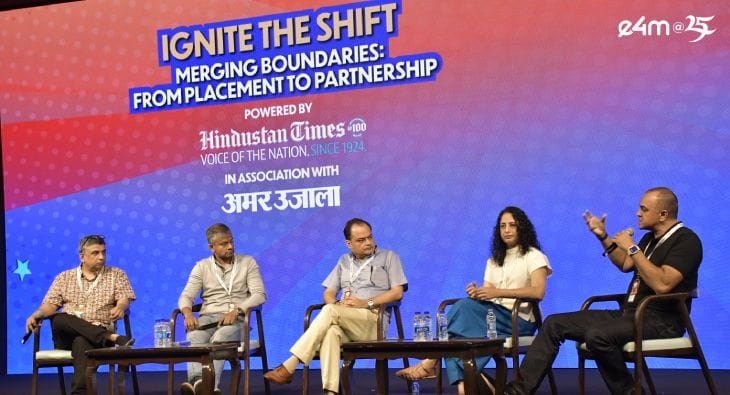

In the evolving marketing landscape, the tension between performance-driven campaigns and brand-building efforts has become a critical challenge for marketers and agencies alike. Owing to this transition, the traditional role of media agencies as mere ad placement partners is naturally undergoing a significant evolution. What began as a business of media placements has now evolved into a dynamic, multi-dimensional partnership model. This was the core insight that emerged from the power-packed panel discussion at an expert panel on Day 2 of Goafest 2025, where leaders candidly discussed the pitfalls of segregating performance marketing from brand initiatives and the need for a unified approach that drives sustained growth.
Opening the session, Kartik Sharma, Group CEO, Omnicom Media Group India, remarked on how media buying has transformed over the decades. “When we all started our careers, the media was really a business of placement. The big decision was where to advertise and put some ads in print.” He posed a critical question on what a media agency means today, and how that definition has changed in just five years.
Offering her perspective, Rathi Gangappa, Chief Executive Officer, Starcom India, underlined that the biggest shift is in “connectivity.” She said, “It’s not just about placements anymore, we are talking to our clients about building the dots between storytelling, media, creative arts, influencer and even probably loyalty.” For her, agencies are no longer vendors, they're connectors, weaving together disparate threads to build brand relevance. She cited a line from her group CEO, saying, “It’s no longer innovate or die, but it’s actually connect or die.”
Bringing in the advertiser’s lens, Shubhranshu Singh, CMO, Tata Commercial Vehicles, emphasised that the very architecture of agency-client relationships is evolving. “That distinction is not about two teams living in two different offices,” he noted. He predicted a hybrid future where some agency professionals would be embedded within client ecosystems. He also pointed out that partnerships today depend on where in the funnel the collaboration adds the most value, be it top-funnel awareness or bottom-funnel conversion. “It would be beyond the ken of any single partner to do all parts,” he asserted, underlining the need for specialised expertise and long-term alignment. “You must be very judicious about the choices you make. Once you make them, I think you should stick to them. It should work like a marriage,” he further added.
Bringing in a unique and relatable analogy, Satya Raghavan, Director, Marketing Partners, Google India, likened agencies to superheroes. “I think the agency is literally the CMO’s superpower,” he said, comparing marketers to Avengers with agencies as their special allies in navigating the complex consumer universe. He elaborated on this analogy by mentioning, “The consumer is on YouTube and Search, shopping across all of these platforms. So pinpointing that consumer is the most important task.” He also emphasised how data and technology are now integral in understanding shifting consumer journeys and serving content at the right moment.
Ajit Varghese, Head of Revenue, Entertainment & International, JioStar, concluded with a simplified framework of the marketer-agency relationship. He described it as three distinct jobs - understanding the consumer, activating the media, and driving outcomes. He added, “From secondary research to first-party data, the foundation has evolved, but the goal remains unchanged, which is delivering business results. Agencies that go beyond execution and become true growth partners, grounded in shared objectives, are the ones that will define the future.”
The conversation also touched upon the need for the brand-agency partnership model to evolve, on which Varghese highlighted a fundamental challenge that agencies face today - the divide between performance marketing and branding within client organisations. “Even in a client's business, performance and branding have been handled by two different people, and agencies probably have modelled that,” he said. He noted that performance marketing is easier to quantify due to its mathematical nature, which makes short-term results more straightforward to prove. In contrast, branding requires a longer-term perspective, with metrics that are harder to immediately demonstrate. “If the partnership model needs to evolve further as we speak, I think agencies should be allowed to challenge the hypothesis, probably at the same time, both should sit together with one person handling,” he explained.
Gangappa agreed and further added, “Most clients look at it from a short-term perspective versus a long-term perspective”. She highlighted how short-term performance often gets immediate attention, while the branding efforts provide the foundation for sustained growth. She also acknowledged the complex balancing act media agencies perform, striving to be versatile across different skill sets. She added, “If you believe that jack of all trades is not a good word, believe me, as media people, jack of all trades is best, because you have to answer all those questions, and we need to try to do that.”
Lastly, sharing a broader reflection on the challenges the industry faces with attribution and the impact of AI, Singh said, “Generally speaking, the creative industries are losing out, the Excel sheet guys are winning,” he remarked, pointing to the overwhelming focus on measurable digital outcomes. He cautioned against over-relying on attribution alone, saying, “My belief in God, whether I love my mother, whether I believe in honesty are not attributable, but they are true.” He further warned against the seductive but misleading notion that “this time it’s different” with every new technology, including AI. While acknowledging AI’s role, he urged marketers to stay grounded, “Media must operate within those boundaries.”
Read more news about Internet Advertising India, Marketing News, PR and Corporate Communication News, Digital Media News, Television Media News
For more updates, be socially connected with us onInstagram, LinkedIn, Twitter, Facebook YouTube & Google News
