Changing the face of masculinity in advertising
On Day 2 of Goafest 2025, a panel discussion on ‘Mardon Wali Baat: A discussion on Masculinity in Advertising’ unpacked evolving portrayals of masculinity in Indian advertising
 by
by
Published: May 22, 2025 6:46 PM | 5 min read
 Follow Us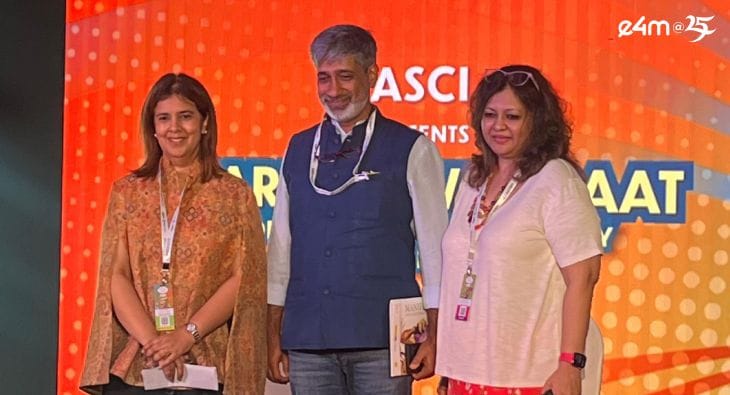

‘Mardon Wali Baat: A discussion on Masculinity in Advertising,’ was the topic of panel discussion - presented by Knowledge Partner – ASCI - that looked to capture the cultural nuances of masculinity with Karthi Marshan - Principal, Marshan.Ink. Kotak, Nisha Singhania - Co-Founder-Director at Infectious Advertising and moderated by Manisha Kapoor CEO and Secretary General of the Advertising Standards Council of India (ASCI)
Kicking off the discussion Kapoor said that often masculinity is used in relation with feminism, and asked if it is now time for masculinity to have its own pillars and not be juxtaposed with feminism. On this Singhania highlighted that today the word ‘man’ is used as a pre-text with negative connotations like mansplaining. She says, “We have forgotten the word ‘human’ which also has man in it and we should look to explore that further - the human side of being a man, as today the branding of masculinity stands for strong. Men have been brought up thinking that they have to be strong which is not necessarily bad, but can we really manifest what strong stands for? Strong just doesn't have to be physicality. It could also be emotions, if a man cries and shows his vulnerability, that is also strong. Masculinity needs a lot more deep diving and opening up the conversation on how it's not just unidimensional and there's so many facets and layers to it.”
Taking the conversation further on the use of tropes in advertising and if tropes are still needed in marketing campaigns. On this Marshan, reminisced about a campaign executed in 2010 on the 25th anniversary of Kotak Mahindra where men were asked what the number 25 meant to them. One respondent answered that he had a traumatic incident when he was 25 – his marriage, while another spoke of a risqué trip to Bangkok; today looking back he is ‘embarrassed’ of this campaign. He says, “It would be dangerous to say this today in a woke, or in a post-woke world. However, we did a campaign for our insurance product where the man says that post-retirement, he would like to buy a house and retire in Goa but his wife then said, no, we will open a restaurant. In my long career at Kotak Mahindra, we tried to flip the narrative and tested what we could explore but the truth is, it's super complex and this is just the beginning. The words masculine and feminine are super loaded and could trigger some section of the audience. We need to redefine and find a new vocabulary. I feel we need to just remove sex and gender from the conversation completely sanitize it, and then discover what it means to be human. That's the bottom line for me and let's focus on that.”
Kapoor highlighted the pushback from marketers who believe the audience to be traditional and what could be done to push the envelope particularly in the case of legacy brands. Singhania states, “Being safe is the best option as there is risk aversion. We also have proven data about what has worked in the past and what could likely to work in the future. For a brand to create a new narrative or establish what it stands for is a long journey. Unfortunately, most brands and marketers don't have the patience or the risk appetite to invest in the long term. If brands can give themselves the luxury of time, then maybe a lot more of these conversations can happen but if everyone is going to look at here and now, then it's going to be difficult to have these conversations.”
Taking a Marshan stated, “If marketers and advertising people don't stick their neck out and take a stand and say something disruptive they're wasting their money and their time even in the short term. It may be risky but actually if you hear the audience most of them don't care. Our job is just to get their attention. You can get their attention even with what appears to be woke communication. Once you got their attention, everybody will buy.” He then shares an example of work from Kotak Mahindra, “One of my favorite examples from Kotak Mahindra is a banking product we launched for women called Silk. I did feel the idea was off but the justification for Silk was that silk is soft, feminine, and also strong. It was a product trying to solve for female financial literacy, female emancipation, etc. and the joke is that 70% of people who bought that product were men. When we do what sticks out more people will buy, but it's just about getting attention.”
Kapoor also highlighted that earlier advertisers, brands and marketers would take a risk and stick their heads out and it doesn't feel like that anymore. She added that today’s advertising is a reflection of what society was of few years ago, if not decades ago. However, when you actually look at people's lives, they are ahead of what advertising shows.
Agreeing to this point Marshan says that advertisers underestimate the audience. He added, “Bollywood actually gets the audience far faster than we in advertising tend to get. We live in our own little bubble and imagined realities.” Adding to this Singhania says, “It is refreshing when a client says let's try and do something different. It's music to one’s ear, but it is equally important for us to go out in the market and have conversations. You'd be surprised that audiences are ahead of the curve and for us to think they will reject the thought is us doing lip service. It is definitely time for both marketers and advertisers to try and be brave. It takes one brave idea to succeed for everybody else to follow suit.”
Read more news about Internet Advertising India, Marketing News, PR and Corporate Communication News, Digital Media News, Television Media News
For more updates, be socially connected with us onInstagram, LinkedIn, Twitter, Facebook YouTube & Google News