How DOOH is reshaping the modern media mix
As DOOH advertising matures, it’s proving to be more than a flashy add-on — it’s a strategic asset in omnichannel brand building, say industry leaders at the e4m Neons OOH Conference 2025
 by
by
Published: May 10, 2025 8:58 AM | 9 min read
 Follow Us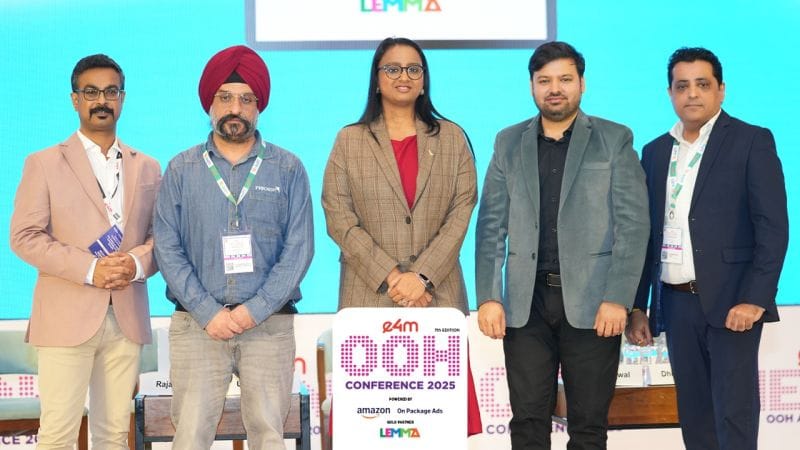

At the e4m Neons OOH Conference 2025, leading industry voices came together to explore how technology, sustainability, and digital integration are reshaping the future of Digital Out-of-Home (DOOH) advertising in India.
The panel featured Rajat Sikder, Director, Walk the Talk; Udita Shroff, Regional Head Marketing, South Asia, Middle East and Africa, Cathay Pacific; and Saket Agarwal, General Manager Brand & Marketing, D'Decor Home Fabrics. The session was chaired by Dhirender Suri, Vice President, GroupM OOH Solutions.
Opening the discussion, Shroff reflected on the evolution of the medium. “Earlier, outdoor advertising was all about frequency, size, visibility, and location. But over time, we’ve seen a lot of tech innovation and interactive elements that have really changed the kind of inventory available for DOOH,” she said.
“India is catching up, but globally, there's a lot more happening, especially in the era of 3D digital outdoor inventory. The change isn't just in formats, but in tech, personalisation, and how clients can use these formats.”
Agarwal described the evolution of DOOH in three stages. “It’s a double whammy for outdoor. Today, you’re not just competing with the board next to you—you’re competing with digital media,” he noted. “You have to tell your story in four seconds while people are distracted by their phones.”
He explained how other traditional media are also adapting. “TV is moving towards CTV, magazines are becoming digital-first. Similarly, outdoor has evolved. In 2024, all our OOH budgets shifted to digital. None of the boards we did were static—they were completely digital-first,” he said.
“For a brand like ours, which is visual and focused on beauty and photography, digital boards allow for more impactful storytelling,” he added. “We haven’t yet tried anamorphic content like some other brands, but the kind of visual impact we can create with DOOH has definitely helped us.”
Sikder took a step back to contextualise DOOH within the broader out-of-home category. “DOOH is not a standalone domain. It’s part of a larger domain—OOH—which is one of the oldest traditional media in the country, almost 100 years old,” he said. “DOOH came in its first avatar over two decades ago when media owners digitised boards in ambient spaces. But it was probably ahead of its time and didn’t see wide adoption.”
He described how the second wave of DOOH, around seven to eight years ago, gained faster acceptance due to the rise of digital-native audiences. “Today’s Gen Zs and younger millennials relate more to digital media and interactions,” he said.
He acknowledged the impact of programmatic and creative innovations in shaping the DOOH landscape. “Programmatic DOOH has started and is already happening, though not across the entire inventory,” he said. “There’s no sanctified data, but we estimate around 1,80,000–1,90,000 screens across the country, including ambient spaces.”
Highlighting the challenges, Sikder said, “OOH has always had its share of nuances, and DOOH is no different. The number of media owners is large, making the process slow. But the way forward for DOOH is definitely programmatic. If we’re not able to offer programmatic, then the biggest element of digital integration is missing.”
Value Proposition of DOOH
Agarwal clarified that while out-of-home (OOH) isn’t their main medium, it holds a strong position in the media mix for D’Decor. “If you ask me if out-of-home is the main medium today for us, the answer is no. But since we are a very visual brand, it’s an important one,” he said.
He emphasised how DOOH supports upper-funnel goals. “You can show your story, your visuals, especially with digital boards, and the impact. My top-of-the-funnel objective is very well met with out-of-home, whether it’s awareness or limited-period campaigns like Diwali promotions,” he added.
Citing an older campaign with Shah Rukh and Gauri Khan, he said, “I remember our purple couch ad. It became so popular because out-of-home stores started demanding that exact purple cloth.” He believes that while that was during traditional OOH’s prime, DOOH makes storytelling even more effective today. “You can’t replicate that scale or impact in print or on a small digital screen,” he noted.
Shroff offered a different perspective. “For us, the take is a little different. We’re not a hardcore retail brand, so OOH or even DOOH has never been an active part of our communication strategy,” she admitted.
However, she acknowledged that evolving formats and increased interactivity have changed the game. She also pointed out that DOOH’s expanding presence in airports, corporate hubs, and malls—spaces more relevant to Cathay Pacific—has opened new doors. “A decade ago, these opportunities weren’t there. But now we can hyper-personalise, reach the right audience, and eventually see better ROI,” she said.
Changing Client Perspectives on Media Mix
Sikder observed a noticeable evolution in the client mindset regarding media investments. “There is a definite shift in the media mix from the time DOOH picked up to today,” he said.
He stressed that brands must be intentional in how they use DOOH. “It’s not just about putting up a creative. If a medium is five to six times more costly than traditional, and you’re investing heavily, you better use it to its full potential,” he said, adding that creative integration is key.
He also acknowledged market constraints, like regulatory restrictions in cities such as Mumbai, but said DOOH’s share is steadily rising. “The contribution of DOOH is now between 10 to 12 per cent, and for us, it’s around 18 to 20 per cent,” he shared.
Innovations have helped drive this growth. “We did an anamorphic DOOH for one of our brands, and it won a lot of accolades,” he said.
Impact of Integrating DOOH with Social Campaigns
On the social extension of the campaign, Shroff said, “Any campaign today cannot be looked at in a silo. We have to look at multiple media together.” She explained that while audiences may glance at DOOH while looking out of a car, they’re also constantly on their phones. “We had a strong social and PR campaign to support one of our campaigns, and it became a well-rounded, holistic campaign.”
She emphasised how equal investment in digital ensured consistent messaging across platforms. “It wasn’t just about visibility on DOOH, but also about syncing it with digital. That’s where the extension comes from.”
Shroff also highlighted the rising relevance of contextual messaging. “Today, being part of the right conversations is key. Earlier, only digital gave us the flexibility for contextual messaging because of the fast turnaround. But now, even with DOOH, you can bridge that gap,” she said.
Agarwal agreed that DOOH has worked well for D’Decor. However, he admitted to a misstep with QR codes. “Let me say my failure: we tried using QR codes, thinking we’d collect data, get people to our website to fill in their names. But it didn’t work.”
He explained that the success of QR codes depends entirely on context. “If it’s used for instant gratification—discounts or vouchers—it works really well,” he said. “But using a QR code on a billboard? That’s not going to work. Nobody stops to scan one.”
Instead, he suggested controlled environments. “Use it at a mall or maybe an airport. Not at a metro, because we’re a premium brand. But you need the right environment,” he emphasised. “Don’t blindly copy-paste strategy.”
To reinforce his point, Agarwal referenced Calvin Klein’s #MyCalvinKleinLook campaign and Spotify Wrapped as global examples. “People posted their Calvin Klein look on social, and that content went on OOH. Spotify took people’s top songs and turned them into DOOH stories.”
“When you pass by and see something you relate to—that’s when social and OOH truly come together,” he concluded.
Sustained vs. Campaign-Based Use of DOOH
“It depends entirely on the brand,” said Sikder. He cited a recent KFC campaign that was entirely DOOH-driven. “They were launching a new product, and we executed a visually stunning anamorphic display. Anamorphic has to be on DOOH.”
He pointed out that for most brands today, DOOH is becoming a regular part of the media mix. “In many key touchpoints, DOOH is the only option available,” he said, adding that outdoor is all about “where your TG dwells most.”
He emphasised that the medium is expanding rapidly. “Every day, there’s a new DOOH screen being put up somewhere.”
However, he flagged challenges in policy and infrastructure. All stakeholders need to represent their case to the authorities. If there are limitations, DOOH won’t scale.
On the creative side, Sikder stressed the importance of consistency. “For a cross-media campaign to work, the creative needs to be synced, DOOH, static, digital, it should all feel like one campaign.”
But that’s easier said than done. “It’s very simple to adapt a static creative. Adapting a DOOH creative, especially an animated or video one, is far more complex.” He explained that many videos are shot without considering format constraints. “If it’s filmed in 16:9 and you suddenly need it in a vertical format, the essence is lost. That’s a typical client problem.”
Read more news about Out of Home, Internet Advertising, Marketing, Digital Media, TV Media
For more updates, be socially connected with us onInstagram, LinkedIn, Twitter, Facebook, YouTube & Google News