How storytelling, tech and data are reshaping OOH advertising
At e4m Neons OOH Conference 2025, industry leaders deliberated on how the future of out-of-home lies in immersive storytelling, digital innovation, and actionable data
 by
by
Published: May 10, 2025 7:59 AM | 10 min read
 Follow Us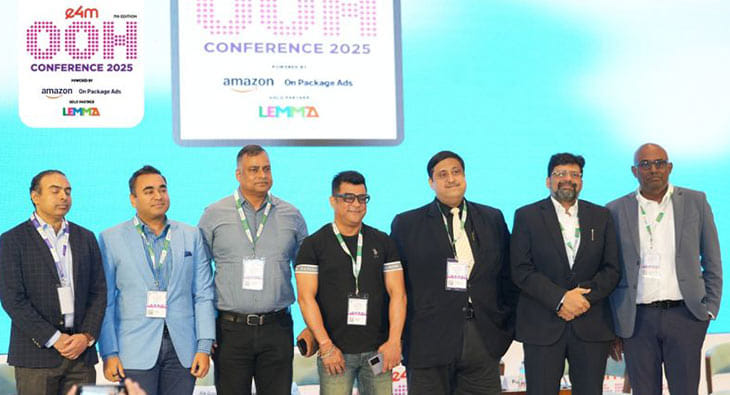

At the e4m Neons OOH Conference 2025, industry leaders gathered to explore the shifting paradigms of out-of-home (OOH) advertising, focusing on how digital innovations, sustainability, and integrated strategies are redefining consumer engagement in public spaces.
The session, titled “Reimagine | Reinvent | Revenue: 3Rs of OOH for Brands”, featured Yuvraj Agarwaal, Chief Strategy Officer at Laqshya Media; Alok Gupta, Director of Graphisads Limited; Dipankar Sanyal, CEO of Platinum Communications; Pushkar Gokhale, EVP & Business Head, Godrej Enterprises Group; and Saibal Gupta, CEO of Xperia. The discussion was chaired by Lekshumanan Annamalai, Business Head at Coral Media.
Agarwaal opened the discussion by reflecting on the evolving scope of OOH. “There’s a lot of shift happening from traditional to digital out-of-home, transit media, and airports,” he said. “Earlier, the billboard was the main saving grace for outdoor, but today we’re seeing outdoor media evolve with more interactivity, data, and engagement metrics. It’s no longer just about impressions or impact. It’s also about connecting with consumers at points of sale, transit locations, and across all segments of the funnel.”
Gokhale shared insights from his experience with Godrej’s OOH campaigns, explaining their approach to crafting category-led communication. “One of the things we are very clear on is having a well-thought-out strategy and plan,” he said. “We start with the objective and then stitch a seamless strategy around it.”
He cited the example of promoting Godrej’s home safes, a category with relatively low market penetration. “We created a larger-than-life safe by converting our shipping containers, painting them with a digital lock, and sending them through the city. It looked like a massive safe moving through town—very impactful,” he said. “It worked like a mobile billboard and got reactions from friends, customers, and channel partners. It made a big difference.”
He emphasised the importance of integrated planning, adding, “We refrain from one-off activities. Instead, we try to work out a complete solution—a seamless one—to create high impact.”
Annamalai took the session forward by posing this question to Saibal Gupta: “You’ve done some great work on sustainability—solar billboards and other innovative formats. Can you share more about these new concepts and how creative thinking makes a difference, especially when it comes to innovative media?”
Saibal Gupta responded by stating how businesses need to reimagine and reinvent because revenue goes to those who do things differently.
“In outdoor advertising today, most players are just taking billboard tenders and doing the same thing. That leads to competition and rate wars, which don't work. So it’s the right time to do things differently. Outdoor is such a powerful platform—a massive canvas where creativity can drive both engagement and impact, he stated.
He also shared how the innovation of solar billboards and solar wall wraps by Xperia helped them penetrate rural markets because of electricity being a challenge there. “Also, getting permissions from authorities in states like UP is becoming tougher. So we found a solution and implemented it. I believe there’s a lot we can do by integrating technology and creativity.”
Sanyal took the stage next to talk about how data metrics in out-of-home (OOH) have evolved significantly and how important data science is in planning and measurement tools. “There was a time when we didn’t have any data, it was all gut-feel. Agencies put their money behind their own systems, processes, and metrics to come up with figures. Now, IOAA is pushing a planning tool that has brought everyone to the same table. That’s a huge step forward. We now have a common language to talk about OOH planning, which was missing before.”
In terms of how it’s helping, he added, while the data isn’t entirely accurate, one gets figures. “We’re seeing impressions, reach, frequency. For example, when a client enters 160 markets, earlier we might've said, ‘Let’s put seven sites in Gaya.’ But that was based on intuition. Now, with data, we can see that after the fifth site, there’s no incremental reach. So anything beyond that is wasted spend. That’s a big shift. It lets us plan and budget more effectively.”
Annamalai asked Alok Gupta what government policies he thought needed to be standardised to improve accountability, especially given the evolving landscape and the varying city bylaws.
Alok Gupta answered by explaining that the outdoor advertising industry occupies a unique position in the market. "Outdoor is a bit of an outlier. We're not just part of the media industry, but we also operate in the real estate space. That mix means we're locally regulated, unlike other national media formats. And that's both a perennial issue and an opportunity."
He pointed out that there is no national outdoor policy to govern the industry uniformly, which creates challenges for standardisation, highlighting how this fragmentation affects national campaigns. He said, "What applies in Delhi doesn't apply in Mumbai or Bangalore. We can't have the same site sizes or formats across India, which means one national campaign might require 10-15 different creatives and formats to execute."
He emphasised that this challenge actually presents an opportunity for reimagination in the industry.
"That's where reimagination comes in. It's where creative agencies really play a role, and where hyper-local media becomes powerful. A consumer in Chandni Chowk is not the same as one in Bandstand, Mumbai. If you embrace that difference, reimagine, and reinvent, revenues will follow."
Agarwaal addressed the challenge of creating impact with Digital OOH advertising despite the inherent sharing of space. "With digital out-of-home, you're inevitably sharing space with multiple brands, so your share of voice takes a hit. The best way to counter that is through creativity."
When asked how to create real impact amidst the clutter, given that DOOH always splits share of voice unlike traditional large static formats, he emphasised the importance of standout creative content.
“Use creatives that stand out from the clutter. Choose your locations strategically because contextual and location-based targeting is essential. Leverage measurement tools to understand your target group in each specific area. These are the parameters that help you regain the impact lost to clutter. So creativity, context, and data-driven planning are key.”
Gokhale took the conversation in the direction of ROI. “We try to keep things simple,” he said. “When it comes to ROI, we follow a structured process to open new outlets, whether it’s our own, distributor-run, or retail-based.” What supports these launches, he explained, is hyperlocal billboard placement. “We make sure billboards are close to the new store and drive traffic to it.”
He shared an example of how their approach is evolving with technology. “We’re now embedding QR codes into billboards. So someone can scan it, maybe get a coupon or a discount. The idea is to drive more people to the store.”
He pivoted to something he strongly believes in — surprise. Giving an example, he described a memorable campaign tied to Air India. “On certain flights, passengers were given coupons onboard. When they landed at Lucknow airport, they saw a larger-than-life safe as part of our Desh Ki Tijori campaign. Using a password from the coupon, they could unlock the safe and get a gift.”
He smiled as he recalled the response. “There were long queues—people didn’t even wait for their luggage. They wanted to try the safe first. It became a real ‘wow’ moment.” The campaign, he added, didn’t end there. “We amplified everything on digital—Instagram, social media, you name it. We captured customer reactions and shared their experiences. It turned into a high-impact campaign that blended physical and digital perfectly.”
When asked about the future of technology in out-of-home (OOH) advertising, especially in rural areas where data remains a challenge, Saibal Gupta was unequivocal. “Advertising, in the traditional sense, is dying,” he said. “Millennials and Gen Z don’t want to see ads anymore. They’re not watching TV, and newspapers are no longer relevant. The shift is massive—from radio to OTT, from print to app-based news, and from TV to streaming.”
According to Gupta, the only form of traditional media still holding ground is OOH, but even that, he said, must evolve. “ATL and BTL won’t exist in the future. It’ll all be experiential. Ask a millennial, ‘Have you seen this ad?’ and they’ll say, ‘No, but let me try the product. Let me experience it.’ That’s the direction we’re heading in.”
He emphasised the importance of engaging multiple senses to create memorable brand experiences. “When more than one sense is touched—smell, taste, sound, sight, touch—that’s when you create experiences,” he explained. “And to build those experiences, storytelling will be key. Our canvas in outdoor is huge—we can integrate storytelling with creativity and technology.”
Turning to the evolving mindset of brands toward outdoor in a data-rich era, Sanyal explained the agency's role in helping clients adapt. “That’s where agencies like us come in,” he said. “Our job is to help the client understand what’s going to work. That’s where storytelling becomes critical.”
Sanyal noted that outdoor today is no longer about simply placing a billboard, but it’s about crafting impact. “We ask: where do you want to create the experience? Where does DOOH come into play? How will it add to your story?”
Data, he pointed out, is a key enabler. “During COVID, when outdoor was hit hard, Google Mobility Data gave us credibility. It showed where people were moving, and that helped bring brands back. Today, data from various tools gives brands confidence. But it’s not just about showing numbers. It’s about using that data to tell a compelling story.”
Alok Gupta, speaking from the media owner's perspective, saw more opportunity than challenge. “We’re seeing new interest from digital agencies,” he said. “They want impressions, they want performance numbers, and DOOH is delivering that.”
Gupta noted that digital out-of-home now accounts for about 25% of their OOH portfolio. “That’s a steep number, especially for a legacy media owner. It’s attracting new-age clients and opening up fresh demand.”
He was optimistic about what lay ahead. “DOOH is still a sunrise sector,” he said, “but in the next five years, we believe it’ll be a dominant force. The future is full of excitement and opportunity.”
Read more news about Out of Home, Internet Advertising, Marketing, Digital Media, TV Media
For more updates, be socially connected with us onInstagram, LinkedIn, Twitter, Facebook, YouTube & Google News