Serious journalism no longer requires big budgets: Sanket Upadhyay
Journalist Sanket Upadhyay speaks to e4m about his new YouTube channels, the crisis of legacy media, AI’s role in journalism, and more
 by
by
Published: Feb 17, 2026 9:07 AM | 4 min read
 Follow Us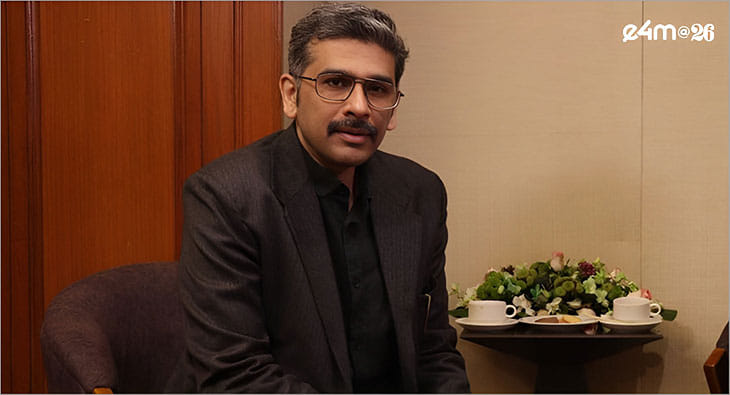

- Journalist Sanket Upadhyay has launched two YouTube channels: Double Check, which emphasizes fact-driven journalism, and Awadh Punch, which focuses on regional culture and Awadhi storytelling.
- Upadhyay advocates for prioritizing accuracy over speed in journalism, criticizing the trend of prioritizing rapid news delivery at the expense of factual integrity.
- He notes that digital media has democratized journalism, allowing independent creators to reach audiences without the need for large budgets, while legacy media faces credibility challenges.
- Upadhyay highlights the potential of AI in journalism for efficiency but stresses the importance of human oversight to ensure accuracy and credibility.
Journalist Sanket Upadhyay recently launched two new YouTube channels--Double Check and Awadh Punch. While Double Check focuses on fact-driven, consumer-centric journalism, Awadh Punch explores regional culture and language through Awadhi storytelling. In a conversation with e4m, Upadhyay reflects on credibility, the crisis of legacy media, AI’s role in journalism and why the future of news may lie in being accurate rather than fast.
Excerpts:
What led you to launch Double Check and Awadh Punch?
The question I asked myself was simple: What is the purpose of journalism? For me, journalism has always been about being factual, not being first. In 24×7 news, speed became everything, but facts cannot be optional. You cannot go soft on facts just because you want to break news faster.
That’s why the idea of Double Check emerged. The mantra is clear: “Not first, but factual.” If I cannot verify something through multiple confirmations, I simply won’t do the program, even if that means losing traction.
This isn’t revolutionary journalism. It’s Journalism 101, what we were taught by institutions of this profession.
Is serious journalism becoming difficult to practise?
Serious journalism is difficult everywhere, not just India. It’s easy to ride emotions and say things that titillate audiences. Shortcuts bring popularity.
I remember an editor once telling me: “Shed this caution. We are late. Just put it out.” Speed meant business and viewership. The problem began when opinions became absolute, and facts were later hunted to support those opinions. Life doesn’t work that way. Journalism certainly shouldn’t. If popularity becomes your only pursuit, facts will inevitably suffer and that is what I want to reverse.
Has digital media fundamentally broken the link between financial scale and journalistic impact?
Earlier, large newsrooms controlled distribution, marketing and advertising. Today, both a giant network and an independent journalist arrive before the audience as just one hyperlink.
Digital media has levelled the playing field. Legacy organisations are facing credibility and existential crises. That’s why they are suddenly embracing creators; not necessarily to empower them, but often to ride on their popularity.
If your work connects with audiences, advertisers reach out directly. Revenue conversations now happen in direct messages. So no, serious journalism no longer requires Big Bang budgets.
Having spent decades in television news, how do you view the medium today as a consumer?
I don’t even have a DTH connection anymore. After my mother passed away, we packed it up. My news consumption is entirely digital now, mobile and web streaming.
What worries me is that news debates have become meme-worthy moments. Many channels started treating journalism as content.
Content creation and journalism are not the same thing. Virality may be legitimate for creators, but a journalist’s pursuit cannot be virality alone.
In practical terms, how can independent journalism build long-term financial sustainability?
Digital platforms have made direct audience relationships possible. Sustainability can come from multiple streams- platform monetisation, subscriptions, memberships, exclusive content and direct advertising.
Legacy organisations can still play a role, provided collaboration doesn’t compromise editorial independence. If partnership creates parallel revenue streams without influencing journalism, it works. Otherwise, it defeats the purpose.
For me, popularity cannot be the only metric. Credibility must remain central.
How is AI changing independent journalism?
AI is extremely empowering if used responsibly. It can reduce dependence on large teams: editing, research, scripting and voiceovers, AI tools can assist across workflows. But blindly trusting AI is dangerous.
AI is like a junior employee. It can make mistakes. Ultimately, it is my responsibility to double check everything before publishing. Artificial intelligence cannot replace human intelligence as long as journalists remain in control.
With many digital creators drawing larger audiences than trained journalists today, how do you read this shift?
Classical journalism will never go out of fashion, just like classical music. It may not always be the most popular, but it remains foundational.
Many new creators aren’t morally wrong; they are simply untrained. Journalism requires restraint; knowing when to speak and when to stay silent.
“Speech is silver, silence is golden because silence allows you to double check.”
Truth, like gold, is becoming expensive.
How has the response been to Double Check and Awadh Punch so far?
The word is still spreading. People are discovering the platforms gradually.
After my mother passed away in October 2025, I almost quit journalism entirely. My priorities had changed. Friends thought it was professional harakiri.
But some close friends encouraged me to merge personal passion with professional purpose. That’s how Awadh Punch began.
My father, journalist Madhukar Upadhyay, is deeply passionate about the Awadhi language. We uploaded a simple Instagram video of him speaking Awadhi, it crossed seven lakh views instantly. That was our turning point.
For more updates you can follow the channel here:
Read more news about Television Media, Digital Media, Advertising India, Marketing News, PR and Corporate Communication News
For more updates, be socially connected with us onInstagram, LinkedIn, Twitter, Facebook YouTube & Google News