National news players see muted Q2; political advertising expected to prop rest of FY26
In Q2, regional advertising remained steadier, supported by local retail, government spending and festival-linked campaigns
 by
by
Published: Nov 18, 2025 9:17 AM | 5 min read
 Follow Us

India’s television news broadcasters closed the September quarter of FY26 with a mix of steady growth, widening losses and sharp divergence in performance across national and regional networks.
While some companies benefitted from the festive lead-up, others continued to feel the impact of muted advertiser sentiment from core categories like FMCG and automobiles. With no major national news triggers in the quarter, the industry saw limited spikes in short-duration advertising, keeping inventory utilisation moderate.
As the sector enters an election-heavy second half, Q2 numbers offer a clear view of the structural pressures and strengths shaping each network.
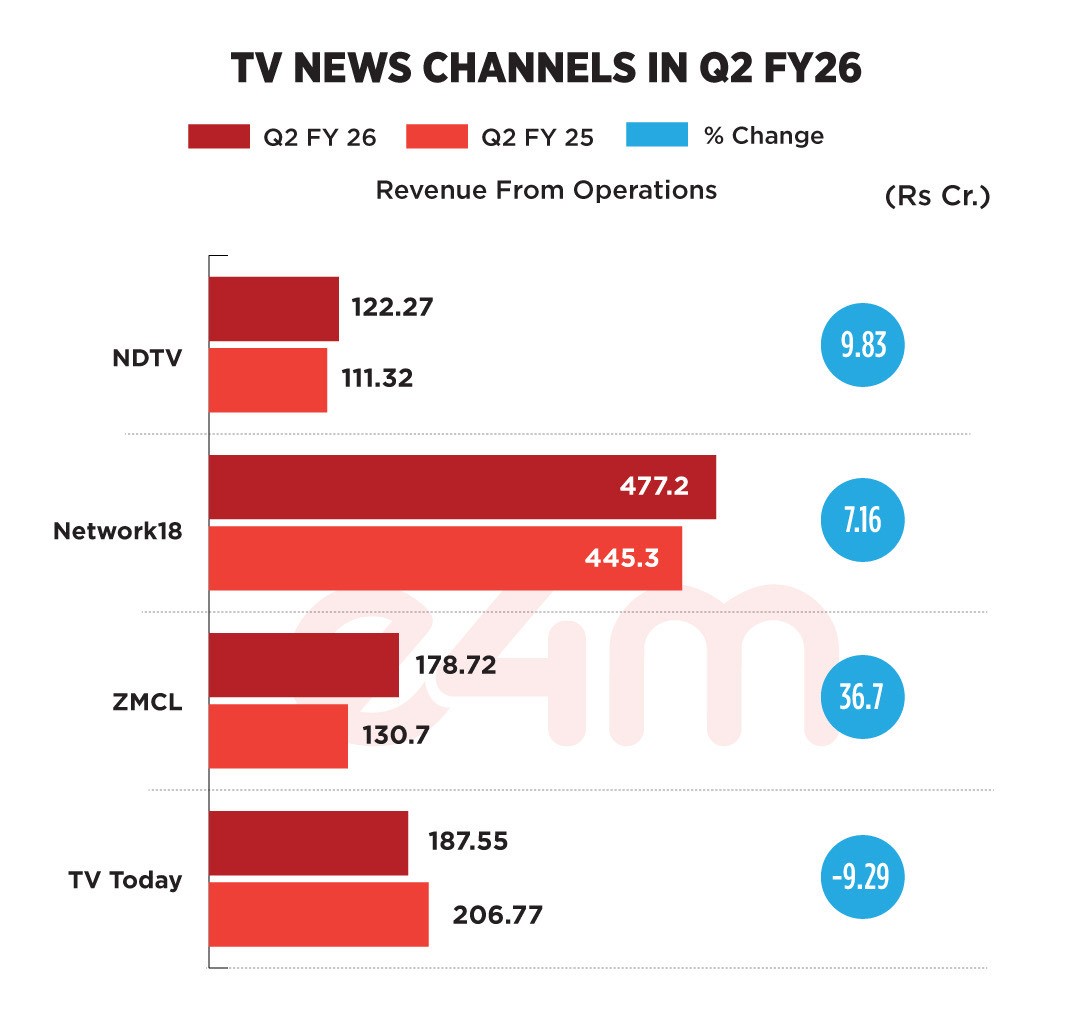
Sector Performance at a Glance
NDTV posted a 9.83 per cent rise in operating revenue to Rs 122.27 crore in Q2 FY26, up from Rs 111.32 crore in Q2 FY25. The company benefitted from the early festive push and stable advertiser interest in premium programming.
During the quarter, NDTV completed a Rights Issue to support future growth and undertook a structural consolidation by merging four entities into one. This simplification of operations is aimed at enabling sharper focus on core business priorities. However, these investments weighed on profitability.
Read e4m report on NDTV reports rise in revenue
Losses widened to Rs 74 crore from Rs 53.45 crore a year earlier. NDTV said the bottom-line impact was driven by significant investments in content excellence, digital integration and its broader transformation agenda. It expects the festive and election cycles to support momentum in the coming period.
Network18’s news business delivered a 7.16 per cent year-on-year rise in operating revenue, increasing to Rs 477.2 crore from Rs 445.3 crore in Q2 FY25. The company does not provide standalone profit numbers for the news vertical.
Read more about Network18 posting growth in Q2 operating revenue
In its earnings release, Network18 said operating revenue grew 7 percent YoY despite a soft advertising climate. Inventory demand for the TV news industry declined 7 per cent YoY during the quarter. The company benefitted from better pricing yields supported by its strong presence across both national and regional markets. This pricing-led growth helped offset a relatively weak volume environment.
Zee Media Corporation recorded the strongest revenue growth among national news broadcasters. Operating revenue surged 36.74 per cent to Rs 178.72 crore from Rs 130.7 crore a year earlier. Losses narrowed sharply, with the company reporting a loss of Rs 15.53 crore versus Rs 49.86 crore in Q2 FY25. Zee Media continues to benefit from its regional strength and recent cost optimisations. Stronger traction across Hindi and regional feeds supported both revenue growth and loss reduction.
Winners and Laggards
TV Today Network had a challenging quarter. Operating revenue declined 9.29 per cent to Rs 187.55 crore from Rs 206.77 crore in Q2 FY25. Profit after tax turned negative, with the company reporting a Rs 1.98 crore loss compared to an Rs 8.27 crore profit a year earlier. English news viewership continued to soften, while Hindi news faced aggressive competition and fragmentation, affecting inventory utilisation.
Read e4m report on TV Today's Q2 performance
While TV Today’s digital assets continue to perform strongly, the linear news business shows visible strain. The company faces the dual challenge of maintaining editorial competitiveness while managing a cost structure that has become harder to sustain against fluctuating ad demand.
Sun TV Network posted consolidated revenue of Rs 1,299.87 crore in Q2 FY26, up 38.91 per cent from Rs 935.7 crore a year earlier. Profit after tax, however, declined to Rs 354.69 crore from Rs 409.45 crore. As these are consolidated figures, they include entertainment, sports, movie and digital businesses. Sun TV does not issue a separate earnings statement for its news channels, so these numbers are not reflective of news performance alone.
Ad Market Signals & Road Ahead
The quarter revealed a noticeable split between diversified broadcasters with strong regional presence and pure-play national news networks. Regional advertising remained steadier, supported by local retail, government spending and specific festival-linked campaigns. National news channels, however, saw softer demand from large categories that typically anchor revenue.
FMCG, auto and e-commerce advertisers continued to take a cautious approach, impacting both volume-led and rate-led growth for many networks. Without significant national events, broadcasters also missed the usual spikes in short-burst buys that come during volatile news cycles.
Industry data also indicates a subtle shift in advertiser preferences. TAM AdEx reported that between January and September 2025, the News, Movies and Music genres saw a minor decline in their share of ad volumes compared to January–September 2024, while the GEC genre gained marginally. This change suggests that advertisers leaned more toward mass entertainment formats during the year, adding pressure on news channels that were already facing conservative spending from core categories.
Digital migration further complicated the picture, with viewership shifting at a pace that linear cost structures have struggled to match.
The second half of FY26 is expected to look materially different. With general elections approaching, networks anticipate stronger revenue traction through political advertising, increased viewership and higher programming-led demand. Historically, election cycles provide a sizeable but temporary lift for news broadcasters.
For national networks, this surge may help offset some of the pressure seen in Q2. For regional networks, state-level political activity also tends to provide incremental demand.
However, sustaining growth beyond elections will remain the industry’s biggest challenge. Even with political ad spikes, long-term structural pressures like fragmentation, competition from digital-first outlets and cost-heavy operations, will continue to define strategy.
The upcoming election cycle will offer a temporary boost, but the sector’s long-term trajectory will depend on how well broadcasters convert short-term gains into sustainable growth.
Read more news about Television Media, Digital Media, Advertising India, Marketing News, PR and Corporate Communication News
For more updates, be socially connected with us onInstagram, LinkedIn, Twitter, Facebook YouTube & Google News
