The Odyssey review: This is Christopher Nolan at the peak of his powers
Christopher Nolan's adaptation of Homer's epic transforms mythology into a poignant meditation on war, trauma, memory and the enduring search for home
 by
by
Published: Jul 20, 2026 9:44 AM | 6 min read
 Follow Us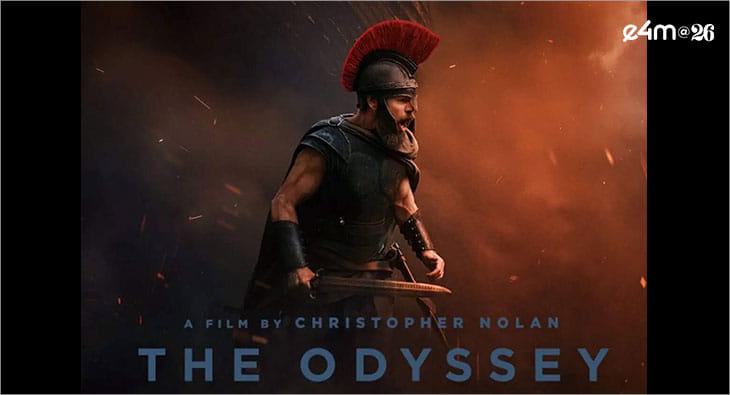

- Christopher Nolan's *The Odyssey* is a reimagining of Homer's epic, focusing on themes of memory, guilt, and the psychological impact of war, portraying Odysseus's journey as an internal struggle rather than just a physical quest.
- The film emphasizes the emotional toll of combat, suggesting that while soldiers may return home, they often remain haunted by their experiences, with trauma affecting their relationships and sense of self.
- Visually stunning, the film features remarkable cinematography by Hoyte van Hoytema, and strong performances from Matt Damon as Odysseus and Anne Hathaway as Penelope, who is depicted as a powerful figure rather than a mere archetype.
- Nolan's screenplay critiques the glorification of war, highlighting the enduring consequences of violence and shifting the narrative focus from male heroism to the resilience of women, ultimately presenting a profound meditation on the costs of conflict.
Some films entertain you for a couple of hours. Some impress you with their ambition and technical prowess. But every so often, maybe once in a lifetime if you're lucky, you encounter something that completely overwhelms yousomething that Walking out of the theater afterward feels less like leaving a cinema and more like returning from an actual voyage. Christopher Nolan's *The Odyssey* is undeniably that kind of film.
This isn't just Homer's ancient epic transplanted onto a modern screen. It's Nolan's intensely personal reimagining of literature's most enduring masterpieces story steeped in mythology yet stripped down to something raw and human: an unflinching portrait of memory, guilt, and the psychological devastation that lingers long after the cannons fall silent. What emerges is fundamentally a tale of one man's struggle to return home, though home has become something far more complicated than a geographical destination, it's about reclaiming the man he was before the war consumed him.
What caught me off guard was Nolan's unwillingness to glorify combat heroism. Victory here feels hollowscarred, weighed down, and achingly solitary. The film implies something quietly devastating: soldiers may come back from war, but their spirits often remain behind, trapped on distant shores, held prisoner by trauma that won't release its grip. Odysseus's real journey becomes not a physical trek across dangerous waters but an internal odyssey through anguish, shame, and the difficult path toward healing.
The emotional scope here rivals the physical grandeur. Memories shift into fever dreams. Spiritual moments blend into psychological unraveling. The gods transform from distant cosmic forces into embodiments of trauma, despair, and fractured mental states. And what's most devastating is Nolan's implicit argument: warfare never stays on the battlefield, it seeps into the suffocating quiet of abandoned homes, into the steadfast endurance of women who wait, into the incomplete lives of children who grow up knowing only stories about fathers they've never met.
Visually, The Odyssey is nothing short of astonishing. Hoyte van Hoytema once again proves why he remains among the greatest cinematographers of our time. Every frame possesses the grandeur of Renaissance art while carrying the melancholy of forgotten myths. The sea stretches endlessly not as a symbol of freedom, but of exile. It swallows light, hope and certainty with equal indifference. Vast IMAX compositions leave you awestruck, yet somehow make Odysseus appear impossibly small against the immensity of fate.
Matt Damon delivers what may well be the defining performance of his career. There is remarkable restraint in the way he embodies Odysseus—not as an invincible conqueror, but as a man slowly collapsing beneath the unbearable weight of his own conscience. His weathered eyes speak of battles long after swords have fallen silent. Even in moments of stillness, Damon conveys a lifetime of sorrow that words could scarcely articulate.
Anne Hathaway's Penelope is equally magnificent. Nolan wisely refuses to reduce her to the archetype of the faithful wife waiting endlessly at home. Instead, she emerges as the emotional and moral centre of the story—a sovereign in her own right, carrying an entire kingdom upon her shoulders while quietly refusing to surrender either hope or dignity.
The Trojan Horse sequence is among Nolan's most extraordinary achievements. Rather than glorifying history's most celebrated military deception, he reframes it as the original wound from which every subsequent tragedy flows. The sacrifice of Sinon is devastating not because of its immediate consequences, but because it becomes the guilt Odysseus is condemned to carry for the remainder of his life. In Nolan's world, victory and loss become almost indistinguishable.
As Odysseus drifts through cursed seas and forgotten kingdoms, every encounter resonates beyond mythology. The Cyclops embodies brutality stripped of reason. Circe represents the seductive illusion of escape. Calypso becomes the temptation of surrender itself. Even Athena, portrayed with remarkable grace by Zendaya, feels less like a conventional goddess and more like the final flicker of hope within a man on the verge of spiritual collapse.
One of the film's most haunting passages unfolds in the underworld. Nolan stages it with extraordinary restraint, allowing silence to become as unsettling as spectacle. The dead emerge from the earth like forgotten memories refusing to remain buried, their presence both terrifying and strangely compassionate. It is here that The Odyssey transcends fantasy altogether and becomes something profoundly philosophical—a meditation on mortality, memory and the debts we carry to those who came before us.
What lends the film unexpected urgency is how acutely it speaks to the present. In an age where conflict continues to redraw maps and shatter lives, The Odyssey feels less like ancient mythology and more like a timeless reflection on humanity's inability to learn from its own violence. Nolan strips away the glamour traditionally associated with conquest and replaces it with uncomfortable introspection. Glory fades. Regret endures.
His screenplay is perhaps the film's greatest triumph. Rather than celebrating war, it interrogates it. Rather than elevating heroes onto pedestals, it quietly dismantles the mythology surrounding them. The most moving moments arrive not during battle, but afterwards, when Odysseus finally confronts the devastation left in the wake of his victories. They are scenes imbued with extraordinary tenderness and moral clarity, reminding us that the greatest acts of courage often begin with accepting responsibility.
Equally compelling are the women who inhabit this world. Penelope, Circe and even Helen are afforded an emotional richness rarely granted in traditional retellings. Nolan gently shifts the narrative away from masculine conquest towards feminine endurance, revealing that while men may wage wars, women are so often left to survive them.
At 172 minutes, The Odyssey unfolds with the measured rhythm of an ancient poem. It never hurries yet never lingers unnecessarily. Every chapter feels purposeful, every image carefully composed, every silence eloquent.
By the time the final frame arrives, the film has quietly transformed into something far greater than an epic adventure. It becomes an elegy for innocence lost, for kingdoms broken, for families separated, and for the countless souls who discover too late that there is no true victory in war.
Christopher Nolan has not merely adapted Homer; he has conversed with him across millennia. The result is cinema of astonishing conviction, intellectual richness and overwhelming emotional gravity. The Odyssey leaves you spellbound, emotionally bereft and profoundly contemplative. Long after the lights come up, its echoes remain—like waves that continue to kiss the shore long after the storm has passed.
This is not simply one of Christopher Nolan's greatest achievements. It is one of the defining cinematic masterpieces of our generation.
(With inputs from Sthitipragnya Dash)
Read more news about Digital Media, Television Media, Out of Home Advertising, Print Media, Latest Advertising India
For more updates, be socially connected with us onInstagram, LinkedIn, Twitter, Facebook, YouTube & Google News