Short OTT release window hurting theatrical footfalls?
Trade analysts, industry watchers affirm that there is a need for some discipline in streaming movies to boost box office performances; need content for collective viewing, say others
 by
by
Published: Jul 1, 2025 8:48 AM | 6 min read
 Follow Us

Aamir Khan has reignited the long-running debate over India’s 6–8 week theatrical-to-OTT release window by turning down a staggering Rs 125 crore streaming deal for his upcoming film Sitaare Zameen Par.
In an exclusive interview with e4m, Khan confirmed walking away from the offer, arguing that a compressed window cannibalizes box office earnings and compromises a film’s cinematic journey. At a time when the industry is increasingly driven by digital consumption, his move has thrown fresh spotlight on a critical question: is the current 6–8 week model still viable, or is it time for a course correction?
In an industry increasingly shaped by digital consumption habits, the move has brought renewed focus to a crucial question: is the current 6 to 8-week window hurting box office collections? Or is it still the most viable model for producers and platforms alike?
Audiences are opting to wait — and it’s costing theatres
Senior trade analyst Atul Mohan firmly believes the short OTT window is discouraging theatrical footfalls.
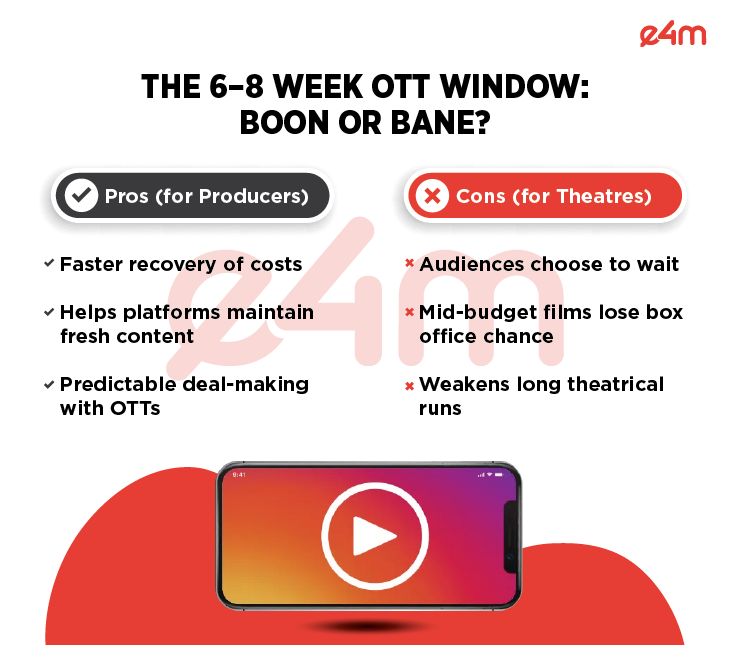
“Audiences are now very aware that most films will land on OTT platforms within 6–8 weeks and many choose to wait and watch them at home. This mindset is especially common for mid-budget or content-driven films. Even for some star-led projects, people are beginning to feel it’s not worth spending on tickets, parking, food, etc., when they know they can watch the same film at home soon — at no extra cost beyond their OTT subscription,” he said.
He suggests the industry needs to bring back some unpredictability and discipline to boost box office potential.
“I strongly feel it’s time to rethink this window — both for the survival of cinemas and for stronger theatrical runs. One thing that could help is to stop publicising the OTT platform and release date during the theatrical campaign. Don’t make it predictable — let there be some curiosity around when and where the film will drop after cinemas,” Mohan added.
Another film expert, who did not wish to be named, said viewers today were fully aware that most films would show up on streaming services in just a few weeks and they go to theatres only for a few exceptionally good films.
“For many, that’s reason enough to skip the theatre altogether, especially when the film doesn’t feel like a ‘big screen’ event. The convenience of watching at home, bundled into an existing subscription, often outweighs the cost and effort of a theatre visit. This behaviour is chipping away at the box office, particularly for smaller and mid-budget films,” the expert said.
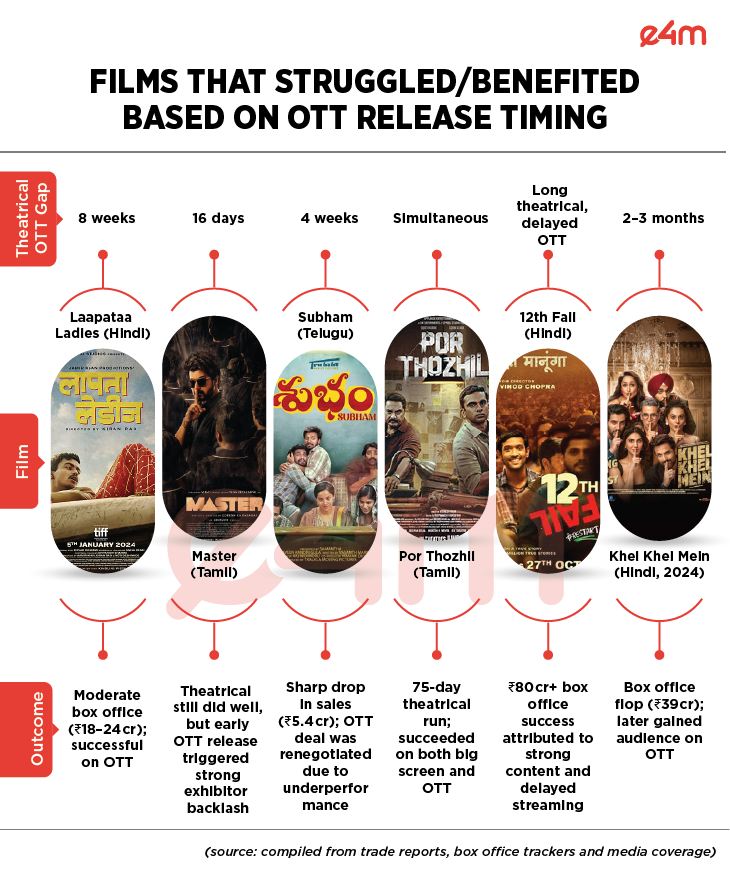
Experts cited the movie ‘Laapataa Ladies’ as a case where OTT anticipation diluted box office returns, while ‘12th Fail’ gained momentum through a long theatrical run and delayed digital release.
“The release model can either dilute the box office or amplify it — depending on how it’s handled,” another expert noted.
Beyond these titles, several Hindi films have seen theatrical underperformance due to early OTT drops. Movies like ‘Jayeshbhai Jordaar’, ‘Khel Khel Mein’, and ‘Odela 2’ struggled to draw audiences to cinemas and only found their audience once they premiered online — in some cases, within just three weeks of release. While they eventually gained popularity on streaming platforms, the early digital availability likely discouraged footfalls, especially among OTT-savvy viewers. These cases add weight to the argument that short OTT windows can dampen a film’s box office potential, particularly for mid-budget offerings.
Regional practices vary, so does audience behaviour
Sunil Chainani, Business Head - Movies at Applause Entertainment, pointed out how OTT windows vary across India’s film industries.
“Largely, the Hindi film industry is strictly following the 8-week SVOD window, whereas in the South, it’s usually 4 weeks. There have been a few exceptions, but those have been guided by extraneous, unforeseeable circumstances. One can certainly assume that a shorter window would directly impact footfalls, thus having larger implications on the business. However, audiences are unpredictable and have, on occasion, chosen to buy tickets irrespective of the film being available online,” he said.
Sharing instances, Chainani said: “‘Laapata Ladies’, having abided by the 8-week window, outperformed on Netflix, and yet continued to bring in a steady stream of audiences into the theaters. Our own Tamil film, ‘Por Thozhil’ crossed a rare 75-day run in cinemas, while simultaneously drawing huge audiences on SonyLiv. Re-releases like ‘Rockstar’, ‘Laila Majnu’ and ‘Sanam Teri Kasam’ proved to be outliers and were huge successes in cinemas, after having been consumed online for years.”
These examples highlight the complex, often unpredictable nature of audience behaviour, and the idea that strong content can perform across platforms if the release strategy is right.
‘The window isn’t the only issue’
Not everyone believes the 6-8 week gap is a problem. Karan Taurani, EVP at Elara Capital, says declining theatrical performance is more about the kind of films being made and changing viewer preferences.
“This 8-week window was very much there during pre-Covid times also and even then, films were doing well. What’s impacting the film industry more than this 8-week window is the supply of content — small- and medium-budget films not doing well in terms of occupancy and footfall — and also the nature of content. Audience preference is changing, moving online, etc,” he said.
Taurani emphasised that most box office revenue is earned early in the film’s run, so OTT release timing isn’t as critical as many believe.
“I think it can co-exist. I don’t think it’s time to revisit or re-extend this window. In global markets, the window is 8-12 weeks, but those markets behave differently. In India, 6-8 weeks is a fair window.”
“Only 1 or 2 films out of 15 successful ones run for more than 4-5 weeks anyway. So, while a few films may be impacted, overall I don’t see this windowing model as a big negative.”
For Taurani, the OTT window debate is somewhat of a distraction from the larger issue: the quality and nature of content being offered.
Another industry expert echoed the opinion, saying it is the weak content that needs to change.
“The real challenge isn’t the OTT window but weak content and changing viewer tastes. Most films earn what they can in the first two weeks. Extending the gap won’t fix that,” said the expert.
While digital rights continue to be an essential monetisation avenue, many industry watchers argue that theatrical runs deserve more breathing room. After all, the magic of cinema lies in the collective experience — something that no home screen can replicate.
At the same time, producers are balancing creative risks and financial returns, and shortening the OTT window often helps recover costs quicker. This tension is likely to continue unless a more sustainable release model is found.
Read more news about Digital Media, Television Media, Out of Home Advertising, Print Media, Latest Advertising India
For more updates, be socially connected with us onInstagram, LinkedIn, Twitter, Facebook, YouTube & Google News