Need to understand difference between a content creator & a journalist: Sudhir Chaudhary
Speaking at Samachar4Media's Journalism 40 Under 40 event, Chaudhary said the blurring of content creator and journalist roles has made it increasingly difficult to preserve journalism's credibility
 by
by
Published: Aug 3, 2026 12:56 PM | 2 min read
 Follow Us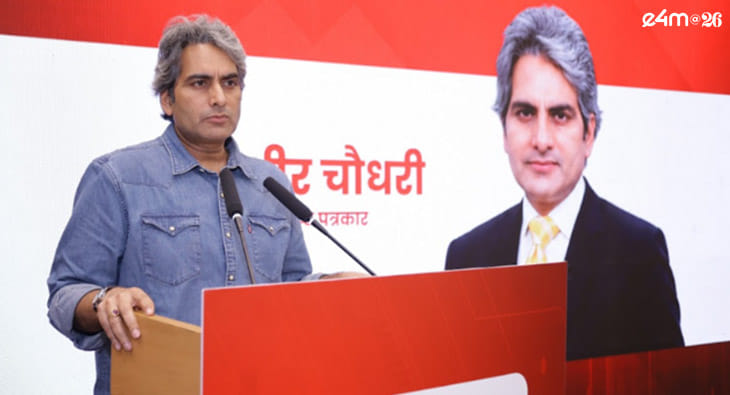

- Senior journalist Sudhir Chaudhary highlighted the threat to news media credibility posed by the overlap between content creators and journalists, urging a clear distinction between the two roles.
- At the "Journalism 40 Under 40" event, he criticized mainstream media's reliance on social media trends, noting that editorial discussions have shifted from identifying important stories to focusing on trending topics.
- Chaudhary emphasized the need for media organizations to prioritize editorial principles over viewership and advertising revenue, warning that compromising these values could lead to a loss of credibility.
- He expressed concern that mainstream media is increasingly resembling social media in content and presentation, resulting in diminished original journalism and a lack of independent story generation in newsrooms.
Senior journalist Sudhir Chaudhary has cautioned that the growing overlap between content creators and journalists poses one of the biggest threats to the credibility of the news media, urging news organisations to clearly distinguish between the two.
Speaking at Samachar4Media's "Journalism 40 Under 40" event, Chaudhary said the blurring of roles has made it increasingly difficult to preserve journalism's credibility.
"If every content creator considers themselves a journalist and editor, the credibility of the media will be seriously compromised," he said.
Chaudhary also criticised what he described as the mainstream media's increasing dependence on social media trends. He said editorial meetings that once centred on identifying important stories are now often driven by discussions around what is trending online.
"Earlier, editors decided what was news. Today, the first discussion is about what's trending on social media," he said, adding that hashtags and viral videos are increasingly shaping television programming and editorial priorities.
He argued that media organisations need to decide how much they are willing to sacrifice for editorial principles, even if it comes at the cost of viewership or advertising revenue.
"Taking a stand has a price. If media organisations are unwilling to face a loss of viewership or financial setbacks for their principles, no one else will come to their defence," he said.
Referring to recent protests, Chaudhary said mainstream media faced sustained criticism during the movement, but once it gained momentum, many of the same individuals appeared on television channels for interviews. He attributed this to the industry's competition for ratings and audience share.
Drawing on his experience at Zee News, Chaudhary recalled that the channel had once decided not to provide a platform to leaders of the Aam Aadmi Party (AAP), despite the party's electoral success at the time. He said other media organisations did not support the decision, fearing it would affect their viewership and advertising revenues.
Chaudhary also expressed concern that mainstream media is increasingly mirroring social media in both content and presentation.
"If you remove social media content from mainstream media today, the question is how much original journalism remains," he said.
He noted that before the rise of social media, reporters and editors generated original story ideas independently. Today, however, he said the influence of online platforms has significantly reduced original thinking in newsrooms, making television news and social media content increasingly similar in tone, subject matter and presentation.
Read more news about Digital Media, Television Media, Out of Home Advertising, Print Media, Latest Advertising India
For more updates, be socially connected with us onInstagram, LinkedIn, Twitter, Facebook, YouTube & Google News