People don't need more news. They need more context: Sushant Sinha
News18 India’s senior journalist and anchor Sushant Sinha speaks to e4m on the success of the Pathshala format, audience trust and why he believes credibility is the most valuable currency in news
 by
by
Published: Jun 22, 2026 9:12 AM | 7 min read
 Follow Us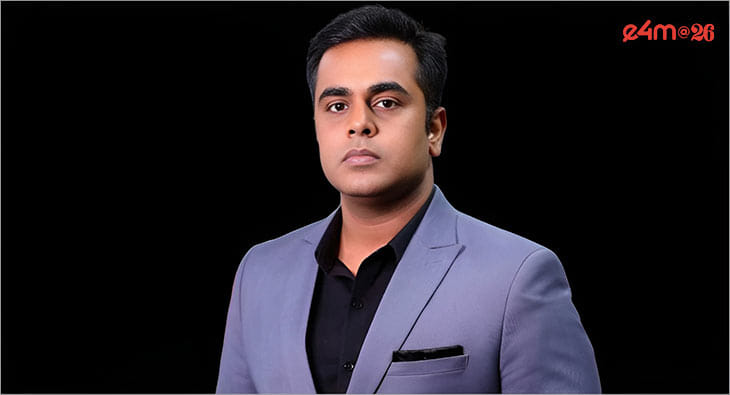

- Senior journalist Sushant Sinha has joined News18 India from Times Now Navbharat, bringing his explainer format, 'Desh Ki Pathshala,' to a broader audience.
- The format is built on three key principles: Content (deep research), Connect (conversational tone), and Credibility (trustworthiness in reporting).
- Sinha emphasizes the importance of simplicity in explaining complex issues, aiming to make news accessible to diverse audiences while maintaining depth and intellectual richness.
- He believes that both explainers and debates have their place in news, with the former focusing on clarity and understanding, and the latter providing multiple viewpoints.
As he begins a new innings at News18 India after moving from Times Now Navbharat, senior journalist and anchor Sushant Sinha is bringing his signature explainer-led format, ‘Desh Ki Pathshala’, to a larger platform.
In this conversation with exchange4media, Sinha discusses the success of the Pathshala format, the future of explainers versus debates, audience trust and why he believes credibility remains the most valuable currency in news.
Excerpts from the conversation:
The Pathshala format has created a buzz, and we are now seeing several channels trying to replicate it. What makes it so special?
First of all, bringing Desh Ki Pathshala to News18 India is a big responsibility because it is one of the country's largest news networks. The reach becomes bigger, the audience becomes larger, and therefore the responsibility also increases.
The USP of Pathshala is what I call the three Cs. The first C is Content. Our research is extremely deep. I can confidently say that the level of research we bring to a story is difficult to find elsewhere in that specific news cycle. People may see the same news everywhere, but they often do not get that depth of understanding.
The second C is Connect. Traditionally, television news has often been a one-way communication process—an anchor speaks and viewers listen. We wanted to make it feel like a conversation. Our tone is designed to create the feeling that we are discussing the news together, much like a conversation happening at home.
The third C is Credibility. At a time when trust in news is frequently debated, we have worked very hard to preserve credibility. One of the most satisfying things is when viewers tell me, "When you speak, it feels like you're telling the truth." Maintaining that trust has been a priority throughout my more than two decades in journalism.
These three Cs form the foundation of Pathshala.
Many channels and independent creators are producing explainer-based content today. What makes Desh Ki Pathshala different?
Its biggest strength is simplicity. There is a famous thought that it is very simple to be happy, but very difficult to be simple. The challenge is not gathering information, everyone has information today. News is available on mobile phones, websites and social media.
The challenge is explaining it in a way that everyone understands.
When we pick a topic, our effort is to ensure that a person sitting in a village, someone in a city, a graduate, a child, a homemaker, or someone with limited formal education can all understand it equally well.
At the same time, we keep digging deeper into stories through research. We continue exploring until we find angles and context that are not readily available elsewhere. That combination of simplicity and depth makes the format unique.
Context-driven explainers seem to be becoming the new prime-time format. Does that mean traditional debates are losing relevance?
I don't think so. I often compare debates and explainers to food. Sometimes you go out and enjoy something spicy and exciting. But your life runs on simple home-cooked food. For me, explainers are that home-cooked meal.
Debates have their own place because they bring multiple opinions together. If you reduce the noise, debates can be very meaningful.
At the same time, viewers have always liked explainers. If you look at Hindi news prime time, particularly around the 9 pm slot, almost everyone is trying to explain the news in some form. The style may differ, the content may differ, but the objective remains similar.
So debates and explainers will coexist. Neither is going away.
Simplicity is central to your format. How do you ensure that it remains informative and intellectually rich at the same time?
That is actually the biggest challenge. The goal is to make complex issues understandable without making them sound simplistic or childish.
We have a strong team of researchers, writers and producers. Often we discuss multiple ways of explaining a complicated issue. Sometimes we use graphics. Sometimes we use handwritten illustrations or notes. Sometimes we completely change our storytelling approach.
The key question is always the same: Can a child understand it while an informed adult still finds value in it?
If we feel we haven't achieved that balance, we continue working on it. Occasionally we even drop an approach and start over.
Fortunately, most of the time we are able to find a way to simplify even the most complicated subjects.
You've done a similar format before. What elements are you carrying into Desh Ki Pathshala?
Every show is different, but an anchor carries his own style and personality wherever he goes. The one thing we always carry forward is respect for the viewer's time.
Whether someone spends five minutes, fifteen minutes or an entire hour with us, they should feel that their time was worthwhile.
One of the biggest challenges with Pathshala is that it is largely a monologue-driven format. We are not relying on constant debate panels or multiple packages. Keeping audiences engaged for an extended duration through storytelling and explanation requires a very specific editorial DNA. That DNA remains constant.
In an age where social media has democratised content creation and everyone can have a platform, what, in your view, defines a truly successful news anchor today?
Today almost everyone can be an anchor. For me, success is when people actively want to hear your perspective because they believe it has relevance to their lives.
Ultimately, success is not measured only through views or numbers. It is measured through trust.
You can create an image around yourself, but when you step outside and meet people, you get genuine feedback. That's where you discover whether people truly value your work.
The real question is not whether people recognise you. The real question is whether they trust you.
With AI now capable of creating content, analysing data and even presenting information, where do you believe the irreplaceable value of a journalist lies?
Absolutely. AI can assist research. It can simplify certain workflows. It can help journalists become more efficient.
But journalism is fundamentally a human activity.
News is not merely information; it is also emotion. People connect with news because it validates their concerns, hopes and understanding of the world around them.
AI can process information, but it cannot genuinely replicate human emotion, judgment and lived experience.
So while AI will become an important tool inside newsrooms, I do not believe it can replace human journalists.
Success brings both admiration and criticism. How do you deal with the hate that comes with visibility?
I won't pretend that it has no impact. Sometimes criticism affects you, especially when it extends beyond professional disagreement and becomes personal.
But I have learned one important lesson: don't let praise go to your head and don't let criticism settle in your heart.
If you start living for applause, criticism will destroy you. And if you focus only on negativity, you lose sight of the people who genuinely support you.
Whenever I see criticism, I also remind myself of the thousands of people who appreciate the work, engage positively and continue to watch. You have to maintain perspective.
When viewers think of Desh Ki Pathshala, what do you hope they associate it with?
The nation. The central idea behind the show is that our reporting should always be viewed through the lens of what is right for the country.
Today, news is available everywhere. Information is not scarce. What matters is perspective.
When you travel abroad and speak to people outside India, you often gain a different appreciation of how the country is evolving and how India is viewed globally.
For me, the guiding principle is simple: if there is a country, there is all of us. Without the country, nothing else matters.
That does not mean asking questions only of one political side or another. Journalism must question everyone—governments, opposition parties and institutions alike.
The focus should not be whether a particular political camp is right or wrong. The focus should be what serves the interests of the country.
That is the spirit with which Desh Ki Pathshala is created.
It is not just a television show. It is an emotion. And we hope viewers continue to be part of that journey.
Read more news about Television Media, Digital Media, Advertising India, Marketing News, PR and Corporate Communication News
For more updates, be socially connected with us onInstagram, LinkedIn, Twitter, Facebook YouTube & Google News