40 years, no regrets: Sandeep Goyal on advertising's lost soul & algorithmic future
As Sandeep Goyal, MD of Rediffusion, marks four decades in the business today, he speaks to e4m candidly about the gut, the grind, and where he feels Indian advertising lost its way
 by
by
Published: Mar 10, 2026 9:35 AM | 14 min read
 Follow Us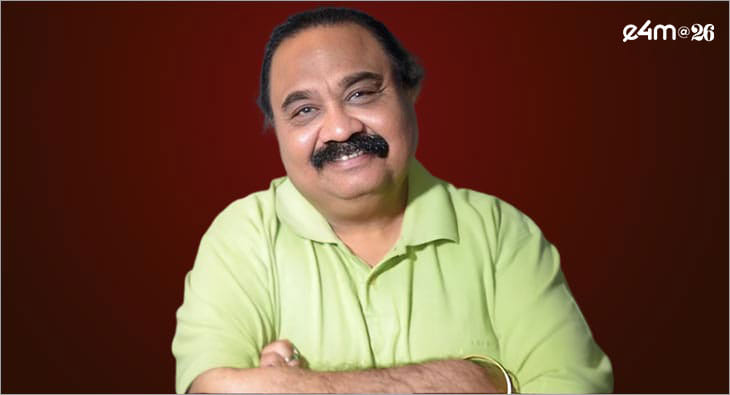

There is a certain ease to the way Sandeep Goyal talks about advertising. The kind that only comes from four decades of doing it. He does not reach for industry-speak. He does not hedge. On 10th March 2026, Goyal completes 40 years in advertising, a milestone that, by any measure, places him among the longest-serving admen in India.
He has been, at various points, a hotshot account manager at the old HTA, a president at Rediffusion who helped launch Airtel from scratch, the founder-chairman who brought Dentsu to India and grew it to over ₹1,200 crore in capitalised billings, and now, the man who acquired and is rebuilding one of Indian advertising's most iconic agency names.
But sit across from him, and what you get is not a résumé reading. You get something far more interesting: a man with strong opinions about what advertising has become, what it has lost, and what, if anything, can bring it back.
From Amritsar to HTA: A detour through paint cans
The year was 1986. Sandeep Goyal, a gold medallist in English Literature from Panjab University and a fresh MBA from the Faculty of Management Studies, Delhi, was two years into a job at Goodlass Nerolac Paints, selling paint to dealers, making his rounds. He was 23, technically employed, functionally restless.
"I was very clear that I was not enjoying going and interacting with dealers. It was fun, but beyond a point, I didn't see a career in that," he says. "So, the move to advertising was pretty conscious. Because I was a literature graduate, a gold medallist in English, my bent of mind was always more creative. I thought advertising would be more fun."
And so he walked into what was then called Hindustan Thompson Associates, later JWT, now Wunderman Thompson, as an Account Executive in Delhi. It was a different world then. The business was flush with money, flush with talent, and flush with a certain intellectual self-regard that made people feel they had chosen a calling, not just a career.
"Those days, you could qualify quite early. When you are that young, you actually don't know what your trajectory should be or what it can be," Goyal reflects. "You can act very intellectual and say I knew what I was doing. I wasn't. I just joined advertising because it seemed like more fun. It seemed a little more intellectual than being in sales. And I also thought you would get to work on many more brands than working for one company."
What followed was a career that moved with velocity and purpose, a year at Trikaya Grey working on Kelvinator, HCL, and Bata, then four years at DDB Mudra's Interact Vision handling Symphony aircoolers, Bhutan Board, and Andrew Yule. Then, in 1994, the move that would define his first act: joining Rediffusion Delhi as Head of New Business.
The Rediffusion years and the making of Airtel
When Goyal joined Rediffusion in 1994, the agency was already a legend. Founded in 1973 by Diwan Arun Nanda, Ajit Balakrishnan, and Mohammed Khan, it had built its reputation on giving Indian brands a communication identity that was rooted and modern simultaneously: Lakme, Garden Vareli, Jensen & Nicholson, and Eveready's iconic 'Give Me Red!' campaign. In 1982, it designed the Maruti logo and launched the brand in India. In 1984, it had become the first Indian ad agency to create a political campaign for the Congress party, in the immediate aftermath of Indira Gandhi's assassination.
Goyal arrived in this history and promptly got to work. He brought the Airtel account with him, and what followed was one of the most storied brand-building exercises in Indian telecom history. In 1997, at the age of 35, he was elevated to President and moved to the Bombay office, where he added Colgate, Citibank, Tata, and Taj Hotels to the agency's roster. "Rediffusion as an agency took brands like Airtel from zero to market leadership," he says. The agency quickly climbed into the top three in India.
By 2001, he had moved on to Zee Telefilms as Group CEO, running 32 TV channels beaming content to over 100 countries, then, in 2003, to a new and audacious venture: bringing Dentsu Inc. of Japan to India. He became the JV's founder-chairman, and over the next eight years, built it from zero to ₹1,200 crore in capitalised billings before exiting in 2011.
What followed 2011 was perhaps the most eclectic chapter of his career (and the most revealing about the kind of mind he has). He enrolled for a PhD from FMS Delhi in 2012, finishing it in 2017. Simultaneously, he ran Mogae Media, was associated with data intelligence platform Zeotap (which today works with global enterprises across 60+ countries), and Sync Media.
From 2018 to 2021, he served as India head at Snapchat-parent Snap Inc., building the platform's relationships with Indian advertisers and media buyers. In parallel, from 2019, he served as a brand and communications adviser to the Government of Punjab; a four-year engagement that gave him a ringside view of public sector communication at scale.
And then, in April 2021, life came full circle in the most literal sense possible. Goyal's company, Mogae Consultants, acquired 100% of Rediffusion and Everest, two of India's largest independent agencies. He was coming home, but this time as the owner.
Stepping into giant shoes
Running Rediffusion today is not the same as running Rediffusion in 1997. When Goyal took over in 2021, the agency had been through a bruising decade: a protracted fallout between Diwan Arun Nanda and Sir Martin Sorrell of WPP had cost its marquee clients, including Colgate, Airtel, Citibank, and Ford. The media division had gone. The agency was, by Goyal's own account, "demoralised."
He is not sentimental about the scale of what he walked into. "I have inherited an agency that had a very troubled decade," he has said publicly. But he is equally clear about what Rediffusion represents, and what it owes its founders.
"Filling into the shoes of three giants — Diwan Arun Nanda, Ajit Balakrishnan, and Mohammed Khan — has not been easy," he says. "The reason they set up the agency was that advertising was largely dominated by multinational agencies catering to multinational clients. With so many Indian clients emerging, they came to Rediffusion because it brought a quintessential Indianness to the communication of all these companies. Whether it was Lakme or Garden, it made them look as good as global, yet had an intrinsic element of being Indian."
The rebuilding has been visible. In the past four years, Rediffusion has reopened offices in Delhi and Bangalore, expanded to Chandigarh and Kolkata, and brought in clients including Taj Hotels, BMW, Dabur, Zydus, Shyam Steel, Tata Power, and Nippon India Mutual Fund. But what Goyal is proudest of is not the client list, but the forward bets he has been placing.
Betting on AI, content, and the next frontier
In a business where most agencies still debate whether AI is friend or foe, Goyal has moved several steps ahead. Rediffusion's Aesthetic Intelligence Lab (AIL) is, by the agency's own claim and growing industry acknowledgement, India's most active AI design studio.
In 2025, the lab rebranded as RAIDS (Rediffusion AI Design Studios) and counts Tata Play, Tata Consumer Products, Danone, Wipro Consumer, HDFC Mutual Fund, and Birla Opus among its clients. Last year, RAIDS worked with over 50 clients, and Goyal is now looking to raise external capital for this arm of the business.
"We are producing fabulous products. We are doing some completely new things in AI, in social, in digital, in agentic AI," he says. "AI is doing extremely well."
But the bigger announcement, he suggests, is still in the pipeline. Rediffusion is making a significant move into content, and Goyal, with his years running Zee, is perhaps better positioned than most agency heads to make that call.
"I believe now creative has its own role,” he says, “but brands are going to use content far, far more going forward. Integrating brands into content is going to become the next frontier. We are going to do stuff in content which I don't think anybody has done so far in India, at least." An experience marketing play is also said to be at an advanced stage of closure.
The logic connecting all of this is straightforward. In an era where digital has democratised distribution and QCommerce has upended retail, brands can exist and scale without the traditional advertising machinery. But that makes the question of deep consumer connection (not just reach, not just performance metrics) more urgent, not less. Goyal is clearly positioning Rediffusion as the agency that can answer that question.
The data delusion and the algorithm consumer
Few people in Indian advertising will say out loud what Goyal says freely: that “data killed the soul of the business.” The industry has spent the better part of two decades celebrating the shift from gut to metrics, from intuition to attribution. For Goyal, this is not progress. It is an amputation.
"All this over-dependence on data killed the soul of advertising. The soul of advertising was about gut feeling, nothing else: connect to the heart of the consumer while connecting with the mind of the consumer. Today, there is no scope for heart-to-heart. It has become very empirical, very metric, very arithmetical, very mathematical," he says. "Data might have brought pinpointed accuracy, may have even made for better and more optimal buying. But brand connect is weakening, and we will feel the impact of it in the next 5 to 10 years."
It is a view that cuts against the current of where most agency and client conversations are headed. But Goyal is watching something he finds genuinely alarming: the consumer, as a human being, is being progressively replaced by the consumer as a data point. He articulates this with characteristic sharpness. "Your consumer is no longer a human. Your consumer is now an algorithm. So if your advertising is not talking to that algorithm as the algorithm wants to process it, then your advertising actually means nothing."
This is not a rejection of technology. Goyal has, after all, built one of India's most aggressive AI creative studios. It is a more precise concern: that the advertising industry has confused optimisation for communication, and that the brands of today are building reach without building relationships.
On awards, IPL, and the triumph of media money
The industry's obsession with awards is another subject on which Goyal holds little back. His position at Rediffusion is deliberate and unambiguous: the agency does not participate in award shows. "I said, we are participating in no awards. I don't want anybody to judge me. I don't even care," he says. "I've never seen 95% of the advertising that wins awards. I don't know where they run it and who sees it."
The point is not resentment but irrelevance. "No client has ever, in a new business pitch, ever asked me how many awards I've won. Just to keep a few creative people happy, you keep doing award shorts. It's the output that matters." He is equally blunt about the role of pure media firepower in brand-building today. "If you want to make a campaign famous, you can run anything on IPL by spending ₹200 crore. The brand will become famous. Its advertising will become famous. You can make anything; it doesn't matter. So it is now more about brutal media power than a creative idea. That is too bad."
AI anxiety and the normalisation curve
The current industry anxiety around AI-generated content: the concerns about 'slop', synthetic creativity, and authenticity, leaves Goyal largely unmoved. He has seen this film before, multiple times. His view is that the anxiety is, in a word, “temporary.”
"When digital came, we had the same concerns. When websites started being made in the late 90s, people asked, ‘What nonsense is this?’ When people started using email, they said, ‘It is so impersonal, it has no letterhead, it has no authenticity’. Now email has become a norm," he says. "These are today's questions. After a year or two, no one will ask such silly questions. It will become a part of our lives."
The analogy he reaches for is food. "We had never eaten Noodles. We had never eaten pizza. In North India, we had never eaten Dosa. Twenty years ago, no one had eaten Momos. They were points of excitement. After a while, it becomes like this." The diffusion-of-innovation curve, in other words, will do what it always does. Mainstream adoption will follow the early adopters, the laggards will eventually catch up, and the thing that once seemed transgressive will become ambient. AI, in Goyal's view, is simply on that curve.
The profession's fading sex appeal
On the question of young talent entering advertising, Goyal is perhaps at his most candid and most melancholy. In the 1980s, advertising attracted the best minds from the best management schools. Goyal's own boss, Diwan Arun Nanda, was a first-batch gold medallist from IIM Ahmedabad. That pipeline, he believes, has thinned considerably.
"Advertising has lost its sex appeal," he says plainly. "In the old days, we used to be so bright that I could say I work in HTA and people would take notice. In today's world, if you say you work in advertising or in any agency, frankly, nobody gives a damn. So many sexier and far more attractive destinations have suddenly surfaced."
The respect equation has also shifted dramatically. Where agencies were once the equivalent of management consultants (the “McKinsey of their day,” in Goyal's words), they are now, in the eyes of many clients, simply another vendor. "They don't show any respect to the ad agency any longer. In the old days, if my chairman or my boss used to go to the client, they used to welcome him with a red carpet. As a profession, we've lost currency. And therefore, it has lost the star value it had many years ago."
And yet he stops short of pure pessimism when addressing those who are still choosing the profession. "If you come into the profession, I think the one thing you should do is enjoy it. You can do some really sexy stuff with AI. Move with the times, move with where the advertising business is moving to. And enjoy it. As long as you enjoy it, you're fine."
Forty years, and a quiet grief
Forty years is a long time to stay in one industry. Goyal has had offers: banking, telecom, other verticals. He stayed. And as he marks the milestone today, there is both the pride of longevity and something harder to name. Not bitterness, exactly. More like a quiet grief for a business that used to be something else.
"One used to love going to work. You used to wake up in the morning and be ready to go to the office because you had so many interesting things to do," he says. "Today, the only thing you worry about is your client. He says, ‘give me my work’, he says, ‘I will work on a project basis’, we talk weird things these days. The fun has gone out of the business."
The agency he now leads has eight books to his name, a PhD from FMS Delhi, a Lifetime Achievement Award from Assocham, and the institutional weight of 52 years of Rediffusion behind it. The AIL is growing. The content play is coming. The experience marketing announcement is around the corner. By any account, Goyal is not done.
But the man who came into HTA at 23 because it seemed like more fun, the literature gold medallist who wanted to work on many brands instead of selling paint to dealers, still feels the absence of that original energy most keenly. "I hope before I get out, some of the effervescence comes back," he says. "But honestly, it looks more like wishful thinking. A business that was so fun and so energetic and so full of life is nowhere close to what it was four decades ago. It has become a lonely business."
He pauses and invokes a line from the Guru Granth Sahib with the ease of someone who has been thinking this for a while. "Nanak Dukhiya Sab Sansaar," he says, the whole world is in suffering. "It has become like that. Not a nice thing to say. But it has happened."
Read more news about Internet Advertising India, Marketing News, PR and Corporate Communication News, Digital Media News, Television Media News
For more updates, be socially connected with us onInstagram, LinkedIn, Twitter, Facebook YouTube & Google News