Brand India
Writer Shreya Meher shares why seventy-nine years on, the honest measure of India is not what it has announced. It is what the structure carries
 by
by
Published: Aug 15, 2026 10:08 AM | 5 min read
 Follow Us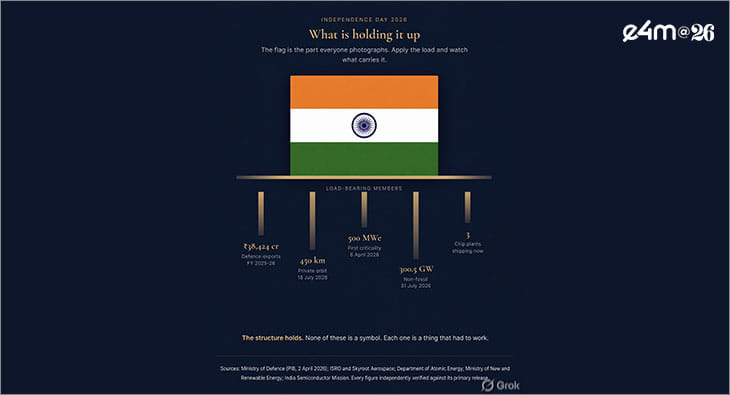

- The Chenab Bridge, the highest railway arch bridge in the world at 359 meters, was completed after nearly two decades of construction and cost ₹1,486 crore, showcasing India's engineering capabilities.
- India's defense exports surged from ₹686 crore in 2013-14 to ₹38,424 crore last year, with private firms contributing 45%, reflecting a significant growth in the country's defense manufacturing sector.
- The successful launch of the private rocket Vikram-1 and the criticality of a 500 MWe fast breeder reactor mark milestones in India's space and nuclear programs, although challenges remain in domestic manufacturing capabilities.
- India's non-fossil energy capacity surpassed 300 GW, and advancements in public distribution systems, banking, and digital transactions, such as UPI processing billions of transactions, indicate progress in infrastructure and economic stability.
A train crosses the Chenab 359 metres above the river, riding the highest railway arch bridge ever built. The deck clears the Eiffel Tower by 35 metres. It took the better part of two decades, survived a suspension in 2008 when the engineers were no longer sure the mountain would hold it, and cost ₹1,486 crore.
Inside, someone is complaining about the Wi-Fi.
The bridge holds anyway. That is what bridges are for, and it is precisely why nobody looks at them.
For most of its independent life, Brand India arrived as a brochure: ancient civilisation, young population, enormous market and, always, enormous potential. Potential is a generous word. It is what people say while waiting for delivery.
Delivery has begun. Just not where the cameras point.
The budget flatters. The invoice does not.
Any country can inflate a defence budget. Only some can persuade another government to buy the result. The second number is the one worth watching, because it is audited by people with no interest in flattering you.
India's defence exports rose from ₹686 crore in 2013-14 to ₹38,424 crore last year, a jump of nearly 63 per cent in twelve months. Private firms supplied 45 per cent of it.
Rhetoric does not travel. Equipment does.
Trade tells the same story from the other side of the table. India now has nine agreements spanning 38 countries. Negotiations with the European Union concluded in January after nearly two decades of circling one another; the British agreement came into force in July.
Nobody grants market access out of affection. It gets signed when the other party has done the arithmetic and decided you are worth the concession.
The rocket was private. The launchpad was not.
Space is where the applause lands most often, and usually off target. Chandrayaan-3 reached the lunar south-polar region in 2023, where no country had landed before, and within a day the conversation had become about how little it cost. The comparison to a film budget was irresistible and slightly beside the point.
Cheapness is a tactic. Not a strategy.
The more revealing moment came this July, when Skyroot's Vikram-1 reached a 450-kilometre orbit, the first privately built Indian rocket to do so from Indian soil. The headline wrote itself: private enterprise arrives in Indian space.
Then look at the supporting cast. ISRO provided the engine testing, the integration, the trajectory work, and the launchpad the rocket left from.
The milestone was private. The scaffolding beneath it was decades of public money. No country gets to skip that part, and the ones that try end up importing their rockets instead of building them.
First criticality is not first electricity.
At Kalpakkam in April, a 500 MWe fast breeder reactor reached first criticality, carrying India into the second stage of the three-stage nuclear programme Homi Bhabha sketched in the 1950s, and towards eventual use of the thorium India holds in abundance and most of the world does not.
It has not yet supplied a single unit to the grid.
Semiconductors are further along and no closer to finished. Three packaging plants are producing commercially and a front-end fab is rising at Dholera. Yet the sophisticated machinery and materials inside that new ecosystem remain heavily imported. India can package a chip. It cannot yet build the machine that makes one.
Both are further than India has ever travelled. Neither is arrival.
Installed is a headline. Dependable is a country.
All of it runs on electricity, and the queue is lengthening.
Non-fossil capacity crossed 300 GW on 31 July, more than half the national total. Data-centre capacity has grown from 375 MW in 2020 to roughly 1,575 MW, and is projected to pass 6 GW by 2030. India generates close to a fifth of the world's data and holds three to four per cent of the capacity to process it.
Servers, factories and farms will increasingly ask the same grid, and often the same water system, to feed them. Installed capacity makes a headline. Dependable power builds a country, and the distance between those two sentences is where the next decade of work sits.
The real test is what reaches a doorstep.
Doors open when the building is real. India chairs BRICS this year. Ahmedabad will host the centenary Commonwealth Games in 2030. Taj was named the world's strongest luxury hotel brand for the fifth time by a London consultancy, for a kind of personalisation Indian hospitality practised long before software turned it into a dashboard.
All of it pleasant. None of it decisive.
India's public distribution system is built to serve 81.35 crore people through more than five lakh fair-price shops, which for decades meant queueing, hoping the scales were honest, and being told to come back tomorrow. Annapurti changes the experience rather than the entitlement: after biometric authentication, the machine dispenses up to 50 kilograms of grain in five minutes, with an error rate of 0.01 per cent.
It does not take lunch. It does not ask you to come back tomorrow.
Odisha went first. Chhattisgarh switched on its machines this month.
The banks tell a version of the same story. Gross bad loans stood at 1.8 per cent at the end of March, a multi-decade low, against a peak above 11 per cent in 2018. A balance sheet that was once the standing argument against Indian ambition has quietly become the least dramatic thing about it.
And only then comes UPI, the innovation everybody mentions because everybody touches it. In July it processed 23.66 billion transactions worth ₹29.88 lakh crore. The transaction is now so unremarkable that nobody notices the architecture underneath.
The unremarkableness is the achievement.
Independence in 1947 was a minute long: one flag down, another up, and a room full of people with no guarantee the structure would hold. Seventy-nine years later the evidence is different, and duller, and far larger. In what other governments buy. In what leaves the ground at Sriharikota. In a machine dispensing grain at two in the morning.
The Chenab bridge was built for winds of 266 kilometres an hour. Trains are stopped when the wind reaches ninety.
That margin is the whole idea. You build for the storm you hope never comes, and then you let people cross it while complaining about the Wi-Fi.
Nobody will applaud. They do not have to.
The bridge holds.
Read more news about Digital Media, Television Media, Out of Home Advertising, Print Media, Latest Advertising India
For more updates, be socially connected with us onInstagram, LinkedIn, Twitter, Facebook, YouTube & Google News
