World Cup win: Will brands finally write the cheque for women's cricket?
While some industry watchers say brand endorsement monies coming for women's cricket won't be as big as it should, the optimists assert these names will evolve into strong personal brands
 by
by
Published: Nov 13, 2025 8:59 AM | 10 min read
 Follow Us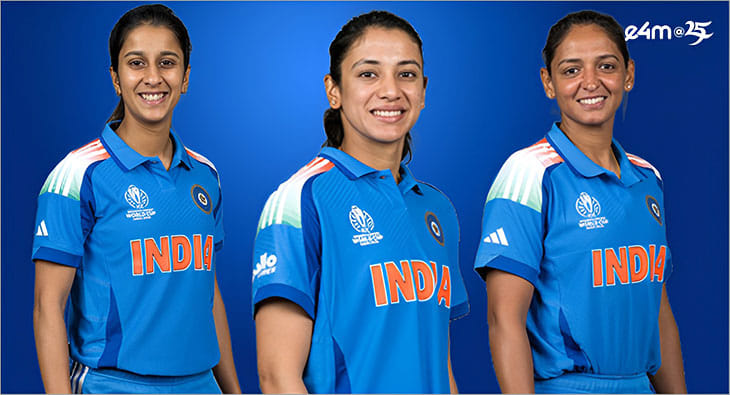

The numbers from India's historic World Cup win tell a powerful story. Brand endorsement values for players like Jemimah Rodrigues, Smriti Mandhana and Harmanpreet Kaur have surged by 25-100%, with social media followings doubling or tripling overnight. Brands scrambled to align themselves with the moment.
Surf Excel ran a full-page ad featuring the team’s jersey, while Swiggy Instamart posted viral tributes. The noise was real, the sentiment felt authentic. However, here's the uncomfortable truth: noise and sentiment don't write annual contracts or fund grassroots programmes. They don't build sustainable careers for athletes who aren't named Smriti or Harmanpreet.
Read e4m report on how sponsorship for women's cricket is up nearly 50%
India's advertising and brand ecosystem seem to have always had a complicated relationship with women's sports. Women athletes have so far been visible only during two periods: International Women's Day campaigns and moments of national triumph. Outside these narrow timeframes, the investment dries up, the attention fades, and the narrative shifts back to the men's game, where the real money lives.
This isn't conjecture. It's a pattern. Look at what happened after India's near-miss in the 2017 Women's World Cup final. The coverage was electric, but the commercial aftermath was muted. A few individual endorsements trickled in, but nothing that fundamentally shifted the economics of women's cricket. Now, in 2025, the question is whether this time will be different. And the early signs are mixed.
Read e4m report on how women cricket stars are now batting for brands
The commercial math
Harish Bijoor, Brand Guru and Founder of Harish Bijoor Consults Inc., frames the issue bluntly. "India's women's win at the ICC World Cup 2025 has really been a big one, a very well-achieved success. From a pure brand endorsement perspective, I do believe women's cricket will still remain a second rung to the cricket monies that will go out in terms of sponsorship," he says.
JioStar's list of sponsors for Women's World cup
Comparing the pattern to Olympic wins, he spoke about how the excitement surges around the victory, but the aura diminishes over a few months. "I do believe women's cricket will continue on that trajectory, sad but true. Yes, brand endorsement monies will go to women's cricket, but not as much as it should."
The gap Bijoor points to is stark. "The ultimate arbiter of it is the kind of prizes that a woman cricketer will command vis-a-vis a man cricketer, and till that gap gets bridged, inequity shall reign supreme." Men's cricket in India commanded around ₹350 crore annual kit sponsorship at its peak. Women's cricket, despite recent momentum, isn't even in the same conversation. But that's the old playbook. And disruptors are emerging who believe the rules are about to be rewritten.
The signal versus the noise
Suraj Nedungadi, Associate Vice President of Strategy at YAAP, takes a markedly different view. "This isn't a moment, it's a movement," he argues. "The surge in viewership for women's cricket isn't just noise; it's a signal. The 2025 Women's ODI World Cup attracted more viewers than the previous three editions combined. JioHotstar reported over 185 million viewers tuning in for the final alone. That's not a spike in interest, that's a tectonic shift in how India consumes sport."
Nedungadi's thesis is compelling, as he says that "Audiences today are watching sports for great stories, skills, and spectacle, and not for gender labels. The lines between men's and women's sports are blurring, and with stars like Shafali Verma rising to national fame, it's only a matter of time before we see these star athletes evolve into strong personal brands, cultural forces, and business empires."
The commercial evidence supports his optimism to some extent. Sponsorship and ad rates for the 2025 Women's World Cup surged by 40-50% compared to 2022, with title sponsorships priced between ₹20-35 crore. The ICC officially decoupled women's events from men's events for sponsorship, making the women's tournament its own commercial product rather than a CSR add-on.
JioStar also secured a blockbuster sponsor line-up – Google, Hindustan Unilever, State Bank of India, and the International Gemological Institute. These aren't niche or cause-driven brands. They're massive, mainstream corporate names betting that the audience for women's cricket is commercially viable on its own terms.
The Puma playbook
While most brands were still treating women's sports as a side bet, Puma was building relationships. Puma has consistently signed women cricketers like Harmanpreet Kaur, Richa Ghosh, and Deepti Sharma, bringing in three to seven players annually, long before the rest of the ecosystem woke up to the potential. In 2023, Puma signed Harmanpreet as a brand ambassador, shattering stereotypes after 80% of consumers initially assumed their mysterious teaser campaign was for a male cricketer.
Puma's approach demonstrates something crucial: consistency matters more than one-off topical campaigns. It's not about showing up when the cameras are already rolling. It's about being there during the years when nobody's watching, in the background, when players are grinding through domestic circuits and smaller tournaments that don't trend on Twitter. After India's World Cup victory, Harmanpreet posted a picture wearing a Puma T-shirt that read 'Cricket is everyone's game,' with 'gentleman's' struck out. That's the kind of cultural positioning that creates lasting value.
Will team deal translate to player investment?
Adidas secured a multi-year partnership with the BCCI running through March 2028, becoming the official kit sponsor for India's men's, women's, and youth teams across all formats. In a historic move, Adidas unveiled the new ODI jersey with the Indian Women's Cricket Team first in December 2024, marking the first time a jersey was launched with the women's team rather than the men's.
On paper, this looks like progress. But symbolic gestures, however significant, don't pay the bills or fund the training infrastructure that creates the next generation of athletes. The question with Adidas isn't whether they're committed to the team; it's whether that commitment translates to individual player endorsements, personal brand-building opportunities, and the kind of marketing muscle that turns athletes into household names beyond cricket-watching audiences.
Gaming ban setback
Here's the elephant in the room: Real Money Gaming platforms, which were once aggressive sponsors in cricket, are now banned from advertising or endorsing in India under the Promotion and Regulation of Online Gaming Act, 2025 (PROGA) regulations. Dream11, which was the Indian cricket team's jersey sponsor and IPL title sponsor, can no longer play that role. This creates a massive void in the sponsorship ecosystem that women's cricket was hoping to tap into.
RMG platforms had aggressive marketing budgets and wanted to align with cricket's massive reach. Dream11 paid approximately ₹358 crore to the BCCI for a three-year jersey sponsorship deal back in 2023. That's serious money that's now off the table for everyone, including women's cricket leagues. The ban fundamentally changes the financial landscape of Indian sports marketing, and for women's cricket, which was banking on diversification of sponsor categories, this represents a significant setback.
Where else are women athletes making noise?
Nedungadi's point about cricket being just the starting point deserves unpacking because 2025 has been remarkably eventful for Indian women's sports beyond the cricket pitch. The Women's Hockey Team, under Harendra Singh, claimed the Asian Champions Trophy title and is currently competing in the FIH Pro League, facing powerhouses like England, Spain, Germany, and the Netherlands. The Asia Cup in September doubles as a World Cup qualifier for 2026, with players like Salima Tete, Deepika, and Sangita Kumari carrying the responsibility of keeping India competitive at the highest level.
Women's football has perhaps delivered the most stunning narrative of 2025. After years of administrative chaos, coaching changes, and heartbreaking near-misses, the Blue Tigresses qualified for the AFC Women's Asian Cup Australia 2026 after a 22-year wait. Sangita Basfore's brace against Thailand in the qualifier final wasn't just two goals; it was a statement that women's football in India refuses to die despite systematic neglect. The qualification came after a grueling campaign where India scored 24 goals and conceded just one, proving that talent exists even when support doesn't. The Indian Women's League is scheduled for September 2025 to January 2026, deliberately timed to allow for proper Asian Cup preparation.
The U20 women's football team also qualified for the AFC U20 Women's Asian Cup Thailand 2026 for the first time in 20 years, defeating Myanmar in a tense final qualifier. These aren't isolated victories. They're systemic shifts happening across multiple sports simultaneously, creating a landscape where brands have multiple entry points into women's sports beyond cricket. The question is whether brands will see these openings or continue to funnel all their money into one sport during tournament windows.
The WPL factor: Is franchise cricket the real game-changer?
If there's genuine cause for optimism, it’s the Women's Premier League. First launched in 2023 after Sourav Ganguly, the then BCCI President, announced plans to establish a women's version of the IPL, the WPL represents something women's cricket has never had before: a domestic franchise structure that guarantees annual visibility, regular salaries, and a platform independent of international tournament cycles. The IPL model works because it creates sustained commercial value across an entire season, not just during World Cups or bilateral series.
Franchise cricket further solves a fundamental problem: brand continuity. When players are attached to franchises, they become visible throughout the season, appearing in team promotions, franchise events, and associated marketing. This creates the sustained presence that builds personal brands and justifies long-term endorsement deals. Franchise owners are capitalizing on World Cup excitement by releasing co-branded merchandise, NFTs, and limited-edition kits, which signals that women's cricket is being treated as a viable merchandising opportunity, not just a feel-good story.
Cautious optimism with significant caveats
So where does this leave us? The honest answer is somewhere in the complicated middle. The World Cup win has created genuine commercial momentum. Brands across FMCG, e-commerce, tech, and finance are coming in early and asking for premium inventory, with larger deal sizes and wider category participation. But momentum isn't the same as structural change.
The real test wasn't what happened after India's World Cup win this month. The real test is what happens three months later, when there's no major tournament, when the news cycle has moved on, when the easy marketing wins have been exhausted. Will brands still be investing in women's cricket then? Will there be year-round campaigns featuring women cricketers? Will new categories enter the space? Will the budgets allocated to women's sports grow meaningfully, not just marginally?
Progress is real, but it's fragile. The commercial ecosystem for women's sports in India is expanding, but it's not yet self-sustaining. Brands are investing more, but they're still hedging their bets in ways they don't with men's sports. The question isn't whether women's cricket has arrived as a commercial property. It has. The real question is whether brands are ready to commit to it with the same seriousness, the same budgets, and the same long-term thinking they bring to men's cricket. Not as a CSR initiative. Not as a Women's Day marketing activation. But as a core sports marketing platform that delivers value year-round.
India's women's cricket team has done their part. They've won the trophy, delivered the eyeballs, and created the cultural moment. Now it's on brands to prove they're serious about being in it for more than just the victory lap.
Read more news about Marketing News, Advertising News, PR and Corporate Communication News, Digital News, People Movement News
For more updates, be socially connected with us onInstagram, LinkedIn, Twitter, Facebook, YouTube & Google News