The 2.5-Day Cycle — How FMCG buying behaviour changed forever
K. Ramakrishnan, MD, Worldpanel by Numerator, speaks with Shripad Kulkarni on how individual baskets and quick commerce have rewritten the rules of FMCG buying — and what it means for every media plan
 by
by
Published: Apr 30, 2026 4:46 PM | 5 min read
 Follow Us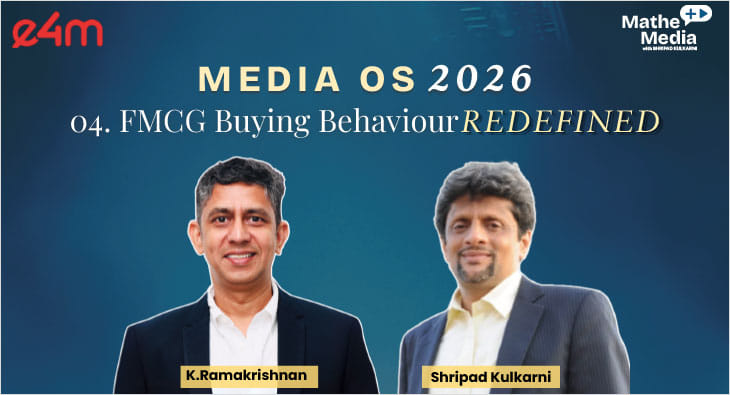

- Indian households are shopping for fast-moving consumer goods (FMCG) every two and a half days, indicating a permanent state of market engagement rather than sporadic purchasing.
- The traditional media planning approach, which focuses on building awareness and waiting for purchase moments, is becoming outdated as consumer behavior shifts towards continuous shopping cycles.
- The dynamics of household purchasing are changing, with individual family members increasingly making their own brand choices, reducing the housewife's share of household purchases from 85-90% to about 55-60%.
- The rise of multi-channel shopping, including quick commerce and e-commerce, is reshaping consumer behavior, while the competitive landscape between national and local brands is narrowing due to digital accessibility.
Every two and a half days, an Indian household is shopping for something in FMCG. Not browsing. Not considering. Not being primed by your last campaign. Shopping. A transaction, or something close to one, every 60 hours. The consumer is not waiting to be triggered. She is already in market. Permanently.
That one number — from data at Worldpanel — should make every media planner reconsider what always-on means. K. Ramakrishnan, who heads Worldpanel, fondly called as Ramki by all, works with data that most marketers only see in aggregated form. He sees the raw shopping behaviour of Indian households, category by category, channel by channel, week by week. When he speaks about what is happening to the Indian consumer, he is not theorising. He is reading a live feed.
Let That Sink In
Start with the number that reframes everything else.
“Once in every two and a half days people are shopping for something in FMCG. Be present everywhere. Always.”
Not browsing. Not researching. Shopping. That single statistic makes the old paradigm of media planning — build awareness, prime the consumer, wait for the purchase moment — look like a plan designed for a different country. The purchase moment is not an event. It is a permanent condition.
The implications for always-on media strategy are direct and unavoidable. A brand that goes dark for two weeks has missed multiple shopping cycles. A brand present only in awareness mode has no presence at the moment that matters most.
One Household. Many Baskets.
Beneath that headline number is a structural shift that has been building for years and is still accelerating.
“From a household basket, it’s moved to individual basket...The multiplicity of brands entering a household is higher than ever. Just to give you a statistic, the average number of soap brands that enter a household in a year, soap brands is 8.5. This is something which you buy every month. So, 8.5 brands.”
Soap. A category purchased every single month. And yet 8.5 different brands enter a single household across the year. That is not brand loyalty. That is a market in permanent churn — where share is being continuously contested, won and lost, on every shopping occasion.
Who Is Doing the Buying?
The shift that enabled this is a change in who is doing the buying. The housewife’s grip on the household purchase has not disappeared. But her share has fallen sharply.
“It exists, I mean it is a significant part still, but the importance of that has come down. What would have been 85-90 percent has now come down to about 55-60 percent.”
The remaining 40-45% now belongs to every other individual in the household — each with their own basket, their own brand preferences, their own purchase occasions. A media plan built for the housewife alone accounts for just over half the opportunity. And even that half is changing. The continual depletion of the monthly list, Ramki believes, is one of the most definite structural shifts of the next two years. Household to individual is a direction, not a destination.
The Channel Picture Is More Complex
Every new channel in India has arrived with an obituary for the channels that came before it. Modern trade was going to kill general trade. E-commerce was going to kill modern trade. Quick commerce is going to kill everything.
“There is no single household which can say I am 100 percent quick commerce or 100 percent e-commerce. All households are multi-channel households.”
Quick commerce is real, growing, and genuinely changing behaviour at the margin. But it is nine cities deep, with penetration still in the 30s even in urban metros. General trade, which accounts for 90% of Indian FMCG volume, is not going anywhere on any foreseeable timeline.
What quick commerce has changed is the nature of specific transactions.
“The percentage of premium brands in quick commerce is higher than what it is in general trade...bigger packs selling in quick commerce more than in traditional trade.”
A consumer on a quick commerce platform is often a different version of themselves — more premium, more immediate, less price-sensitive. That is a distinct planning opportunity, not a replacement for the full channel architecture.
The Age of Parity
One consequence of digital democratisation that Ramki tracks closely is what has happened to the competitive distance between national and local brands. It has effectively collapsed.
“Google and the others have democratized access to ingredients, information, packaging, influencers and all of those things.”
A Matunga brand can source the same packaging as a national brand. It can access the same manufacturing quality. The high-nosed attitude of national incumbents toward regional challengers is increasingly hard to sustain. Local and national will coexist — and there will be seasons when local thumps hard. For national brands, the moat of scale and distribution is narrowing. The advantage that remains is the brand itself.
Start With the Consumer. Always.
In the midst of all this complexity — fractured households, multi-channel behaviour, local parity, permanent purchase cycles — Ramki’s strategic compass is unchanged.
“I would still start with the conventional way of saying who is your consumer? Please go be with that consumer...If you’re media planning, it’s around that individual.”
Not the household. Not the channel. Not the category. The individual. Build the brand around that person. Build the media plan for that person. The others — the collateral consumers, the adjacent audiences, the channel experiments — will follow.
It is the toughest thing to do because the temptation to chase every signal is enormous and continuous. But the brands that stay loyal to their consumer while the market churns around them are the ones that compound.
Once every two and a half days, that consumer is shopping. The only question is whether your brand is there.
Ramakrishnan is a contributor to the Media OS 2026 Report, examining how Indian advertising is being rebuilt from the ground up. This piece has been curated by Shripad Kulkarni based on the conversation for the MatheMedia Podcast Series.
Read more news about Marketing News, Advertising News, PR and Corporate Communication News, Digital News, People Movement News
For more updates, be socially connected with us onInstagram, LinkedIn, Twitter, Facebook, YouTube & Google News