Is mobile gaming the next frontier for brand engagement in India?
With mobile gaming projected to reach $8b in revenue by 2028, panellists at the e4m Screenage Conference 2024 emphasized the diverse audience gaming attracts, from casual players to esports fans
 by
by
Published: Dec 2, 2024 2:59 PM | 6 min read
 Follow Us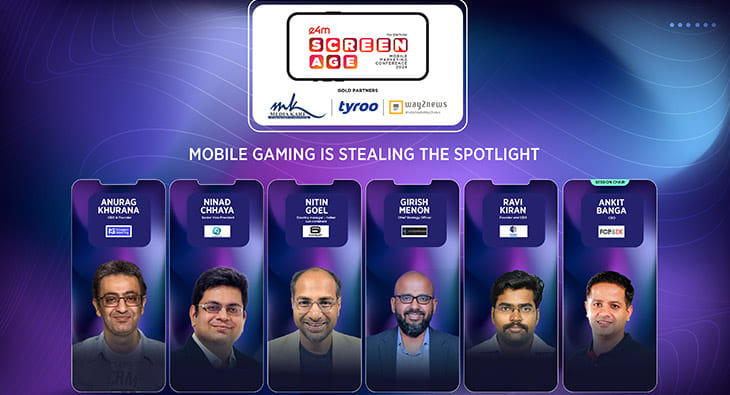

At the e4m Screenage Conference 2024, industry leaders discussed the burgeoning mobile gaming market and its transformative potential for brands. With the sector expected to reach $8 billion in revenue by 2028, mobile gaming is evolving into a dominant platform for engaging diverse audiences and reshaping brand strategies.
The panel featured Anurag Khurana, CEO & Founder, Newgen Gaming; Ninad Chhaya, Senior Vice President, Reliance Games; Nitin Goel, Country Manager, Indian Subcontinent, Gameloft; Girish Menon, Chief Strategy Officer, JetSynthesys; and Ravi Kiran, Founder and CEO, GoLive Games. Ankit Banga, CBO of FCB Six, moderated the session.
Banga began the session by highlighting the sector’s explosive growth. “About 500 million users in India are gaming, almost equivalent to YouTube's user base. The industry is growing at a 20-23% CAGR and is poised to represent 20-23% of the global gaming market by 2028.” He asked the panellists what factors they believed had driven this phenomenal growth.
Khurana identified two key drivers: the country’s youth population and changing perceptions of gaming. “What has led to the growth of this industry is number one, the youth population. And secondly, people have accepted it as a form of entertainment. Back in 1999, it was just considered time pass. That acceptability has fueled the industry’s growth,” he noted.
Goel, on the other hand, focused on the disruption caused by free-to-play gaming models, which democratized access and enabled rapid growth. “In India’s value-conscious market, the shift to free-to-play games has been transformative. Players no longer need to pay upfront for licenses, which significantly boosted user numbers,” he explained. Goel added that mobile gaming’s global rise, reaching a $90 billion industry in just over a decade, reflects the potential of these new monetization mediums.
Banga highlighted the staggering engagement levels in gaming, sharing that India witnessed 10 billion gaming app downloads in 2023. "That’s nearly 20 downloads per user annually, showcasing immense engagement,” he remarked. Contrary to the perception that younger demographics dominate gaming, he noted that the audience spans ages 12 to 70, making it a versatile platform for brands.
He asked the panellists, "What key trends should brands focus on from an audience perspective, specifically regarding user behaviour?"
Kiran answered by elaborating on how brand interactions in gaming have transitioned to immersive experiences. “Earlier, in-game ads were static—banners and videos. Now, it’s about interactivity. In our cricket game, users tap into tournaments sponsored by smartwatch brands, creating a tangible connection. If they come close to winning, it might even drive purchases,” he explained.
He also emphasized the impact of e-sports and creator-led content. “A creator mentioning Kinder Joy during a Minecraft stream can influence purchasing decisions, demonstrating how brands can connect directly through gaming,” he added.
Menon focused on gaming’s unique engagement model. “Unlike TV, which is passive, gaming is a lean-in medium. Players actively engage, making brand resonance significantly higher,” he stated. He urged brands to embrace gaming’s immersive potential, combining game and brand ethos for deeper consumer connections. “Think of gaming holistically—it includes tournaments, creators, and events. This offers unparalleled opportunities for engagement,” he concluded.
When discussing brand integration in gaming, Chhaya proposed measuring success through Return on Engagement (ROE) rather than Return on Investment (ROI). "The player has already invested time, and often money, into the game," he explained. Chhaya highlighted his collaboration with big IPs like Cartoon Network and WWE. He shared a campaign with Hershey's for the Little Singham game, where players collected virtual Jolly Rancher lollipops while progressing through the game, introducing the new candy flavour in a non-intrusive, engaging way. "The integration felt seamless—kids were not just seeing ads, but actively engaging with the brand in the game mechanics," he emphasized.
Chhaya also mentioned using gaming for social good, referencing his partnership with the United Nations Environment Program. The campaign encouraged players to dispose of plastic responsibly while running through virtual towns. "Gaming can create awareness, not just for brands but also for important causes," he noted.
Khurana echoed similar thoughts, highlighting that gaming is now a "new form of social media." He stressed that integrations must remain subtle and integral to the gameplay. "For example, during an esports broadcast, we seamlessly integrated a smartwatch brand by placing a countdown timer within the ad break, which felt like a natural part of the game," he explained. Khurana also shared an example with an energy drink brand, creating a storyline where the winner of a match was associated with consuming the product.
He also pointed out a crucial brand insight: "In gaming, it's not about direct conversion or consideration. It's about brand awareness." He explained that even products not specifically targeted at youth use gaming to build brand recall. "For example, after the Hershey's campaign, kids would think of the Jolly Rancher whenever they see a lollipop," he concluded.
As the gaming industry continues to grow, the brands embracing gaming as a key platform are seeing significant success. When discussing which sectors are most engaged with gaming, Goel pointed to technology, entertainment, and FMCG as key players, with tech leading the charge.
"Tech brands fit well with the gamer persona," he noted, although he emphasized that gaming's appeal extends far beyond this demographic. He mentioned that many gamers, particularly casual gamers, may not identify as such. “68% of gamers don't consider themselves as gamers," he explained. This reveals a broader, untapped audience for brands across industries. Goel encouraged brands to identify their target audience within the gaming ecosystem and create tailored strategies to engage them effectively.
Kiran agreed, stressing the diversity of the gaming audience. "There's a game for everyone," he said, pointing out that gaming spans all demographics, including women and older age groups. He highlighted that younger brand managers are more likely to think about how their products can fit into gaming, as they are themselves gamers. "Gaming will likely capture a significant portion of brand investment in India," he added.
Turning the conversation to esports, Banga noted the rapid rise of esports in India, comparing it to traditional sports leagues like the IPL. "E-sports is growing at a pace that will rival big franchises," he predicted.
Menon reinforced the importance of e-sports in deepening community engagement within gaming. He described e-sports as more than just competitive play; it’s a "new sport," offering a deeper connection to fans. Reflecting on JetSynthesys's experience, he shared their vision of creating a virtual cricket league similar to the IPL to engage with India's massive cricket-loving audience. "E-sports offers an opportunity to build a community around a digital sport, just like traditional sports," he noted, acknowledging the role of virtual platforms in making esports accessible to viewers from all regions.
He emphasized that the future of esports lies in its ability to create community, foster fan engagement, and offer brand-building opportunities for sponsors and franchise owners. "Esports has the potential to evolve in the same direction as traditional sports, even if it's a bit earlier in its stage," Menon concluded.
Read more news about Marketing News, Advertising News, PR and Corporate Communication News, Digital News, People Movement News
For more updates, be socially connected with us onInstagram, LinkedIn, Twitter, Facebook, YouTube & Google News
