If you show up in the chat, you show up in the cart: Ankit Goyle
Snap Inc.'s India marketing head Ankit Goyle told the Pitch CMO Summit that Gen Z's ₹930 billion spending power demands a complete rethink of how brands tell stories and measure attention
 by
by
Published: Jun 18, 2026 12:36 PM | 5 min read
 Follow Us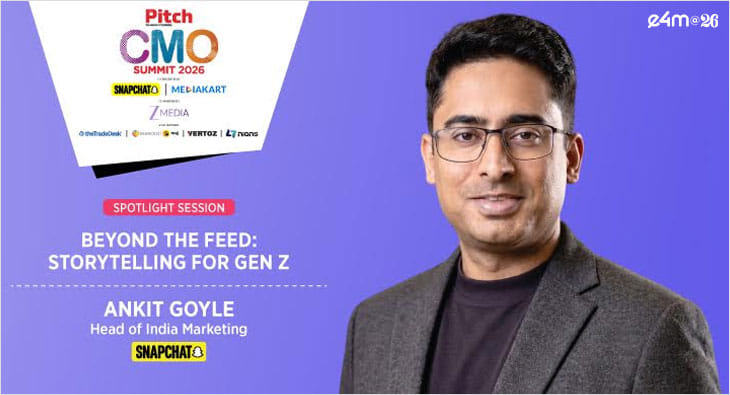

- Ankit Goyle, Snap Inc.'s India marketing head, emphasized the need for brands to better understand and engage with Gen Z, the largest living cohort in India's history, whose spending is projected to reach $2 trillion in the next decade.
- He criticized the industry's reliance on traditional viewability metrics, advocating for attention measurement through eye-tracking technology to assess genuine consumer engagement with advertisements.
- Goyle highlighted that Gen Z prefers authentic, unpolished content and values local identity, urging brands to adapt their creative strategies rather than simply increasing ad frequency.
- He noted Snapchat's unique position in fostering intimate communication among young users, suggesting that brands should leverage private interactions to enhance engagement and drive sales, particularly during cultural moments.
At the Pitch CMO Summit 2026, Snap Inc.'s India marketing head Ankit Goyle brought a message that was equal parts provocation and practical counsel. As one of the few Indian marketing have watched the Gen Z conversation unfold from as many vantage points and seen enough media plans, brand studies and creative briefs to know when an industry is solving for the wrong problem. His argument was that Indian marketing has built an elaborate infrastructure around a generation it does not fully understand, and the cost of that misreading is only going to grow.
The starting point is demographic. Gen Z is the largest living cohort in India's history. One in four people currently in the workforce belongs to it. Far from being the teenager of popular imagination, a significant portion of this generation is now between 21 and 28 years old, working, spending, travelling, starting families and making purchase decisions independently. Their current direct and indirect spending stands at close to 930 billion dollars, a figure projected to reach 2 trillion dollars within the next ten years. "If you're not focusing on this generation, I highly urge you to, whatever platform you choose," Goyle said. For him, the platform is always the secondary question. The primary one is whether brands are paying serious attention to the cohort at all.
The more structural problem Goyle identified is what the industry is actually measuring when it claims to be reaching young consumers. The standard viewability metric, which records whether an ad technically appeared on a screen, is a poor proxy for whether anyone actually looked at it. Attention, in Goyle's framing, is an eye metric, one that measures whether a consumer's gaze landed on the content and stayed there. "It is not an impression. It is not covered in the viewability box," he said. "It is actually an eye metric of whether consumers looked at the ad." The gap between the two has become hard to ignore. The average Gen Z consumer processes around 400 videos in a single day, yet brand recall from digital advertising remains remarkably low.
The industry's response has largely been to increase frequency rather than rethink the creative approach, a habit Goyle described as the lazy loop. It is a cycle in which brands keep pushing the same creative to the same audiences in the hope that repetition builds memory. The data suggests otherwise. Research indicates that Gen Z skips roughly 70 per cent of advertising it has already encountered, meaning higher frequency often accelerates disengagement rather than reversing it.
Snap's proposed answer has been to invest in what Goyle positioned as one of India's largest attention research initiatives, using eye-tracking technology deployed either through controlled panel environments or through smartphone cameras in a non-intrusive setup, to generate data on where consumer attention actually falls across a media plan. For marketers whose VTR figures look healthy on paper but whose brand metrics are not moving, he argued this kind of measurement offers a far more honest read of what is working.
Understanding what Gen Z actually wants from brands requires an equally significant reset in assumptions. Research Snap conducted with the Economic Times found that this generation consistently gravitates toward content that is unpolished, emotionally honest and grounded in local identity. "Gen Z wants authentically messy stuff versus curated perfection," Goyle said. "It's about local pride, being conscious for the environment and the people around you." The generation is also considerably more intentional about its technology use than the dominant narrative suggests, preferring low-pressure environments built around close relationships over broadcast platforms designed for public performance.
That social architecture is central to how Goyle frames Snapchat's position in the market. The platform counts more than 250 million users in India, with 90 per cent of them aged between 13 and 34. It opens into a camera rather than a feed, a deliberate design signal that the user is the creator. Its primary use case is private, reciprocal communication between close friends, and users open the app between 30 and 40 times a day. "Young India is on Snapchat," Goyle said. "If you're not on the platform, I think you're missing out, not just today, but for the next ten years."
The commercial implication of that intimacy is what Goyle finds most significant for brands. When Snap partnered with Swiggy around Friendship Day, placing the brand's creative organically within the Spotlight and chat experience, the campaign drove 60,000 additional transactions and reached 66 million users in a single day. A separate campaign with RGU produced a 1.7 times lift in unaided brand awareness against competitive platforms, according to Kantar. Both results pointed to the same underlying dynamic, one that Goyle captured simply. "If you show up in the chat, you show up in the cart."
The cultural dimension of this argument matters too. Gen Z in India is not disengaged from the country's major festivals and social moments. It celebrates Holi, Diwali, Christmas and other occasions with genuine investment, but does so within closed, trusted circles rather than on public feeds. The planning, sharing, recommendations and purchases that surround those moments are happening in private conversations. For brands trying to locate where culture and commerce intersect for India's largest generation, Goyle's contention is that the answer has been hiding in the chat all along.
Read more news about Marketing News, Advertising News, PR and Corporate Communication News, Digital News, People Movement News
For more updates, be socially connected with us onInstagram, LinkedIn, Twitter, Facebook, YouTube & Google News