Fundamentals of brand building still same but AI has democratised marketing: Experts
At Pitch CMO Summit in Bengaluru, Pallavi Saxena, Chief Marketing and Revenue Officer, Cleartrip, and Nitin Khanna, CMO, ACKO, discussed what marketers need to retain and what they need to rethink
 by
by
Published: Sep 3, 2026 2:20 PM | 12 min read
 Follow Us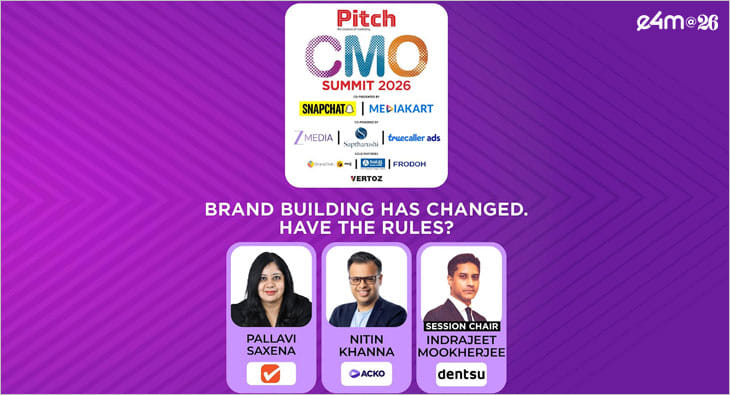

- The environment for brand building has evolved significantly due to AI, creators, and user-generated content, reducing marketers' control over brand perception, as discussed by industry leaders at the Pitch CMO Summit in Bengaluru.
- While the fundamentals of brand building—distinctiveness, usefulness, credibility, and trustworthiness—remain unchanged, marketers must adapt their strategies to navigate the complexities of modern consumer interactions and infinite content.
- Cleartrip and ACKO emphasized the importance of connecting with consumers earlier in their journey, focusing on inspiration and usefulness rather than just pushing products at the point of purchase.
- The discussion highlighted the need for brands to balance long-term investments in brand building with short-term performance marketing, while also recognizing the challenges posed by AI in creating distinctive marketing content.
The fundamentals of brand building may not have changed, but the environment in which brands are built has changed dramatically, with AI, creators, user-generated content and recommendation-led discovery giving marketers less control over how their brands are perceived.
That was one of the key takeaways from a fireside chat titled ‘Brand Building Has Changed. Have the Rules?’ at the Pitch CMO Summit in Bengaluru, where Pallavi Saxena, Chief Marketing and Revenue Officer, Cleartrip, and Nitin Khanna, Chief Marketing Officer, ACKO, discussed what marketers need to retain and what they need to rethink.
The session was chaired by Indrajeet Mookherjee, President – Integrated Client Management, dentsu India.
Khanna said that while consumers continue to look for distinctive, useful, credible and trustworthy brands, the ecosystem around brands has become far more complex. “I don't think the rules are fundamentally changing. I think consumers still look for brands that are distinctive, that are useful for them, are credible, are trustworthy, etc.”
However, according to Khanna, what has changed is the environment in which brands are being built. Earlier, marketers had greater control over the narrative through conventional communication, whereas brands today are interpreted across creators, reviews, UGC and increasingly through AI-led interactions. “Right now, your brand is interpreted in so many different ways and often in mediums where as a brand custodian, you have little control over. There are creators, there are reviews, there is a lot of UGC that gets talked about your brand and then obviously, you know, there is the AI that's also shaping decisions for consumers.”
Saxena echoed the view that the fundamentals remain intact, but said the way marketers apply them has changed significantly. She identified the core consumer, and consistency and uniqueness in communication as the fundamentals that continue to matter.
“The fundamentals still remain the same of brand building. You need to have a core consumer, you need to have a need that you're solving for that consumer and you need to have a consistency and uniqueness about what you're talking to that consumer.”
However, in an environment of infinite content and recommendation-led discovery, generic communication is becoming increasingly difficult to sustain.
“In today's world of infinite content, where discovery is more of recommendations, more relevance, I think the appetite to have very generic content is very low in the consumer.”
Distinctiveness becomes the new battleground
For Khanna, distinctiveness remains the “holy grail” of brand building, perhaps becoming even more important as brands compete in an increasingly crowded content environment. “I think for me, in one word, that would be distinctiveness.”
He pointed to the abundance of content and brands jumping on the same trends as a potential route to a “sea of sameness”.
“With infinite content and, you know, a generation of content now becoming abundant rather than a constraint, I think it's very easy to just fall in a sea of sameness. Everybody's talking the same thing. Everybody's matching on the same trends.”
For Cleartrip, the answer lies in connecting distinctiveness with a genuine consumer need. Saxena cited travel as a high-anxiety, high-involvement category where simplicity and clarity can become part of the brand proposition.
“Travel is a very high anxiety, high-involvement purchase. People are worried what if something goes wrong… So what Cleartrip does is that, you know, we aim to offer a very clean, clear UI that, you know, a consumer is very comfortable with and that is what they remember about us.”
She added that the brand’s proposition around simplicity, clarity and flexibility is also reflected in its newer initiatives, including its upcoming loyalty programme.
Roping in creators
The changing nature of travel discovery is also pushing brands to rethink where they enter the consumer journey.
Saxena noted that travel discovery has moved from a largely planning-led process to one where inspiration is continuously generated through content, particularly among younger consumers.
“The biggest part of the process was planning that itinerary… But how that is totally transformed now. Now the biggest part is the inspiration because it's happening every day.”
According to her, Gen Z in particular is increasingly looking beyond traditional destination bucket lists and towards experiences that fit their lifestyles and personalities.
“Today's generation or the Gen Z specifically, they don't want like a bucket list of locations because they want experiences. They want to do something which will add to their lifestyle, which will add to their personalities.”
This is where creators are becoming relevant to Cleartrip’s brand-building strategy. Rather than waiting until consumers have reached the booking stage, the company is looking to participate much earlier, when travel inspiration is being formed.
“With the launch of our Creators Club, which we've recently done, the whole endeavour is that, you know, there are people who are looking to a creator, who follow them for something that they are doing. How do we integrate with that creator and, you know, latch on that step of inspiration itself?”
She added that brands risk losing consumers if they enter only towards the end of the journey, when the purchase decision has already been made.
“For a brand like Cleartrip, it becomes very, very important that, you know, you are there when that inspiration is happening, when the person is actually making that choice.”
‘Being useful before the purchase’
The challenge is different for insurance, a category where consumers are unlikely to actively seek out brands until a specific need arises.
Khanna said ACKO’s approach has therefore been to become part of the consumer’s consideration much before the actual purchase moment.
“I don't think anybody in this room woke up in the morning thinking about which insurance should I think about? It's not how the category works.”
Instead of simply pushing products, ACKO has attempted to identify life-stage moments when consumers become more receptive to insurance and provide useful information around financial decisions.
“Our endeavour has been to identify, you know, those moments where that need sort of becomes less needed. And secondly, you know, sort of participate as a brand in a lot more useful manner rather than just being pushy to sell.”
Khanna said this becomes particularly important for categories such as term life and health insurance, where the consideration cycle can be considerably longer.
“There's a good space that we've tried to occupy, which is around financial education, how to make the right decisions, what to opt for, what not to opt for.”
The idea, he said, is that usefulness can help a brand enter the consumer’s consideration set before the actual purchase decision.
“When the moment of purchase arises, the brands that were useful to the consumer stand a better chance of making it to the consideration cycle.”
Brand vs performance: ‘CapEx for the future, OpEx for today’
The conversation also touched upon the perennial tension between long-term brand building and short-term performance marketing, particularly as CMOs continue to operate under quarterly business pressures.
Khanna used a financial analogy to explain why brands need to balance the two.
“In the financial world, there is OpEx and there is CapEx. So CapEx is something that you build for the future. OpEx is what runs your business right now. Similarly, you know, I think it's not, you either need OpEx or you need CapEx. You need both to do the business.”
He described brand investment as creating future demand, while performance marketing helps capture existing demand.
“Brand and investing in brands basically creates the demand for the future. Performance, what you're spending on right now, it sort of harvests or precipitates the existing demand that you have for your brand.”
Saxena agreed that the immediate visibility of performance marketing can create a natural temptation to prioritise it, but stressed that brands also need to invest in future demand.
“Since performance results are so immediate, right, there is a natural temptation when you look at financials to skew towards them. But completely, completely agree with the thought that Nitin also mentioned that, you know, that is basically solving for today versus solving for the future.”
‘AI may make average marketing easier, but not distinctive marketing’
AI emerged as another major area of discussion, particularly around the risk that increased content generation could lead to greater sameness.
Khanna argued that while AI has lowered the barriers to producing marketing content, it has simultaneously increased the importance of judgement and distinctive thinking.
“AI has democratised marketing, but it has democratised average marketing.”
He said this makes the role of the CMO and brand custodian more difficult because marketers are now operating in an environment where similar content can be produced at scale.
“It makes the job of the CMO, the brand head, the brand custodian, the comms head much, much more difficult because everybody is largely churning out very similar stuff.”
For Khanna, the answer is a stronger point of view and a more distinctive brand voice.
“If ever there was a time to have a very distinctive POV on things, have a distinctive voice, I think it's now more than ever.”
Saxena pointed to another emerging challenge — AI is not only changing how marketers create content, but also how consumers discover brands.
“Since a large part of planning also right now is happening on AI, where people are actually figuring that I've decided I have to go here, now give me an itinerary, tell me where do I get the best prices at, etc. So, how I get discovered on the AI platform also becomes a very important point and a problem for us.”
She argued that being distinctive and solving a specific consumer need could become increasingly important in determining which brands are surfaced by AI.
“If we are like any other player and we are a commodity, the chances of us showing up might or might not be there. So hence the need for being more unique and solving for the consumer needs becomes more and more important.”
At the same time, she said marketers will have to identify the human insight that AI-generated content cannot easily replicate.
“How do you get that genuine human insight beyond that? How do you get that golden egg to come out, which the AI cannot solve?”
What gets cut when budgets shrink?
When asked what they would protect if their marketing budgets were cut by 20%, both marketers pointed towards investments that build the future and strengthen distinctiveness.
For Cleartrip, Saxena said investments aimed at future growth audiences and newer business propositions would be protected.
“One thing that we cannot compromise is what will solve my future work.”
She pointed to younger audiences and the growth opportunity in Tier 2 and Tier 3 markets, while also highlighting the need to build awareness for Cleartrip’s newer offerings beyond flights.
“Cleartrip is known to be for flights, but we are a multimodal platform. We have trains, we have buses, we have packages. Now they are new, so people don't know about us and these are going to be our sources of growth from a business perspective.”
Khanna’s priority was similar: protect future-building investments and distinctive brand assets.
“Don't sacrifice on something that you're building for the future.”
He added: “Don't sacrifice on your distinctive assets. If there is, for example, a creative device that you are known for. If there is a creative mnemonic that you are known for. Anything that makes you distinctive is something that they would definitely not want to cut.”
The three rules that remain
As the session drew to a close, the conversation returned to the fundamentals of brand building.
For Khanna, creating memory remains central, but marketers also need to remember that consumers do not spend as much time thinking about brands as marketers often assume.
“Continue to create memory because I think memory structures will take you much longer than anything else.”
He also stressed the importance of consumer-centricity and usefulness.
“Don't think that the consumer cares about your brand too much. I think we live in our own province.”
And, he argued, brands that are genuinely useful can build stronger relevance in an environment where marketers have less control over how brands are interpreted.
“Today's consumer appreciates brands being useful to them more than just pushing them for a purchase decision.”
Saxena, looking towards 2030, distilled her own brand-building rule into two fundamentals: solving a real consumer need and doing so distinctively.
“One thing that I'll definitely keep to the core is solve for a real consumer need and be distinctive or unique about what you're talking about.”
According to her, the bigger change required from marketers is perhaps in how success is measured.
“I think the high focus on numbers showing up in today's or tomorrow's day… this whole measure of showing the deliverables tomorrow or next week, I think that has to slightly go away.”
She added that marketers need to retain the ability to build for the longer term.
“We have to build a real brand three years down the line, four years down the line.”
The discussion at the Pitch CMO Summit thus pointed to a paradox in modern brand building: while the channels, technologies and consumer journeys are changing rapidly, the fundamentals of solving a real consumer problem, creating distinctiveness and building memory remain as relevant as ever. What has changed is the number of variables — from creators and UGC to AI and performance pressures — that marketers now have to navigate while applying those fundamentals.
Read more news about Marketing News, Advertising News, PR and Corporate Communication News, Digital News, People Movement News
For more updates, be socially connected with us onInstagram, LinkedIn, Twitter, Facebook, YouTube & Google News